21 April 2026
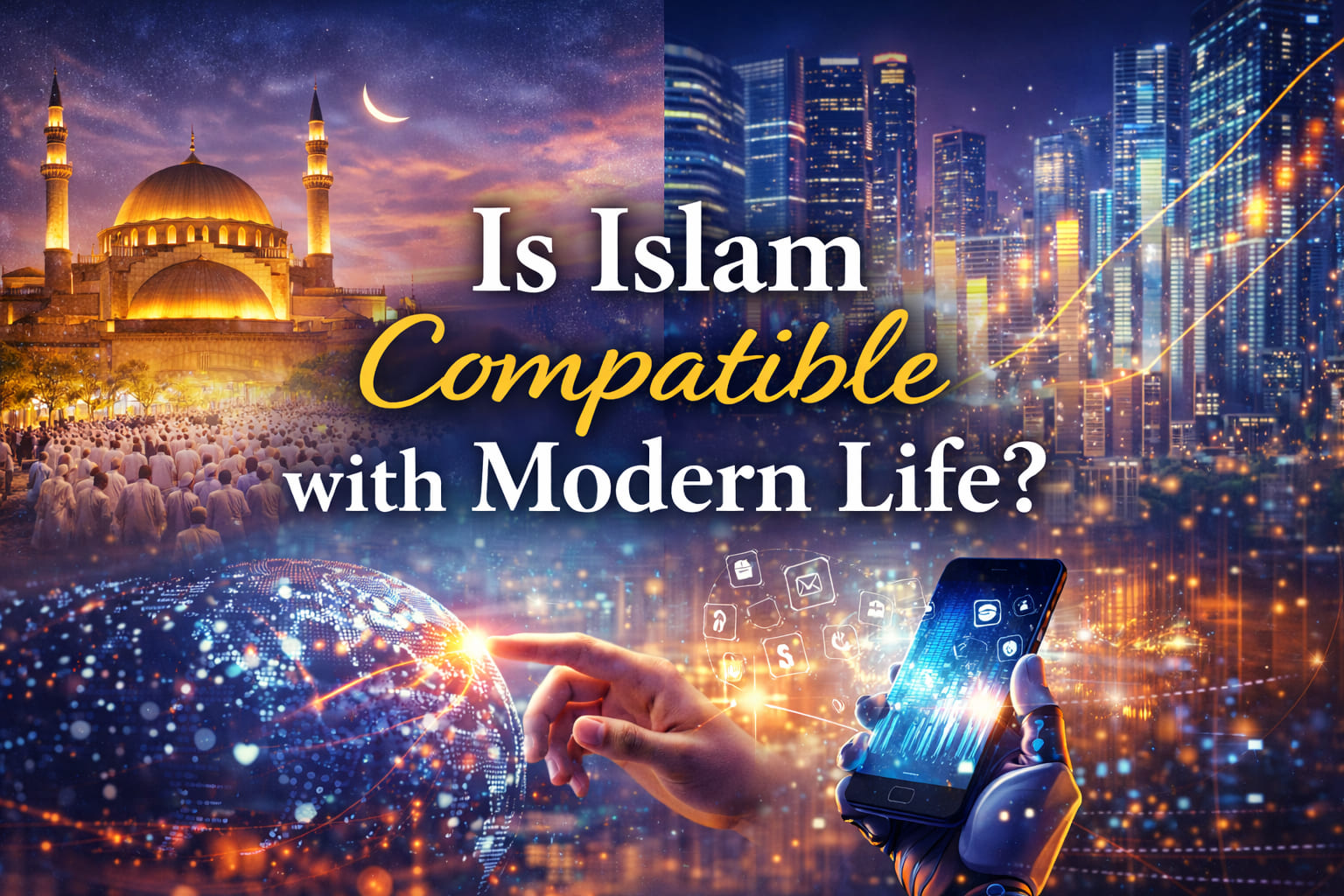
 Is Islam Compatible with Modern Life?
Is Islam Compatible with Modern Life?
Introduction
In the modern era, a recurring question frequently arises in intellectual and media discussions: Is Islam compatible with modern life?
This question emerges amid rapid developments in technology, science, human rights, and social and economic lifestyles. Some critics argue that Islam is a traditional religion rooted in the past, while others affirm that it is a faith suitable for all times and places.
To address this issue objectively, Islam must be examined through its core principles and values, rather than through misconceptions or flawed practices.
First: The Concept of Modernity and Modern Life
Modern life does not merely refer to technological advancement. It also includes:
-
Scientific and technological progress
-
Political and legal organization
-
Human rights and public freedoms
-
Cultural and religious diversity
-
Rapid changes in social and economic lifestyles
Modernity should not be confined to a single cultural model. While its expressions vary across societies, it generally revolves around shared values such as rationality, justice, and human dignity.
Second: The Nature of Islam as a Religion
Islam is not a rigid or static system. Rather, it is based on:
-
Fixed texts that establish foundational values and principles
-
Broad space for interpretation (ijtihad) in application
-
Consideration of changing circumstances and realities
The Qur’an did not aim to provide detailed rules for every era, but instead laid down universal moral and legal foundations capable of guiding societies across time.
Third: Ijtihad and Renewal in Islam
One of the strongest reasons Islam remains compatible with modern life is the principle of ijtihad, which involves:
-
Using reason to understand religious texts
-
Focusing on objectives rather than literal forms
-
Considering changes in time and place
Throughout history, Muslim scholars have exercised ijtihad in areas such as:
-
Financial transactions
-
Political systems
-
Social relations
-
Medical and scientific issues
This demonstrates that Islam is dynamic in interpretation, while remaining firm in its core beliefs.
Fourth: Islam, Science, and Technology
Contrary to some assumptions, Islam:
- Encourages the pursuit of knowledge
- Promotes reflection and critical thinking
- Does not oppose scientific discovery
The Qur’an states:
“Say: Are those who know equal to those who do not know?”
Historically, Muslims made significant contributions to:
- Medicine
- Mathematics
- Astronomy
- Philosophy
In the modern world, there is no inherent conflict between Islam and technology. The real challenge lies in ethical use, an area where Islamic values provide balanced moral guidance.
Fifth: Islam and Human Rights
Islam is often accused of conflicting with modern human rights concepts. However, a closer examination reveals that Islam:
-
Honors human dignity by default
-
Protects life, property, intellect, and moral integrity
-
Strongly opposes oppression and injustice
Islam established principles such as:
-
Justice
-
Equality before the law
-
Sanctity of life
-
Individual accountability
Most disagreements arise not from values themselves, but from cultural interpretations or flawed implementations.
Sixth: Women in Islam and Contemporary Society
The issue of women is among the most debated topics. In reality, Islam:
-
Grants women the right to education
-
Recognizes their financial independence
-
Affirms their human dignity
Practices that oppress women in some Muslim societies often result from:
-
Cultural traditions
-
Misinterpretations of religion
-
Social customs unrelated to Islamic teachings
The real solution lies in correct understanding, not in blaming the religion.
Seventh: Islam, Pluralism, and Coexistence
Modern societies are built upon cultural and religious diversity. Islam acknowledges:
-
Freedom of belief
-
Respect for others
-
Peaceful coexistence
The Qur’an states:
“There is no compulsion in religion.”
History provides numerous examples of coexistence between Muslims and followers of other faiths, demonstrating Islam’s compatibility with pluralistic societies.
Eighth: Contemporary Challenges and Misconceptions
Many perceived conflicts between Islam and modernity stem from:
-
Extremist groups misusing religion
-
Political systems exploiting religious language
-
Selective media narratives
-
Widespread ignorance of original Islamic texts
These factors contribute to distorted perceptions that do not reflect Islam’s true essence.
Ninth: Islam as a Value System, Not a Rigid Lifestyle
Islam does not impose a single cultural or social model. Instead, it:
-
Establishes universal moral values
-
Grants individuals flexibility in social organization
-
Balances permanence with adaptability
This balance enables Islam to coexist with modern lifestyles without losing its identity.
Conclusion
In essence, Islam is fully compatible with modern life because it:
- Encourages reason and reflection
- Balances spiritual and material needs
- Upholds human dignity
- Embraces renewal through ijtihad
The real challenge lies not in Islam itself, but in how it is understood and practiced in a rapidly changing world.
When approached thoughtfully and freed from stereotypes and misapplications, Islam emerges not as an obstacle to modernity, but as a moral compass that can guide it.
Join IslamLearn Academy for free and gain authentic Islamic knowledge in a simple and clear way, guided by qualified scholars.
Related Posts
18 June 2026
Can God Become a Human?
Can God Become a Human? The Islamic Response to the Idea of Incarnation Introduction One...
 Read More
9 June 2026
Why Is the Qur’an Not a Human-Made Book?
Why Is the Qur’an Not a Human-Made Book? Linguistic, Historical, and Rational Evidence Introduction Why...
Read More
Search
Categories
Tags
Recent Posts
Can God Become a Human?
Can God Become a Human?...
Why Is the Qur’an Not a Human-Made Book?
Why Is the Qur’an Not...
Can the Universe Have More Than One God?
Can the Universe Have More...
Do Muslims Worship the Prophet Muhammad?
Do Muslims Worship the Prophet...
Does Islam Oppose Non-Muslims?
Does Islam Oppose Non-Muslims? An...