23 December 2025
 Islamic Religion: Belief and Sharia
Islamic Religion: Belief and Sharia
Introduction
The Islamic religion is the religion with which Allah sent Muhammad ﷺ. Through it, He sealed the religions, perfected it for His servants, completed upon them His favor, and approved it for them as a religion. Therefore, Allah does not accept any religion from anyone except it. Allah, the Exalted, says: “This day I have perfected for you your religion, completed My favor upon you, and approved Islam as your religion” (Al-Ma’idah: 3). He also says: “And whoever seeks a religion other than Islam, it will never be accepted from him” (Al ‘Imran: 85).
The Islamic religion encompasses all the benefits contained in the previous religions and is distinguished by being valid for all times, places, and nations. Adhering to it does not contradict the interests of people at any time or place; rather, its goal is their rectitude and well-being. Allah summarized His commands in a comprehensive verse when He said: “Indeed, Allah commands justice, the doing of good, and giving to relatives; and forbids immorality, wrongdoing, and oppression. He admonishes you that you may take heed” (An-Nahl: 90).
First: The Belief of the Islamic Religion
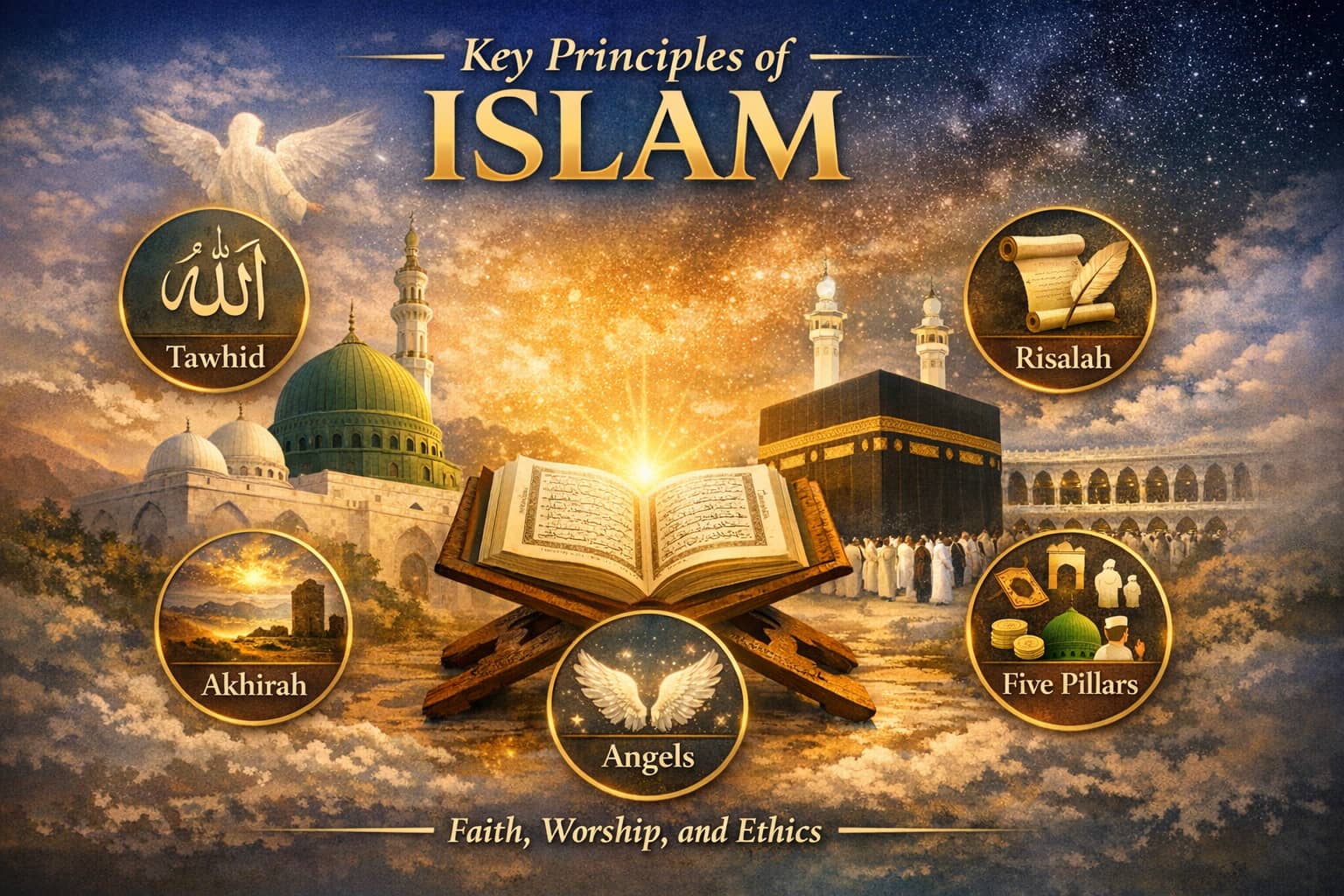
The belief of the Islamic religion is based on faith in the six pillars of faith, as affirmed by the Book of Allah (the Qur’an) and the Sunnah of His Messenger Muhammad ﷺ.
1. Faith in Allah
Faith in Allah includes four matters: – Faith in Allah’s existence: evidenced by innate nature (fitrah), reason, revelation, and perception. – Faith in His Lordship (Rububiyyah): believing that He is the sole Lord, without partner or helper; there is no creator, owner, or provider except Allah. – Faith in His Divinity (Uluhiyyah): dedicating all acts of worship, such as prayer, supplication, and others, to Allah alone, without partner. – Faith in His Names and Attributes: affirming what Allah has affirmed for Himself in His Book and the Sunnah of His Messenger without distortion, denial, asking “how”, or likening.
2. Faith in Angels
The angels are an unseen world, created by Allah from light. They are obedient servants of Allah, fully submissive to His commands, and empowered to carry them out. Faith in them requires belief in their existence, names, attributes, and deeds as mentioned in the Qur’an and Sunnah, such as Jibril (Gabriel), responsible for revelation; Mikail (Michael), responsible for rain and vegetation; and the Angel of Death, responsible for taking souls.
3. Faith in the Revealed Books
Faith in the revealed Books is believing that Allah sent them down from Him, believing in the Books whose names we know, such as the Qur’an, the Torah, the Gospel, and the Psalms, affirming what is authentic in their accounts as long as they are not altered or corrupted, and acting upon their rulings confirmed by the Qur’an.
4. Faith in the Messengers
Faith in the messengers is believing that Allah sent messengers among humans with laws and commanded them to convey them. The first messenger was Nuh (Noah), and the last was Muhammad ﷺ. It is obligatory to believe that their messages are true from Allah, to believe in the messengers whose names we know, such as Muhammad, Ibrahim, Musa, ‘Isa, and Nuh, peace be upon them, and to believe generally in those whose names we do not know. It is also obligatory to follow the Sharia of the messenger sent to us, Muhammad ﷺ.
5. Faith in the Last Day
The Last Day is the Day of Resurrection in which people will be raised. It is called the “Last” because there is no day after it: the inhabitants of Paradise will dwell in their abodes, and the inhabitants of Hell will dwell in theirs. Faith in the Last Day includes belief in resurrection after death, judgment, recompense for deeds, and belief in Paradise and Hell.
6. Faith in Qadar (Divine Decree)
Faith in Qadar is believing that Allah knows everything in general and in detail, and that He wrote everything that has occurred and will occur in the Preserved Tablet.
second: The Sharia of the Islamic Religion
The Sharia of the Islamic religion represents the practical aspect of Islam and is based on the pillars of Islam.
The Five Pillars of Islam
-
The Two Testimonies of Faith
Testifying that there is no deity worthy of worship except Allah and that Muhammad is the Messenger of Allah. It is a firm conviction of the heart expressed by the tongue. No deed is accepted without sincerity toward Allah and following the Messenger ﷺ.
Fruits of the testimonies of faith: – Freedom of the heart and soul from servitude to creatures. – Following only the messengers and not submitting to others.
-
Establishing Prayer
It is worshiping Allah by performing prayer correctly and completely at its prescribed times and forms.
Fruits of prayer: – Tranquility of the heart and peace of mind. – Prayer prevents immorality and wrongdoing.
-
Giving Zakat
It is worshiping Allah by giving the prescribed portion of wealth obligated for zakat.
Fruits of zakat: – Purification of the soul from the vice of stinginess. – Meeting the needs of Islam and Muslims.
-
Fasting in Ramadan
It is worshiping Allah by abstaining from what invalidates the fast during the daytime in the month of Ramadan.
Fruits of fasting in Ramadan: – Training the soul to leave what it loves in pursuit of Allah’s pleasure.
-
Hajj (Pilgrimage) to the Sacred House
It is worshiping Allah by performing the pilgrimage to the Sacred House for those able to do so.
Fruits of Hajj: – Training the soul in financial and physical effort in obedience to Allah. – Achieving unity among Muslims from all over the world.
Summary
The Islamic religion is based on two main foundations: belief and Sharia. Belief establishes true faith in Allah, His angels, His Books, His messengers, the Last Day, and Divine Decree. Sharia organizes the practical life of the Muslim through the five pillars of Islam. Through this comprehensiveness and balance, Islam ensures the righteousness of the individual and society in this world and the Hereafter, and remains a religion valid for all times and places.
Join IslamLearn Academy for free and gain authentic Islamic knowledge in a simple and clear way, guided by qualified scholars.
Join IslamLearn Academy for free and learn Islam in a simple and authentic way
Related Posts
28 December 2025
What Is Islam? A Simple Explanation of Belief and the Pillars of Faith
What Is Islam? A Simple Explanation of Belief and the Pillars of Faith Introduction Islam...
 Read More
20 February 2025
Why Islam is the True Religion
Islam is considered by its followers to be the final and complete revelation of God’s...
Read More
Search
Categories
Tags
Recent Posts
The Status of Jesus Christ in Islam
The Status of Jesus Christ...
What Is Islam? A Simple Explanation of Belief and the Pillars of Faith
What Is Islam? A Simple...
Islamic Religion: Belief and Sharia
Islamic Religion: Belief and Sharia...
The Role of Women in Islam: An In-Depth Perspective
The Role of Women in...
What are the Key Principles of Islam?
What are the Key Principles...