22 February 2025
 What are the Key Principles of Islam?
What are the Key Principles of Islam?
Islam is a major world religion with over 1.8 billion followers globally. Rooted in the teachings of the Prophet Muhammad (PBUH), Islam offers a comprehensive way of life for Muslims. The religion emphasizes faith in one God, Allah, and outlines a set of principles that guide followers in their spiritual, social, and ethical lives.
In this article, we will explore the most important principles of Islam, covering the foundational beliefs, practices, and ethical guidelines that shape the lives of Muslims. These principles not only provide spiritual guidance but also promote peace, justice, and compassion in the world.
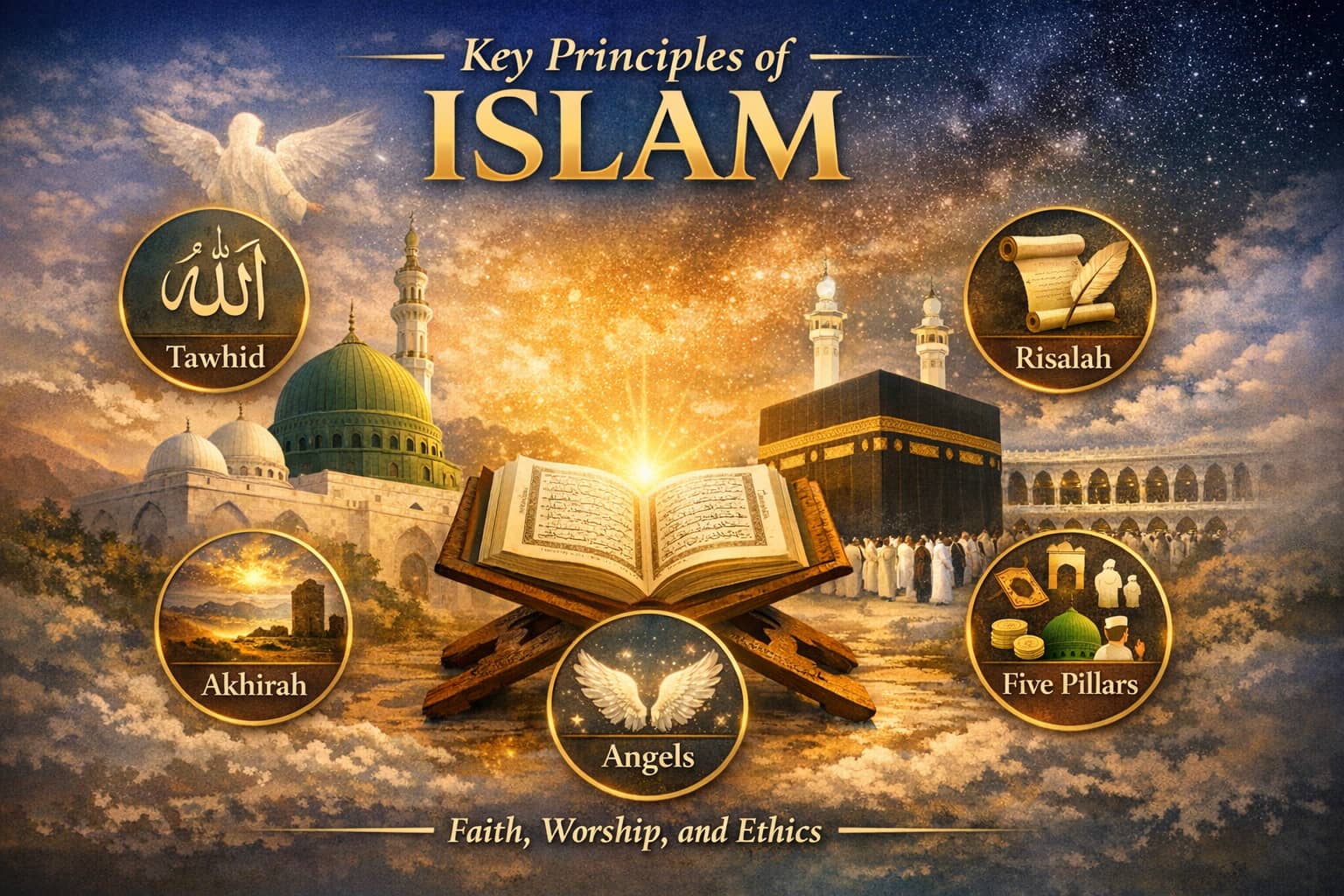
1. Belief in the Oneness of God (Tawhid)
Definition and Importance
The most fundamental principle in Islam is the belief in the oneness of God, or Tawhid. Tawhid refers to the concept that Allah is the one and only deity, without any partners, associates, or intermediaries. This belief is central to Islamic theology and is reflected in the first part of the Shahada, the Muslim declaration of faith: “There is no god but Allah.”
The Concept of God in Islam
In Islam, Allah is not only the Creator but also the Sustainer of the universe. He is unique, all-powerful, and beyond human comprehension. The Qur’an describes Allah as merciful, compassionate, and just, and Muslims are encouraged to develop a personal relationship with Him through prayer, reflection, and worship.
2. Belief in the Prophets (Risalah)
The Role of Prophets
Muslims believe that Allah sent a series of prophets to guide humanity. These prophets, who include figures such as Adam, Noah, Abraham, Moses, and Jesus, conveyed Allah’s messages to their communities. However, Muslims believe that Muhammad (PBUH) is the final prophet, and the Qur’an is the ultimate and unaltered message of Allah.
The Qur’an as the Final Revelation
The Qur’an is the holy book of Islam, believed to be the literal word of God as revealed to Prophet Muhammad (PBUH) over a period of 23 years. It serves as the primary source of Islamic teachings and covers every aspect of life, including guidance on faith, law, ethics, and personal conduct.
3. Belief in the Angels (Mala’ika)
Nature and Function of Angels
In Islam, angels are spiritual beings created by Allah from light. They do not have free will and are assigned specific tasks, such as delivering messages to the prophets, recording human deeds, and managing the forces of nature. For example, Jibreel (Gabriel) is the angel who revealed the Qur’an to Prophet Muhammad (PBUH).
The Role of Angels in Islam
Muslims believe that angels are an essential part of the unseen world, and they perform duties that support the divine will of Allah. Belief in angels is an important part of Islamic faith and is essential for understanding the broader framework of divine creation.
4. Belief in the Day of Judgment (Akhirah)
Life After Death
Muslims believe that life on earth is temporary and that all humans will be resurrected on the Day of Judgment. On this day, every individual will be judged based on their actions during their lifetime. Those who have followed the guidance of Allah will be rewarded with eternal paradise, while those who have lived in disobedience to Allah’s commandments will face punishment in hell.
Accountability and Justice
The belief in the Day of Judgment encourages Muslims to live righteously and justly, knowing that their actions will be held accountable. This belief also underscores the importance of repentance and forgiveness, as Allah is merciful and always willing to forgive those who sincerely seek His forgiveness.
5. The Five Pillars of Islam
Shahada – The Declaration of Faith
The Shahada is the Islamic declaration of faith, stating: “There is no god but Allah, and Muhammad is His messenger.” This declaration serves as the foundation of a Muslim’s belief, affirming their commitment to the core tenet of Tawhid.
Salah – The Prayer
Salah is the Islamic practice of ritual prayer, performed five times a day. These prayers serve as a direct link between the individual and Allah. Muslims face the Ka’bah in Mecca during prayer, symbolizing unity in worship. The five daily prayers include Fajr (dawn), Dhuhr (noon), Asr (afternoon), Maghrib (sunset), and Isha (night).
Zakat – The Almsgiving
Zakat is a form of charitable giving, where Muslims are required to donate a portion of their wealth (usually 2.5%) to those in need. This obligation purifies a person’s wealth and promotes social welfare by helping the poor, orphans, and others in need.
Sawm – Fasting during Ramadan
Sawm refers to fasting during the month of Ramadan, where Muslims abstain from food, drink, and other physical needs from dawn until sunset. Fasting is seen as a way to develop self-discipline, empathy for the less fortunate, and gratitude for Allah’s blessings.
Hajj – The Pilgrimage to Mecca
Hajj is a once-in-a-lifetime pilgrimage to the holy city of Mecca that every Muslim who is able must undertake. It involves a series of rituals performed over several days, symbolizing unity, equality, and submission to Allah. Hajj is an essential act of worship and serves as a powerful reminder of the global Muslim community.
6. Ethical Principles in Islam
Justice and Fairness
Islam places a strong emphasis on justice, both in personal conduct and in societal matters. The Qur’an instructs Muslims to stand up for justice, even if it goes against their own interests. Allah commands Muslims to be just in their dealings with others, regardless of their race, religion, or social status.
Compassion and Mercy
Compassion and mercy are core values in Islam, embodied by the name of Allah as “The Most Merciful.” Muslims are encouraged to show kindness to others, including family, neighbors, and even strangers. The Prophet Muhammad (PBUH) emphasized the importance of mercy, saying: “He who does not show mercy to others will not be shown mercy.”
Honesty and Integrity
Islam encourages truthfulness and integrity in all aspects of life. Lying, cheating, and dishonesty are strictly prohibited in Islam, and Muslims are urged to uphold truthfulness in both their words and actions. This is part of fostering trust and maintaining strong relationships within the community.
Respect for Parents and Family
Islam highly values family ties and encourages respect and kindness toward parents. The Qur’an commands Muslims to honor their parents, particularly mothers, as they are the primary caregivers and nurturers of children. The family is considered the foundation of a healthy and moral society in Islam.
7. Social and Legal Principles in Islam
Rights of Women
Islam recognizes the inherent dignity and rights of women. Contrary to misconceptions, Islam grants women rights to inheritance, education, and participation in social, economic, and political affairs. While the religion advocates modesty and specific roles in society, it also emphasizes the importance of mutual respect and fairness between men and women.
Prohibition of Usury (Riba)
Islam prohibits the practice of charging interest on loans, known as riba. This is viewed as exploitative and unjust, as it can lead to the accumulation of wealth by the rich at the expense of the poor. Instead, Islam encourages ethical financial transactions based on fairness, transparency, and mutual benefit.
Law and Punishment
Islamic law, known as Shari’ah, provides a comprehensive system of rules governing not only personal behavior but also civil, criminal, and family law. Shari’ah emphasizes justice, fairness, and the protection of human rights, but its application varies depending on the cultural and legal context of different Muslim societies.
Conclusion
Islam offers a complete and balanced system of faith, worship, and morality. The key principles of Islam, from the belief in the oneness of God to the practice of the Five Pillars and the ethical guidelines for social conduct, form a holistic framework for living a righteous and fulfilling life. By adhering to these principles, Muslims aim to achieve spiritual peace, social justice, and personal growth, while contributing to the well-being of society as a whole.
This article summarizes the most important principles in Islam, with references drawn from the Qur’an and Hadith to ensure accuracy and authenticity. Muslims’ commitment to these principles not only defines their relationship with Allah but also guides their interactions with others, fostering a world built on respect, fairness, and compassion.
Join IslamLearn Academy for free and gain authentic Islamic knowledge in a simple and clear way, guided by qualified scholars.
Subscribe now to IslamLearn Academy for free
Related Posts
2 September 2026
Is Islam a Continuation of Christianity?
Is Islam a Continuation of Christianity or a Correction of It? Introduction When Islam emerged...
 Read More
30 August 2026
Jesus in Islam and Christianity: Key Differences
Who Is Jesus in Islam and Christianity? A Comparative Reading of the Qur’an and the...
Read More
Search
Categories
Tags
Recent Posts
Is Islam a Continuation of Christianity?
Is Islam a Continuation of...
Jesus in Islam and Christianity: Key Differences
Who Is Jesus in Islam...
How Was the Quran Preserved Before Printing? Complete Guide
How Was the Quran Preserved...
The Story of Uthman ibn Affan: The Third Rightly Guided Caliph
The Story of Uthman ibn...
How to Become a Muslim: A Complete Step-by-Step Guide
How to Convert to Islam:...