10 May 2026
 How Has the Quran Been Preserved for 1400 Years?
How Has the Quran Been Preserved for 1400 Years?
The preservation of the Quran is considered one of the most remarkable phenomena in the history of religious texts. While many ancient scriptures have undergone changes, translations, or loss over time, Muslims believe that the Quran has remained exactly as it was revealed to the Prophet Muhammad more than 1400 years ago.
This raises an important question for many researchers and readers: How has the Quran been preserved for more than fourteen centuries without alteration or distortion?
To answer this question, we must look at several historical and scholarly factors that contributed to the preservation of the Quran, beginning from the time of the Prophet Muhammad and continuing until the present day.
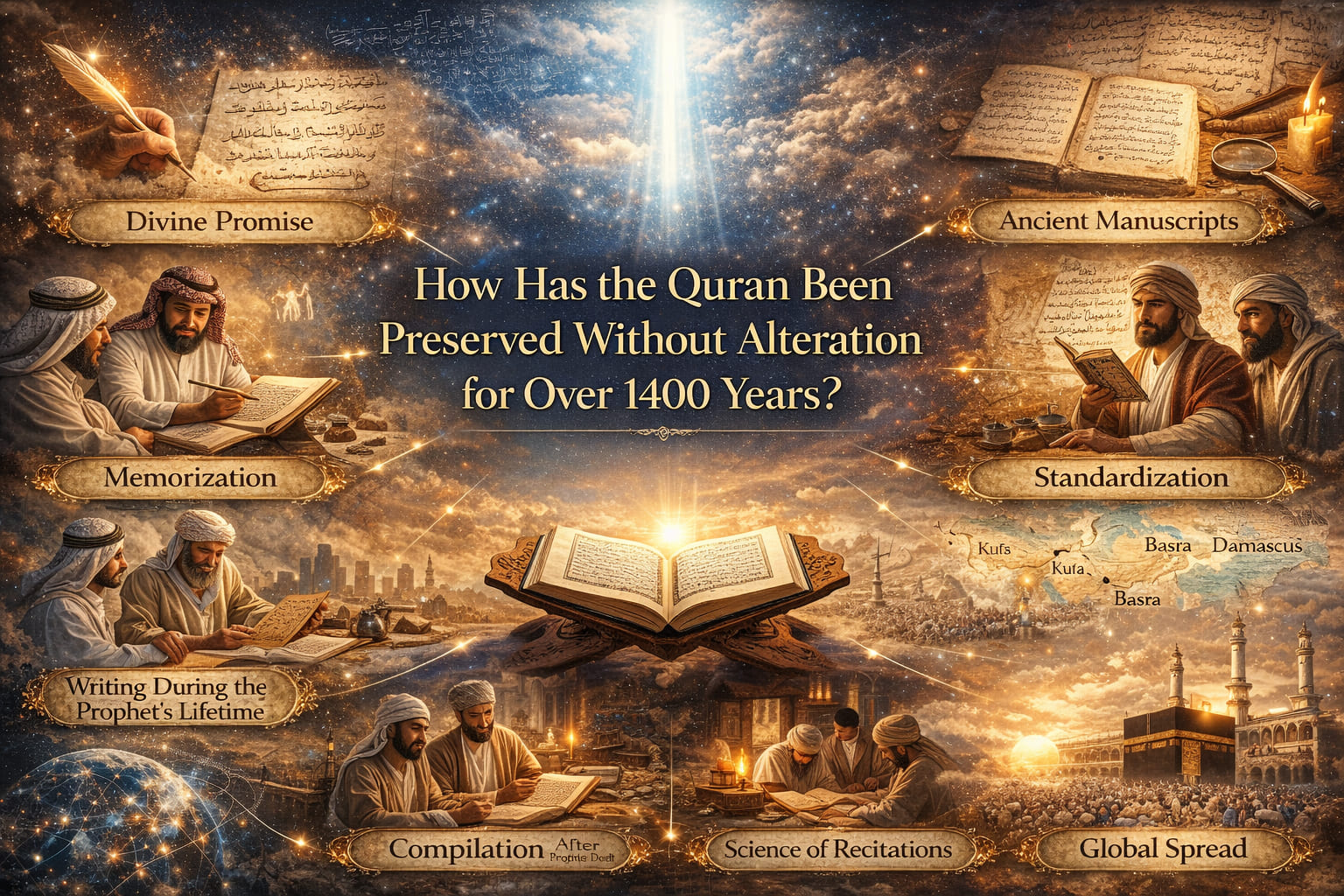
First: The Divine Promise to Preserve the Quran
One of the foundations of the Muslim belief regarding the Quran’s preservation is a divine promise mentioned within the Quran itself. God says:
“Indeed, We have sent down the Reminder, and indeed, We will surely preserve it.” (Quran 15:9)
Muslims understand from this verse that the preservation of the Quran is ultimately guaranteed by God. This belief distinguishes the Quran from many other ancient texts whose preservation relied solely on human effort.
However, from a historical perspective, an important question arises: Through what practical means was this preservation achieved?
Second: Memorization in the Hearts
One of the primary reasons the Quran has been preserved since its revelation is memorization.
Arab society at the time of the Prophet Muhammad placed great value on memorization, especially in poetry and oral traditions. When the Quran was revealed, many of the Prophet’s companions memorized it directly from him.
The Prophet encouraged his companions to learn and memorize the Quran and to teach it to others. As a result, a large number of them became known as memorizers of the Quran.
Among the well-known companions who memorized the Quran were:
-
Abdullah ibn Mas‘ud
-
Ubayy ibn Ka‘b
-
Zayd ibn Thabit
-
Abu Musa al-Ash‘ari
This tradition of memorization has continued throughout the centuries. Today, millions of Muslims around the world have memorized the entire Quran by heart.
This unique method of transmission is considered one of the most powerful ways to preserve a text across generations.
Third: Writing the Quran During the Prophet’s Lifetime
In addition to memorization, the Quran was also written down during the lifetime of the Prophet Muhammad.
The Prophet had several companions known as scribes of revelation who would write down the verses as soon as they were revealed. Among the most famous scribes were:
-
Zayd ibn Thabit
-
Ali ibn Abi Talib
-
Mu‘awiya ibn Abi Sufyan
-
Ubayy ibn Ka‘b
The verses were written on different materials available at that time, including:
-
parchment and leather
-
bones
-
palm stalks
-
flat stones
The Prophet would review what had been written and specify the correct placement of each verse within its chapter.
Thus, the Quran was preserved through two complementary methods:
in the hearts and in written form.
Fourth: The Compilation of the Quran After the Prophet’s Death
After the death of the Prophet Muhammad, a major battle known as the Battle of Yamama took place. In this battle, many of those who had memorized the Quran were martyred.
Concerned that the loss of memorizers might eventually lead to the loss of parts of the Quran, the companion Umar ibn al-Khattab suggested to the first caliph, Abu Bakr, that the Quran should be compiled into a single manuscript.
The task was entrusted to the companion Zayd ibn Thabit, who had been one of the scribes of revelation.
The companions adopted a very strict method of verification. No verse was accepted unless:
-
It had been written down.
-
Two reliable witnesses testified that it had been recited by the Prophet.
Through this careful process, the Quran was compiled into a single manuscript with great precision.
Fifth: Standardizing the Quranic Manuscript During the Caliphate of Uthman
As the Islamic state expanded and Muslims spread across different regions, some differences in pronunciation began to appear due to various dialects.
Fearing that this might lead to confusion among Muslims, the third caliph, Uthman ibn Affan, ordered the preparation of standardized copies of the Quran based on the manuscript compiled earlier.
Several copies were produced and sent to major Islamic centers such as:
-
Mecca
-
Kufa
-
Basra
-
Damascus
This version became known as the Uthmanic manuscript, and it served as the standard reference for writing the Quran thereafter.
Sixth: The Science of Quranic Recitations
Another scholarly discipline that contributed to the preservation of the Quran is the science of Quranic recitations (Qira’at).
The Quran was revealed with several authentic modes of recitation. These were transmitted through reliable chains of narrators going back to the Prophet Muhammad.
Muslim scholars carefully documented these recitations and developed precise rules for their transmission.
This science represents one of the most meticulous systems of textual preservation in history.
Seventh: Ancient Quranic Manuscripts
Modern historical studies have discovered several ancient manuscripts of the Quran.
Among the most famous are:
-
the Sana’a manuscripts in Yemen
-
the Tashkent manuscript
-
the Istanbul manuscripts
-
the Birmingham manuscript in the United Kingdom
Studies of these manuscripts have shown that their text corresponds very closely with the Quran that is read today.
This strengthens the view that the Quranic text has remained remarkably consistent throughout the centuries.
Eighth: The Global Spread of the Quran
Another key factor in preserving the Quran is its wide global dissemination.
The Quran is recited daily in Muslim prayers and memorized in schools and mosques around the world.
If any alteration were introduced into the text, it would quickly be noticed due to the large number of people who have memorized it.
For this reason, some scholars describe the Quran as the most widely memorized book in human history.
Conclusion
The preservation of the Quran for more than fourteen centuries represents a unique phenomenon in the history of religious texts.
Several factors worked together to ensure its preservation, including:
-
memorization by large numbers of believers
-
written recording during the Prophet’s lifetime
-
the careful compilation by the companions
-
the standardization of the manuscript during the caliphate of Uthman
-
the scholarly discipline of Quranic recitations
-
the existence of early manuscripts
-
the widespread memorization and recitation of the Quran worldwide
Because of these combined factors, the Quran continues to be recited today throughout the world in the same words that were recited by the Prophet Muhammad more than 1400 years ago.
For Muslims, this remarkable preservation is not only a historical fact but also a sign of the unique nature and significance of the Quran in human history.
Join IslamLearn Academy for free and gain authentic Islamic knowledge in a simple and clear way, guided by qualified scholars.
Related Posts
2 September 2026
Is Islam a Continuation of Christianity?
Is Islam a Continuation of Christianity or a Correction of It? Introduction When Islam emerged...
 Read More
30 August 2026
Jesus in Islam and Christianity: Key Differences
Who Is Jesus in Islam and Christianity? A Comparative Reading of the Qur’an and the...
Read More
Search
Categories
Tags
Recent Posts
Is Islam a Continuation of Christianity?
Is Islam a Continuation of...
Jesus in Islam and Christianity: Key Differences
Who Is Jesus in Islam...
How Was the Quran Preserved Before Printing? Complete Guide
How Was the Quran Preserved...
The Story of Uthman ibn Affan: The Third Rightly Guided Caliph
The Story of Uthman ibn...
How to Become a Muslim: A Complete Step-by-Step Guide
How to Convert to Islam:...