17 May 2026
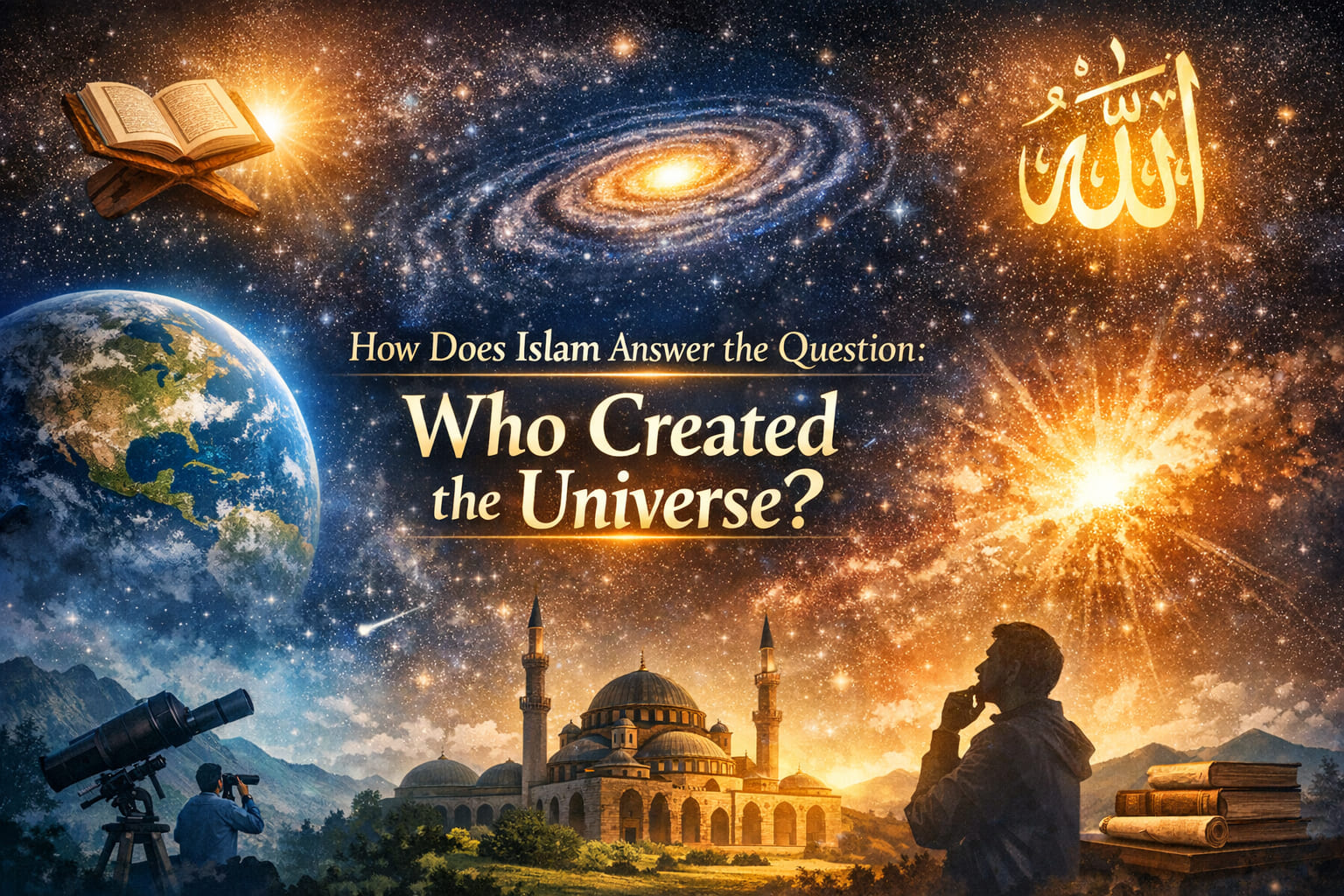
 Who Created the Universe? Islam Answers
Who Created the Universe? Islam Answers
Introduction
The question “Who created the universe?” is one of the greatest philosophical questions that has occupied human thought throughout history. Since humans began observing the sky, the stars, and the vast cosmos, they have wondered whether the universe came into existence by chance or whether it was created by a powerful and intelligent Creator.
Islam provides a clear and comprehensive answer to this question. Its answer combines rational and philosophical reasoning with divine revelation from the Qur’an, addressing both the human mind and the human heart.
First: A Basic Rational Principle – Everything That Begins Has a Cause
The human mind naturally understands a simple principle: everything that begins to exist must have a cause. Nothing appears from absolute nothingness without a reason.
For example, if a person sees a well-built house, they immediately know that someone built it. If they find a book full of organized ideas and sentences, they understand that an author wrote it.
In the same way, the universe we live in is not something simple or random. It is incredibly vast and extraordinarily ordered. There are billions of galaxies, each containing billions of stars, all moving according to precise physical laws such as gravity, motion, and energy.
Is it reasonable to believe that such an enormous and complex system came into existence without a cause?
The rational answer is no. Order indicates a designer, and creation indicates a creator.
Therefore, the logical conclusion is that the universe must have a Creator who brought it into existence and established its laws.
Second: The Impossibility of the Universe Creating Itself
Some philosophers ask whether the universe might have created itself.
However, this idea is logically impossible. Before something exists, it does not exist at all. Something that does not exist cannot act, create, or cause anything.
Therefore, the universe could not have created itself because it would have needed to exist before it existed.
The Qur’an presents this powerful rational argument in a concise question:
“Or were they created by nothing, or were they themselves the creators?”
(Qur’an 52:35)
This verse presents two possibilities:
-
Were humans created from nothing?
-
Or did they create themselves?
Both possibilities are irrational. Therefore, the only logical conclusion is that there must be a Creator who created them.
Third: The Evidence of Order and Design in the Universe
One of the strongest signs of a Creator is the remarkable order and precision in the universe. The universe is not chaos; it is a system governed by precise laws.
The Earth revolves around the Sun at a specific speed. If that speed changed even slightly, life on Earth would either burn or freeze. The atmosphere protects the planet from harmful radiation, and the percentage of oxygen in the air is perfectly balanced for life.
Even the human body reflects astonishing design. The human heart beats thousands of times every day without conscious effort. The brain contains billions of neurons that regulate thinking, memory, and movement.
Such extraordinary precision cannot reasonably be explained by chance alone. Randomness may produce disorder, but it does not produce a consistent and harmonious system like the universe.
The Qur’an calls people to reflect on this reality:
“Indeed, in the creation of the heavens and the earth and the alternation of night and day are signs for people of understanding.”
(Qur’an 3:190)
This verse teaches that thoughtful reflection on the universe leads people of intellect to recognize the existence of a wise Creator.
Fourth: The Beginning of the Universe Points to a Creator
Modern science has discovered that the universe had a beginning. According to the widely accepted Big Bang theory, the universe began around 13.8 billion years ago from an extremely dense and hot state and has been expanding ever since.
This scientific discovery carries an important philosophical implication: if the universe had a beginning, then there was a time when it did not exist.
Anything that begins to exist must have a cause that brought it into existence.
Interestingly, the Qur’an hinted at this reality over fourteen centuries ago:
“Have those who disbelieved not considered that the heavens and the earth were once a joined entity, and We separated them?”
(Qur’an 21:30)
This verse describes the heavens and the earth as once being united before they were separated, which many scholars see as consistent with modern cosmological understanding.
Fifth: Who Is the Creator of the Universe in Islam?
Once reason concludes that the universe must have a Creator, Islam introduces us to this Creator.
Islam declares that the Creator of the universe is Allah, the One and Only God.
The essence of this belief is beautifully summarized in a short chapter of the Qur’an:
“Say: He is Allah, the One.
Allah, the Eternal Refuge.
He neither begets nor is born.
And there is none comparable to Him.”
(Qur’an 112:1–4)
These verses describe God as:
-
One and unique
-
Independent and self-sufficient
-
Not born and does not give birth
-
Nothing is equal or comparable to Him
This concept of pure monotheism (Tawhid) lies at the heart of Islamic belief.
Sixth: Why Do We Not Ask “Who Created God?”
Some people ask: if everything has a creator, then who created God?
Islam explains that God is not like His creation. Created things have beginnings, which is why they need a creator. God, however, is eternal and uncreated.
If God had a creator, then that creator would also need another creator, and the chain would continue endlessly. Such an infinite chain of creators is logically impossible.
Therefore, there must ultimately be a first, uncreated Creator, and that is God.
The Qur’an expresses this idea clearly:
“He is the First and the Last, the Manifest and the Hidden.”
(Qur’an 57:3)
God is the First—there was nothing before Him.
Conclusion
The question “Who created the universe?” is not merely a philosophical curiosity. It is a question that leads human beings to understand their origin, purpose, and destiny.
Islam answers this question through a harmonious combination of reason and revelation. The universe began to exist, everything that begins has a cause, and the extraordinary order of the cosmos points to a wise and powerful Creator.
According to Islam, that Creator is Allah, the One and Only God, who created the universe with wisdom and purpose and invites humanity to reflect upon the signs of creation.
The Qur’an summarizes this truth in a powerful statement:
“Allah is the Creator of all things, and He is the Guardian over everything.”
(Qur’an 39:62)
Thus, through reflection, reason, and revelation, Islam provides a clear and compelling answer: God created the universe.
Join IslamLearn Academy for free and gain authentic Islamic knowledge in a simple and clear way, guided by qualified scholars.
Related Posts
2 September 2026
Is Islam a Continuation of Christianity?
Is Islam a Continuation of Christianity or a Correction of It? Introduction When Islam emerged...
 Read More
30 August 2026
Jesus in Islam and Christianity: Key Differences
Who Is Jesus in Islam and Christianity? A Comparative Reading of the Qur’an and the...
Read More
Search
Categories
Tags
Recent Posts
Is Islam a Continuation of Christianity?
Is Islam a Continuation of...
Jesus in Islam and Christianity: Key Differences
Who Is Jesus in Islam...
How Was the Quran Preserved Before Printing? Complete Guide
How Was the Quran Preserved...

The Story of Uthman ibn Affan: The Third Rightly Guided Caliph
The Story of Uthman ibn...
How to Become a Muslim: A Complete Step-by-Step Guide
How to Convert to Islam:...