9 May 2026
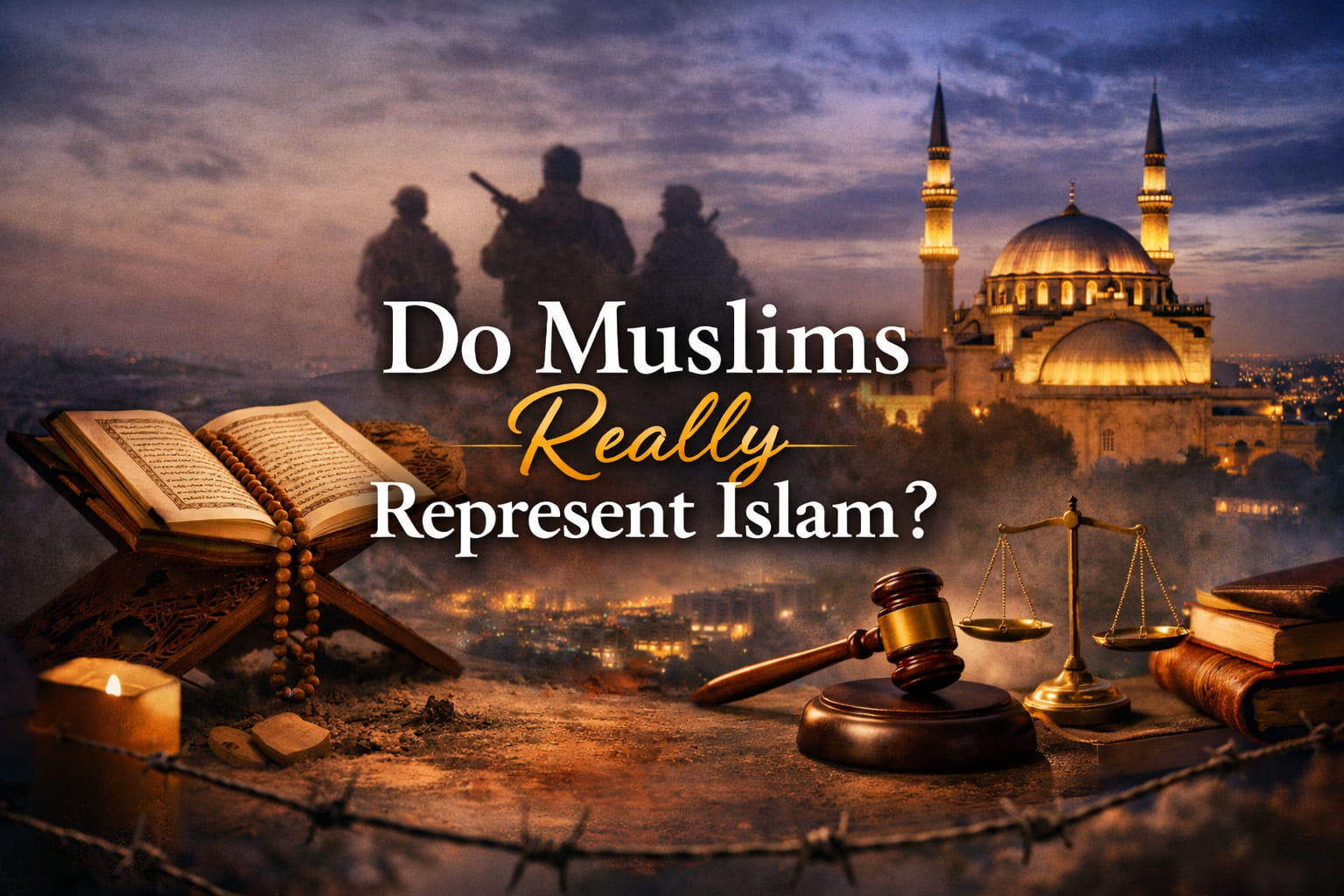
 Do Muslims Truly Represent Islam?
Do Muslims Truly Represent Islam?
Introduction
When Islam is mentioned in the media or public discourse, its image is often linked to the actions of some Muslims—whether positive or negative. This raises a legitimate question for many non-Muslims, and even for some Muslims themselves: Do Muslims truly represent Islam?
And can an entire religion, followed by more than one and a half billion people, be judged through the behavior of certain individuals or specific groups?
To answer this question objectively, it is essential to distinguish between religion as a set of texts and values, and its followers as a human experience subject to both error and correctness.
First: The Difference Between Islam as a Religion and Muslims as Human Beings
Islam—as a religion—is based on:
-
Sacred texts (the Qur’an)
-
Ethical and legal teachings
-
A clear system of values
Muslims, however, are:
-
Human beings who make mistakes and do right
-
Influenced by culture, politics, and circumstances
-
Varied in their level of commitment and understanding of the religion
Therefore, it is illogical to judge Islam through the actions of all Muslims, just as no philosophy or moral system is judged by the worst of those who claim to apply it.
Second: The Qur’an Itself Acknowledges Human Shortcomings
Notably, Islam does not claim perfection for its followers; rather, it acknowledges human weakness and shortcomings. The Qur’an states:
“And mankind was created weak.”
(Qur’an, An-Nisa 4:28)
The Qur’an also clearly distinguishes between:
-
Those who adhere to values
-
And those who violate them despite being affiliated with the religion
This means that the existence of Muslims who do not properly practice Islam does not invalidate the truth of Islam’s teachings themselves.
Third: Do the Actions of Extremists Represent Islam?
Islam is often reduced to the actions of extremist groups that commit violence in the name of religion.
However, the reality is that:
-
These groups contradict clear Islamic texts
-
They justify their actions through distorted interpretations
-
They are condemned by the vast majority of Muslims worldwide
The Qur’an states explicitly:
“Whoever kills a soul—unless for a soul or for corruption in the land—it is as if he had slain all of mankind.”
(Qur’an, Al-Ma’idah 5:32)
So how can actions that contradict Islam’s core texts be attributed to Islam itself?
Fourth: The True (Criterion) of Representing Islam
To understand what truly represents Islam, one must return to:
-
The Qur’an
-
The life of Prophet Muhammad ﷺ
-
The general moral values Islam promotes
The Prophet ﷺ summarized the essence of his mission by saying:
“I was sent only to perfect noble character.”
Any behavior that contradicts:
-
Justice
-
Mercy
-
Honesty
-
Respect for human dignity
cannot be considered a true representation of Islam, even if committed by a Muslim.
Fifth: The Diversity of Muslims and Their Experiences
Today, Muslims live in:
-
More than 50 countries
-
Diverse cultures
-
Different political and social systems
It is unjust to reduce this vast diversity to a single image.
Just as there are:
-
Muslims who uphold ethical values
-
Muslims who fall short
-
And others who exploit religion for personal interests
This diversity confirms that Muslims do not form a single, uniform bloc that represents Islam in one way.
Sixth: Is Any Religion Judged by Its Followers?
If this logic were applied to any religion or ideology:
-
Christianity would be judged by the Crusades
-
Humanitarian values by the crimes of some developed nations
-
Laws by the corruption of certain officials
Yet a fair approach always distinguishes between:
-
The principle
-
And human application
This same approach should be applied when viewing Islam.
Seventh: The Responsibility of Muslims in Representing Islam
Despite all of the above, Islam does not absolve its followers of responsibility.
A Muslim is required to:
-
Reflect the ethics of the religion
-
Be a good role model
-
Avoid distorting Islam’s image through misconduct
The Qur’an states:
“You are the best nation produced for mankind.”
This is a moral responsibility, not a declaration of perfection.
When a Muslim behaves poorly, they harm themselves and the image of their religion—but they do not change the essence of Islam.
Eighth: Why Do People Confuse Islam with Muslims?
This confusion stems from several factors:
-
Selective media coverage
-
Ignorance of Islamic texts
-
Automatic linking of identity with behavior
-
Misconduct by some Muslims
Awareness of these factors helps foster a more balanced understanding.
Ninth: How Can a Non-Muslim Learn About the True Islam?
The fairest approach is to:
-
Read the Qur’an
-
Study the life of Prophet Muhammad ﷺ
-
Examine Islam’s core values
-
Avoid relying solely on media portrayals or individual experiences
Many non-Muslims who embraced Islam did so after studying its texts—not after observing the behavior of some Muslims.
Why Are Many People Attracted to Islam Despite the Mistakes of Some Muslims?
Because Islam:
-
Provides a clear meaning for life
-
Balances spirituality and reason
-
Honors human dignity
-
Calls for justice and mercy
-
Aligns with human nature
These values remain constant, regardless of the shortcomings of some followers.
Conclusion
Muslims do not always represent Islam perfectly, just as no human beings perfectly embody the values they believe in.
Islam is known through:
-
Its texts
-
Its values
-
And the life of its Prophet
—not through the mistakes of its followers or the deviations of some of them.
Those who view Islam through this balanced lens realize that it is a religion that seeks to reform human beings, does not claim their perfection, and places judgment in values—not in claims.
Join IslamLearn Academy for free and gain authentic Islamic knowledge in a simple and clear way, guided by qualified scholars.
Related Posts
20 February 2025
The Famous Islamic Wars: A Detailed Exploration
The Famous Islamic Wars: A Detailed Exploration Islamic history is marked by numerous battles and...
 Read More
Search
Categories
Tags
Recent Posts
Is Islam a Continuation of Christianity?
Is Islam a Continuation of...
Jesus in Islam and Christianity: Key Differences
Who Is Jesus in Islam...
How Was the Quran Preserved Before Printing? Complete Guide
How Was the Quran Preserved...
The Story of Uthman ibn Affan: The Third Rightly Guided Caliph
The Story of Uthman ibn...
How to Become a Muslim: A Complete Step-by-Step Guide
How to Convert to Islam:...