2 September 2026
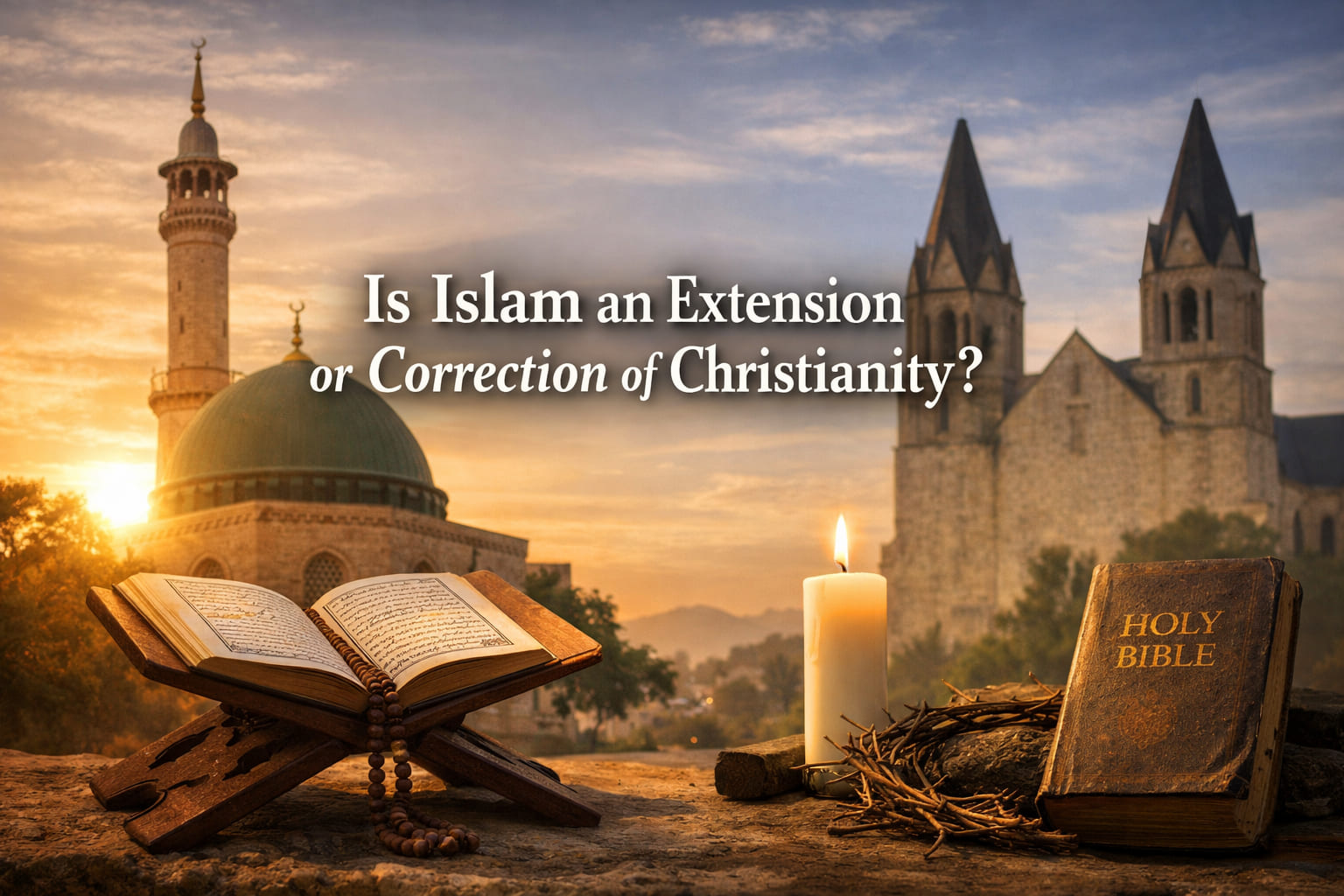
 Is Islam a Continuation of Christianity?
Is Islam a Continuation of Christianity or a Correction of It?
Introduction
When Islam emerged in the seventh century, it did not present itself as a religion completely disconnected from the revelations that came before it. Nor did it ask its followers to reject Moses, Jesus, or Abraham. Rather, belief in these prophets is an essential part of the Muslim faith.
This raises an important question for many people seeking the truth:
Is Islam simply a continuation of Christianity and Judaism, or did it come to correct what it regards as deviations that developed in earlier religious beliefs?
According to the Islamic perspective, Islam is neither a branch of Christianity nor a modified version of it. Rather, it is a continuation of the prophets’ call to worship God alone, a confirmation of the truth that remains from previous revelations, and a correction of the distortions and disagreements that arose in matters of faith. It also brings the final divine law sent through the Prophet Muhammad ﷺ to all humanity.
To understand this more clearly, we first need to examine how Islam views the history of divine revelation and the prophets.
Does Islam Consider Itself a New Religion?
The call to worship God alone did not begin with the Prophet Muhammad ﷺ. Rather, it was the fundamental message preached by the prophets before him.
The Qur’an states that God sent all His messengers with the call to worship Him alone:
“We never sent a messenger before you without revealing to him: ‘There is no god worthy of worship except Me, so worship Me.’”
[Qur’an 21:25]
It also says:
“We surely sent a messenger to every community, saying, ‘Worship Allah and shun false gods.’”
[Qur’an 16:36]
Islam therefore views Noah, Abraham, Moses, Jesus, and Muhammad—peace be upon them—as prophets sent by the same One God, even though some laws and religious obligations differed according to the nations and times in which they lived.
What Is Islam’s Relationship with Abraham, Moses, and Jesus?
Islam does not reject the previous prophets. In fact, a Muslim’s faith is not complete without believing in them.
God says:
“Say, ‘We believe in Allah and what has been revealed to us; and what was revealed to Abraham, Ishmael, Isaac, Jacob, and his descendants; and what was given to Moses, Jesus, and other prophets from their Lord. We make no distinction between any of them. And to Allah we all submit.’”
[Qur’an 2:136]
Islam therefore teaches that the foundation of the message of all these prophets was the same: belief in God, submission to Him, and worship of Him.
The relationship between Islam and previous revelations is therefore not one of complete rejection. Rather, Islam affirms the divine origin of the previous revelations while calling people to believe in God’s final revelation.
Is Islam a Continuation of Christianity?
If by “continuation” we mean that Islam recognizes Jesus and believes that God sent him as a prophet, then there is indeed a clear connection between the two faiths.
However, if “continuation” means that Islam was built upon present-day Christian theology or developed from it, this is not how Islam presents itself.
The Qur’an presents Islam as the continuation of the religion of monotheism preached by Abraham, Moses, Jesus, and the other prophets—not as the continuation of the doctrines of one particular religious community.
God says concerning Abraham:
“Abraham was neither a Jew nor a Christian; he submitted in all uprightness and was not a polytheist.”
[Qur’an 3:67]
The word “Muslim” in this context means someone who submits to God and worships Him alone. It does not mean that Abraham followed the specific religious law brought by the Prophet Muhammad ﷺ centuries later.
Islam can therefore be described, according to its own understanding, as a continuation of the message of monotheism preached by all the prophets, rather than a continuation of Christianity in its present theological form.
What Is the Status of Jesus Christ in Islam?
Jesus holds an exceptionally important position in Islam.
Muslims believe that:
– Jesus is the Messiah.
– He is a messenger sent by God.
– He was miraculously born to the Virgin Mary without a human father.
– God supported him with miracles.
– God revealed the Gospel to him.
– He called people to worship God.
– He will return near the end of time.
The Qur’an describes him:
“The Messiah, Jesus son of Mary, was only a messenger of Allah and His Word which He conveyed to Mary, and a spirit from Him.”
[Qur’an 4:171]
Islam, however, differs from the major Christian doctrines concerning the nature of Christ.
It does not regard Jesus as God or as the Son of God in the theological sense. Rather, he is a servant and messenger of God.
Where Does the Fundamental Difference Concerning Christ Lie?
One of the greatest differences between Islam and traditional Christianity concerns the question:
Who is Jesus Christ?
In mainstream Christian theology, belief in Christ is connected with his divinity and with the doctrines of the Trinity and atonement.
The Qur’an and the teachings of the Prophet Muhammad ﷺ, however, affirm the humanity and prophethood of Jesus and reject his deification.
God says:
“Those who say, ‘Allah is the Messiah, son of Mary,’ have certainly fallen into disbelief.”
[Qur’an 5:72]
The Qur’an then reports Jesus himself as saying:
“O Children of Israel! Worship Allah—my Lord and your Lord.”
[Qur’an 5:72]
Islam therefore teaches that truly honoring Jesus does not mean making him divine, but believing in him as a prophet, messenger, and Messiah sent by God.
What Does It Mean to Say That Islam Came as a “Correction”?
The word “correction” needs to be understood carefully.
Islam does not teach that everything found among Jews or Christians is false. Rather, it affirms that the Torah and the Gospel were originally revelations from God.
God says:
“He has revealed to you the Book in truth, confirming what came before it, as He revealed the Torah and the Gospel.”
[Qur’an 3:3]
At the same time, the Qur’an states that distortion, concealment, and disagreement occurred concerning some of what was attributed to revelation or in the way revelation was understood and transmitted.
The Qur’an therefore came confirming the truth contained in previous revelations and serving as the final authority regarding the disagreements that later arose among people.
God says concerning the Qur’an:
“We have revealed to you this Book with the truth, as a confirmation of previous Scriptures and a supreme authority over them.”
[Qur’an 5:48]
Thus, the Islamic concept of “correction” means calling humanity back to pure monotheism and clarifying the truth regarding matters in which people differed. It does not mean denying that God sent Moses and Jesus or that He originally revealed the Torah and the Gospel.
Did Jesus Call People to Worship God?
God says in the Qur’an:
“Surely Allah is my Lord and your Lord, so worship Him. This is the Straight Path.”
[Qur’an 3:51]
This is central to the Islamic understanding of Jesus’ mission: Jesus did not call people to worship him; he called them to worship God.
Muslims therefore see Muhammad’s ﷺ call to worship God alone not as a break from the message of Jesus, but as a continuation of the fundamental message preached by Jesus and all the other prophets.
Why Did God Send Muhammad ﷺ If He Had Already Sent Jesus?
According to Islam, God sent many prophets throughout different periods of human history.
Some previous prophetic missions were directed toward particular peoples, while Muhammad ﷺ was sent with the final message addressed to all humanity.
God says:
“Say, ‘O humanity! I am Allah’s Messenger to you all.’”
[Qur’an 7:158]
And He says:
“We have sent you only as a deliverer of good news and a warner to all of humanity.”
[Qur’an 34:28]
The Qur’an also states that Muhammad ﷺ is the final prophet:
“Muhammad is not the father of any of your men, but is the Messenger of Allah and the seal of the prophets.”
[Qur’an 33:40]
The mission of Muhammad ﷺ therefore does not cancel belief in Jesus. Rather, according to Islam, it completes and concludes the chain of prophethood.
Do Muslims Believe That Christians Worship a Different God?
Islam teaches that the Creator of Abraham, Moses, Jesus, and Muhammad—peace be upon them—is the One God.
The fundamental disagreement is therefore not that each religion necessarily has a different Creator, but rather concerns how God is understood, His attributes, who deserves worship, and the nature of Christ.
Islam rejects dividing divinity or associating any created being with God in worship. It emphasizes the absolute oneness of God:
“Say, ‘He is Allah—One. Allah—the Sustainer needed by all. He has never had offspring, nor was He born. And there is none comparable to Him.’”
[Qur’an 112:1–4]
This short chapter summarizes a fundamental aspect of the Islamic understanding of God.
Does Islam Recognize the Gospel?
Yes. Muslims believe that God revealed a scripture and revelation known as the Gospel (Injil) to Jesus.
God says:
“We gave him the Gospel containing guidance and light.”
[Qur’an 5:46]
However, the Qur’anic concept of the Gospel does not necessarily mean that all the texts contained in today’s New Testament are identical to the revelation originally given by God to Jesus.
The New Testament consists of a collection of books and letters written within a historical context after Jesus, whereas the Gospel in the Qur’anic understanding refers to the revelation God gave to Jesus himself.
This distinction is important for understanding the difference between Islamic and Christian concepts of revelation and scripture.
Does Islam Abolish All Previous Religious Laws?
Islam distinguishes between the fundamental principles of faith and the details of religious law.
Belief in God, worshiping Him alone, and believing in His messengers form a common foundation shared by the prophets.
However, some practical religious laws differed from one prophetic law to another.
God says:
“To each of you We have ordained a code of law and a way of life.”
[Qur’an 5:48]
With the mission of Muhammad ﷺ, Muslims believe that the law revealed to him became the final divine law that God commanded humanity to follow.
Why Does a Muslim Not Become a Christian If He Believes in Christ?
Because belief in Jesus in Islam differs from the Christian theological understanding of faith in Christ.
A Muslim loves Jesus and believes in his prophethood, miracles, and miraculous birth. But does a Muslim worship Jesus? No.
In Islam, worship belongs to God alone.
Muslims also believe that revelation did not end with Jesus, but that God sent Muhammad ﷺ after him.
Therefore, Islam teaches that true belief in all the messengers means that a person should not accept some while rejecting others.
God says:
“Surely those who deny Allah and His messengers and wish to make a distinction between Allah and His messengers … they are indeed the true disbelievers.”
[Qur’an 4:150–151]
What Message Did the Prophets Share?
Although the prophets lived in different times and some religious laws differed, the Qur’an presents their fundamental call as one:
Worship God alone.
Noah said to his people:
“Worship Allah! You have no other god worthy of worship except Him.”
[Qur’an 7:59]
Hud said:
“Worship Allah! You have no other god worthy of worship except Him.”
[Qur’an 7:65]
Salih said:
“Worship Allah! You have no other god worthy of worship except Him.”
[Qur’an 7:73]
Jesus said:
“Worship Allah—my Lord and your Lord.”
[Qur’an 5:72]
Muhammad ﷺ brought the same fundamental message:
“Say, ‘I am only a man like you, but it has been revealed to me that your God is only One God.’”
[Qur’an 18:110]
This reveals the central idea: Islam understands itself as a return to the original message of all the prophets, rather than the beginning of an entirely separate religious story.
Is Islam a Continuation of Christianity or a Correction of It?
The answer can be summarized in two points:
Islam is a continuation of the message of the prophets, not a continuation of Christianity in its present theological form.
At the same time, Islam teaches that it came to confirm the truth previously revealed by God, correct the distortions and disagreements that developed among people, and complete the chain of divine messages with the final revelation.
Islam therefore does not ask a Christian who becomes Muslim to reject Jesus. On the contrary, Islam requires him to believe fully in Jesus as the Messiah and Messenger of God, while worshiping the God whom Jesus himself called people to worship.
Frequently Asked Questions
Is Islam Derived from Christianity?
Islam does not present itself as a religion derived from Christianity. Rather, it presents itself as an independent revelation from God given to Muhammad ﷺ and connected to the same chain of divine messages that preceded his mission.
Do Muslims Believe in Jesus Christ?
Yes. Belief in Jesus is part of the Islamic faith, and a person cannot be a Muslim while rejecting his prophethood.
Does Islam Consider Jesus to Be God?
No. Islam regards Jesus as the Messiah and one of God’s greatest messengers, but it does not believe that Jesus is God or part of God.
Do Muslims Believe in the Virgin Mary?
Yes. Mary holds an honored position in the Qur’an. An entire chapter of the Qur’an is named Surah Maryam (Mary), and the Qur’an speaks of her purity and her being chosen by God.
Do Muslims Believe in the Gospel?
Muslims believe that God revealed the Gospel to Jesus. Islam, however, distinguishes between the original divine revelation and the texts that were transmitted through history and became associated with the Christian tradition.
Why Did the Qur’an Come After the Gospel?
According to Islamic belief, the Qur’an came as the final revelation, confirming the divine origin of previous revelations, serving as an authority over them, and being preserved as guidance for humanity after Muhammad ﷺ, the final prophet.
Can a Christian Become Muslim While Continuing to Believe in Jesus?
A person must believe in Jesus in order to be a Muslim. What changes is the understanding of who Jesus is: a Muslim believes that Jesus is the Messiah and a messenger sent by God, does not worship him, and also believes in Muhammad ﷺ as the final prophet.
Conclusion
Islam does not present religious history as a series of competing gods or completely unrelated revelations. Rather, it presents a succession of prophets sent by One God to guide humanity.
Abraham, Moses, Jesus, and Muhammad—peace be upon them—according to Islam, did not call people to worship themselves. They called people to worship God.
Therefore, the more precise question is not only:
Is Islam a continuation of Christianity or a correction of it?
But rather:
Is the message of Islam a return to the monotheism preached by Abraham, Moses, Jesus, and all the other prophets?
The Qur’an answers:
“He has ordained for you from the religion what He commanded Noah, and what We have revealed to you, and what We commanded Abraham, Moses, and Jesus: ‘Uphold the faith, and make no divisions in it.’”
[Qur’an 42:13]
Join IslamLearn Academy for free and gain authentic Islamic knowledge in a simple and clear way, guided by qualified scholars.
Related Posts
30 August 2026
Jesus in Islam and Christianity: Key Differences
Who Is Jesus in Islam and Christianity? A Comparative Reading of the Qur’an and the...
 Read More
29 July 2026
How Was the Quran Preserved Before Printing? Complete Guide
How Was the Quran Preserved Before Printing? The Complete Story of How the Quran Was...
Read More
Search
Categories
Tags
Recent Posts
Is Islam a Continuation of Christianity?
Is Islam a Continuation of...
Jesus in Islam and Christianity: Key Differences
Who Is Jesus in Islam...
How Was the Quran Preserved Before Printing? Complete Guide
How Was the Quran Preserved...
The Story of Uthman ibn Affan: The Third Rightly Guided Caliph
The Story of Uthman ibn...
How to Become a Muslim: A Complete Step-by-Step Guide
How to Convert to Islam:...