29 July 2026
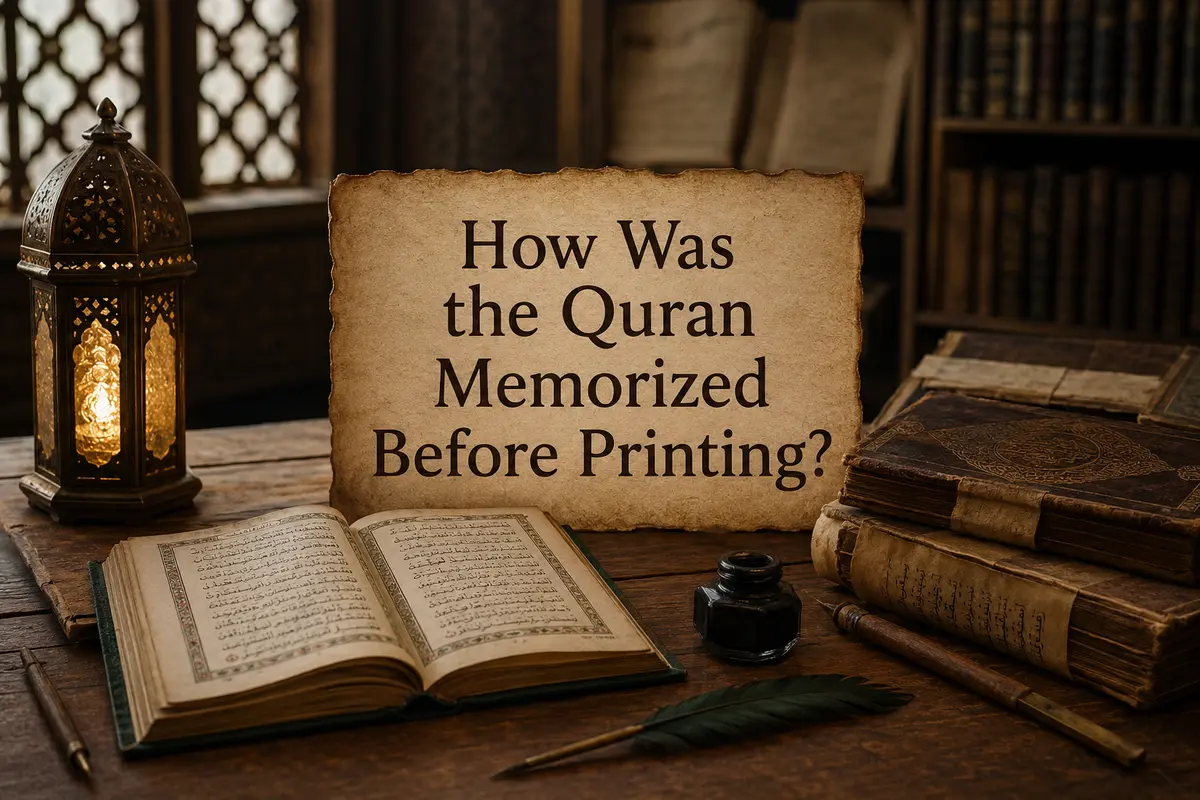
 How Was the Quran Preserved Before Printing? Complete Guide
How Was the Quran Preserved Before Printing? The Complete Story of How the Quran Was Memorized and Collected
The Quran is the most widely recited, memorized, and transmitted book in human history. Yet many Muslims and non-Muslims ask an important question:
How was the Quran preserved before the invention of the printing press?
Some also wonder: If there were no printing presses, no printed copies, and no audio recordings, how did the Quran reach us exactly as it was revealed to Prophet Muhammad ﷺ? Was it preserved only through human memory? And how can we be confident that it was not altered or lost over the centuries?
These are reasonable questions, especially for those studying the history of religions or seeking to understand Islam. The answer reveals a unique system of preservation unlike that of any other religious scripture. Muslims did not rely solely on written manuscripts, nor did they depend only on oral memorization. Instead, they combined both methods from the very beginning, supported by continuous review and careful verification during the lifetime of Prophet Muhammad ﷺ.
In this article, we will explore how the Quran was preserved before the age of printing and why Muslims believe it has remained unchanged until today.
Why Do People Ask How the Quran Was Preserved Before Printing?
When people study ancient books, they often discover that many manuscripts have been lost over time, survived only in a few copies, or contain variations between different manuscripts. This naturally leads to questions such as:
-
How did the Quran avoid the same fate?
-
Was it preserved in only one written copy?
-
Did Muslims rely entirely on memory?
-
Can human memory accurately preserve an entire book?
In reality, these questions arise from comparing the Quran with other historical texts, while the Quran followed a completely different method of preservation from the very beginning.
The Quran was never simply a book that was written down and stored away. It was recited daily in prayer, memorized by men and women, written down under the Prophet’s direct supervision, and constantly reviewed. As a result, preserving the Quran became part of the daily life of the first Muslim community.
How Was the Quran Revealed to Prophet Muhammad ﷺ?
The Quran was not revealed all at once. Instead, it was revealed gradually over approximately twenty-three years, addressing different events and circumstances throughout the Prophet’s mission.
The Angel Gabriel (Jibril) would bring the revelation to Prophet Muhammad ﷺ, who would immediately memorize the verses. He then recited them to his companions, who also memorized them.
The Prophet ﷺ made sure that every newly revealed passage was taught as soon as it was received, allowing it to spread among many companions rather than remaining with only one individual.
This process involved much more than simply hearing the verses once. The companions repeatedly recited the Quran during their daily prayers, study circles, and personal worship until the verses became firmly rooted in their memory.
One of the greatest examples of the care given to preserving the Quran was the annual review between Gabriel and the Prophet ﷺ during the month of Ramadan. In the year of the Prophet’s passing, this review took place twice, which Muslim scholars understand as the final confirmation of the Quran’s complete arrangement and preservation.
Why Was Memorizing the Quran Natural for the Arabs?
Modern readers may find it surprising that people could memorize the entire Quran without electronic devices or printed books. However, it is important to understand the nature of Arabian society at that time.
Before Islam, Arabs relied heavily on memory because writing was not as widespread as it is today.
Many people memorized hundreds or even thousands of lines of poetry, preserved tribal genealogies, historical events, and lengthy speeches entirely from memory.
Poets competed by reciting long poems without reading from written texts, while entire communities passed these works from one generation to another through oral transmission.
When the Quran was revealed, it entered a society already known for its remarkable memory. Yet the Quran occupied an even higher place than poetry because it was recited daily as an act of worship, especially during the five daily prayers. This constant repetition strengthened its preservation in an extraordinary way.
The Quran’s unique style, rhythm, eloquence, and structure also make it easier to memorize. Even today, millions of children around the world memorize the entire Quran in Arabic, although Arabic is not their native language.
Who Memorized the Quran During the Prophet’s Lifetime?
The Quran was never preserved by only one individual. Instead, it was memorized by a large number of the Prophet’s companions, making it virtually impossible for the text to disappear or be altered.
Among the most well-known memorizers of the Quran were:
-
Abu Bakr Al-Siddiq (may Allah be pleased with him)
-
Umar ibn Al-Khattab (may Allah be pleased with him)
-
Uthman ibn Affan (may Allah be pleased with him)
-
Ali ibn Abi Talib (may Allah be pleased with him)
-
Abdullah ibn Mas’ud (may Allah be pleased with him)
-
Ubayy ibn Ka’b (may Allah be pleased with him)
-
Zayd ibn Thabit (may Allah be pleased with him)
-
Mu’adh ibn Jabal (may Allah be pleased with him)
-
Salim, the freed slave of Abu Hudhayfah (may Allah be pleased with him)
-
Abu Al-Darda’ (may Allah be pleased with him)
These companions taught the Quran to others, allowing memorization to spread throughout Makkah, Madinah, and the growing Muslim community.
Therefore, the Quran was not preserved by a small elite. It was memorized by large numbers of Muslims of different ages and from different regions, creating a powerful system of collective preservation.
Was the Quran Also Written Down?
One common misconception is that the Quran existed only in the memories of its reciters.
In reality, Prophet Muhammad ﷺ instructed that the Quran be written down from the earliest days of revelation. He appointed several companions as official scribes of revelation, who recorded each passage immediately after it was revealed.
Among the best-known scribes were:
-
Zayd ibn Thabit
-
Ali ibn Abi Talib
-
Uthman ibn Affan
-
Ubayy ibn Ka’b
-
Mu’awiyah ibn Abi Sufyan
-
Khalid ibn Sa’id (may Allah be pleased with them all)
The verses were written on whatever writing materials were available at the time, including:
-
Parchment
-
Palm stalks
-
Thin white stones
-
Broad shoulder bones of animals
-
Pieces of leather and wood
The scribes did not decide where each verse belonged on their own. Rather, the Prophet ﷺ personally instructed them where every newly revealed verse should be placed within its chapter (Surah). This means that the arrangement of the verses was based on divine instruction, not personal judgment.
As a result, every verse had two independent forms of preservation:
-
It was memorized by numerous companions.
-
It was written down during the Prophet’s lifetime.
This combination of oral memorization and written documentation made the possibility of loss or error extremely remote.
Why Didn’t Muslims Rely Only on Written Copies?
Some may ask: If the Quran was already being written down, why was memorization still so important?
The answer is that writing materials were limited, and written pages were scattered across different materials. It was also impossible for every Muslim to own a complete written copy of the Quran.
Memorization, however, allowed every believer to carry the Quran wherever they went, recite it during prayer, teach it to others, and preserve it without depending on physical manuscripts.
For this reason, two complementary methods worked together from the very beginning:
-
Oral memorization, passed directly from teacher to student.
-
Written documentation, recording every verse during the lifetime of Prophet Muhammad ﷺ.
Together, these two methods established an exceptionally reliable system for preserving the Quran centuries before the invention of printing.
After the death of Prophet Muhammad ﷺ, Muslims faced a new challenge. The Islamic state was expanding, many memorizers of the Quran participated in military campaigns, and a number of them were martyred in battle. This raised an important question:
How could the Quran be preserved for future generations?
The answer was one of the greatest preservation efforts in Islamic history. It was carried out through carefully planned stages that ultimately resulted in the Quran reaching us exactly as it is recited and read by Muslims today.
Why Was the Quran Compiled After the Death of the Prophet ﷺ?
About a year after the death of Prophet Muhammad ﷺ, the Battle of Yamama took place during the Ridda (Apostasy) Wars. A large number of the Prophet’s companions who had memorized the entire Quran were martyred in the battle.
When Umar ibn Al-Khattab (may Allah be pleased with him) witnessed this, he became concerned that if more memorizers were lost over time, it could become more difficult to preserve the Quran in a single written collection.
He therefore approached the Caliph Abu Bakr Al-Siddiq (may Allah be pleased with him) and suggested compiling the Quran into one manuscript.
At first, Abu Bakr hesitated and said:
“How can I do something that the Messenger of Allah ﷺ did not do?”
However, Umar explained that this was not an innovation or alteration of the Quran. Rather, it was a practical step to preserve and safeguard it. Allah then opened Abu Bakr’s heart to this proposal, and the first official project to compile the Quran began.
How Was the Quran Compiled During the Caliphate of Abu Bakr?
Abu Bakr appointed Zayd ibn Thabit (may Allah be pleased with him) to lead this important mission because he had served as one of the Prophet’s scribes of revelation and was known for his honesty, precision, and exceptional memory.
Although Zayd himself had memorized the Quran, he did not rely solely on his memory. Instead, the companions established a remarkably rigorous verification process.
A verse would only be included in the compiled manuscript after two conditions were fulfilled:
-
It had to be found among the written materials recorded during the lifetime of Prophet Muhammad ﷺ.
-
It had to be confirmed by companions who had memorized it directly from the Prophet ﷺ.
In this way, written documentation and oral memorization served as independent evidence supporting one another.
Zayd later described this assignment as one of the most difficult tasks of his life. He famously said that moving a mountain would have been easier than compiling the Quran because of his determination to ensure that nothing was included except what was unquestionably part of the revealed Quran.
Once completed, the compiled manuscript remained with Abu Bakr. After his death, it passed to Umar ibn Al-Khattab, and after Umar’s death, it was entrusted to his daughter, Hafsah, one of the Mothers of the Believers (may Allah be pleased with her).
Why Did Uthman ibn Affan Produce Multiple Copies of the Quran?
As the Islamic state expanded, people from many different regions embraced Islam. Muslims began reciting the Quran according to different accepted dialects and modes of recitation that had been permitted by the Prophet ﷺ.
Over time, however, some people mistakenly assumed that these differences in recitation represented differences in the Quran itself. The companions feared that this misunderstanding could eventually lead to disputes.
For this reason, Caliph Uthman ibn Affan (may Allah be pleased with him) ordered several official copies of the Quran to be produced from the manuscript that had been compiled during Abu Bakr’s caliphate. These copies were sent to the major Islamic centers, including Makkah, Madinah, Kufa, Basra, and Syria.
He also sent qualified teachers with each copy to teach the correct recitation.
Uthman’s work was not a new compilation of the Quran, nor did it involve adding or removing any verses. Rather, it standardized the written text so that Muslims throughout the growing Islamic world would read from the same official manuscript while preserving the authentic, mass-transmitted (mutawatir) modes of recitation taught by the Prophet ﷺ.
For this reason, the Quran used by Muslims today is commonly referred to as the Uthmanic Mushaf, not because Uthman authored or altered the Quran, but because he supervised the standardization of its official written copies.
What Do the Earliest Quranic Manuscripts Tell Us?
In modern times, researchers have discovered several ancient Quranic manuscripts dating back to the earliest centuries of Islam. These manuscripts are now studied in universities, museums, and research institutions around the world.
Among the most famous are:
-
The Birmingham Quran Manuscript in the United Kingdom.
-
The Sanaa Manuscripts in Yemen.
-
The Tashkent Manuscript.
-
The Topkapi Manuscript in Türkiye.
These manuscripts closely correspond to the Quran read by Muslims today. While scholars have identified minor differences in early Arabic spelling and orthographic style, these variations do not change the wording or meaning of the Quranic text.
From the perspective of historical manuscript studies, this provides important evidence for the remarkable stability of the Quranic text since the earliest generations of Islam.
Did Printing Preserve the Quran?
Some people assume that the invention of printing is what preserved the Quran.
In reality, the Quran had already been faithfully preserved for more than eight centuries before the printing press was invented.
When printing eventually became available, it did not rescue the Quran from being lost. Instead, it simply made it easier to distribute copies of the Mushaf to Muslims around the world.
The primary methods of preservation remained exactly the same as they had been since the Prophet’s lifetime:
-
Direct learning from qualified teachers.
-
Memorization by heart.
-
Continuous review and correction.
-
Certified transmission through uninterrupted chains of narration (Ijazah).
For this reason, Muslims continue to learn the Quran orally from teachers, generation after generation, alongside printed and digital copies.
Are There Millions of Quran Memorizers Today?
One of the unique characteristics of Islam is that millions of people around the world have memorized the entire Quran.
Many begin memorizing it during childhood and continue reviewing it throughout their lives.
This tradition is not limited to Arabic-speaking countries. Muslims from Indonesia, Nigeria, Türkiye, India, Pakistan, Europe, North America, South America, and many other regions memorize the Quran in Arabic, even though Arabic is not their native language.
Islamic educational institutions also grant Ijazah (formal certification) to students who master the recitation and memorization of the Quran after completing it under a qualified teacher whose chain of transmission extends back to Prophet Muhammad ﷺ.
This uninterrupted chain of transmission is considered one of the strongest means by which the Quran has been preserved across generations.
Responding to Common Questions
Were Any Verses of the Quran Lost?
Muslims believe that the Quran in existence today is exactly the same revelation that Allah sent down to Prophet Muhammad ﷺ and that Allah Himself guaranteed its preservation.
Allah says:
“Indeed, it is We who sent down the Reminder, and indeed, We will surely preserve it.”
(Quran 15:9)
As for isolated reports sometimes cited by critics, Muslim scholars have examined them for centuries and explained that the Quran can only be established through mass transmission (Tawatur), a method of preservation that makes intentional alteration or accidental loss impossible.
Do Different Readings Mean There Are Different Qurans?
No.
The authentic Quranic readings (Qira’at) are not different versions of the Quran. Rather, they are authentic methods of pronouncing certain words that were all taught by Prophet Muhammad ﷺ.
These readings do not contradict one another, and in most verses, readers will not even notice any difference. They do not represent different texts or competing versions of the Quran.
Could the Quran Have Changed Over Time?
From a historical perspective, the Quran benefited from several layers of preservation that are rarely found together in any ancient text:
- Widespread collective memorization.
- Written documentation during the Prophet’s lifetime.
- Official compilation under Abu Bakr.
- Standardization of the written Mushaf under Uthman.
- Continuous oral transmission through authenticated chains of teachers.
- Strong agreement between early manuscripts and the Quran read today.
For these reasons, Muslims believe that the Quran possesses an exceptional level of preservation and historical authenticity compared with any other ancient religious text.
Conclusion
The history of the Quran’s preservation reveals a comprehensive system that began from the very first revelation and continued uninterrupted throughout the centuries.
The Quran was preserved through:
- Memorization by large numbers of the Prophet’s companions.
- Immediate written documentation during the lifetime of Prophet Muhammad ﷺ.
- The official compilation under Abu Bakr Al-Siddiq (may Allah be pleased with him).
- The standardization of the written Mushaf under Uthman ibn Affan (may Allah be pleased with him).
- Continuous teaching and memorization through authenticated chains of transmission until the present day.
For this reason, the invention of the printing press was not what preserved the Quran. It merely made the distribution of the Mushaf easier after centuries of successful preservation through memorization, writing, and direct transmission.
As a result, the Quran continues to be recited today with the same text that was memorized by the Prophet’s companions and transmitted across generations, making its preservation one of the most remarkable examples of textual preservation in the history of religious literature.
Suggested FAQ
1. How was the Quran preserved before printing?
The Quran was preserved through widespread memorization, written manuscripts, continuous review, and official compilation by the Prophet’s companions.
2. Who compiled the Quran after the Prophet Muhammad ﷺ?
The Quran was first compiled into a single manuscript during the caliphate of Abu Bakr Al-Siddiq under the supervision of Zayd ibn Thabit.
3. Why did Uthman ibn Affan produce multiple copies of the Quran?
He standardized the written text to unite Muslims on one official manuscript while preserving the authentic Quranic recitations.
4. Was the Quran written during the Prophet’s lifetime?
Yes. The Prophet ﷺ appointed scribes of revelation who wrote the verses immediately after they were revealed.
5. Did the invention of printing preserve the Quran?
No. The Quran had already been preserved through memorization and written manuscripts for centuries before the printing press was invented.
6. What do the earliest Quran manuscripts show?
Ancient manuscripts such as the Birmingham Quran Manuscript closely match the Quran read by Muslims today.
Join IslamLearn Academy for free and gain authentic Islamic knowledge in a simple and clear way, guided by qualified scholars.
Related Posts
2 September 2026
Is Islam a Continuation of Christianity?
Is Islam a Continuation of Christianity or a Correction of It? Introduction When Islam emerged...
 Read More
30 August 2026
Jesus in Islam and Christianity: Key Differences
Who Is Jesus in Islam and Christianity? A Comparative Reading of the Qur’an and the...
Read More
Search
Categories
Tags
Recent Posts
Is Islam a Continuation of Christianity?
Is Islam a Continuation of...
Jesus in Islam and Christianity: Key Differences
Who Is Jesus in Islam...
How Was the Quran Preserved Before Printing? Complete Guide
How Was the Quran Preserved...
The Story of Uthman ibn Affan: The Third Rightly Guided Caliph
The Story of Uthman ibn...
How to Become a Muslim: A Complete Step-by-Step Guide
How to Convert to Islam:...