28 July 2026
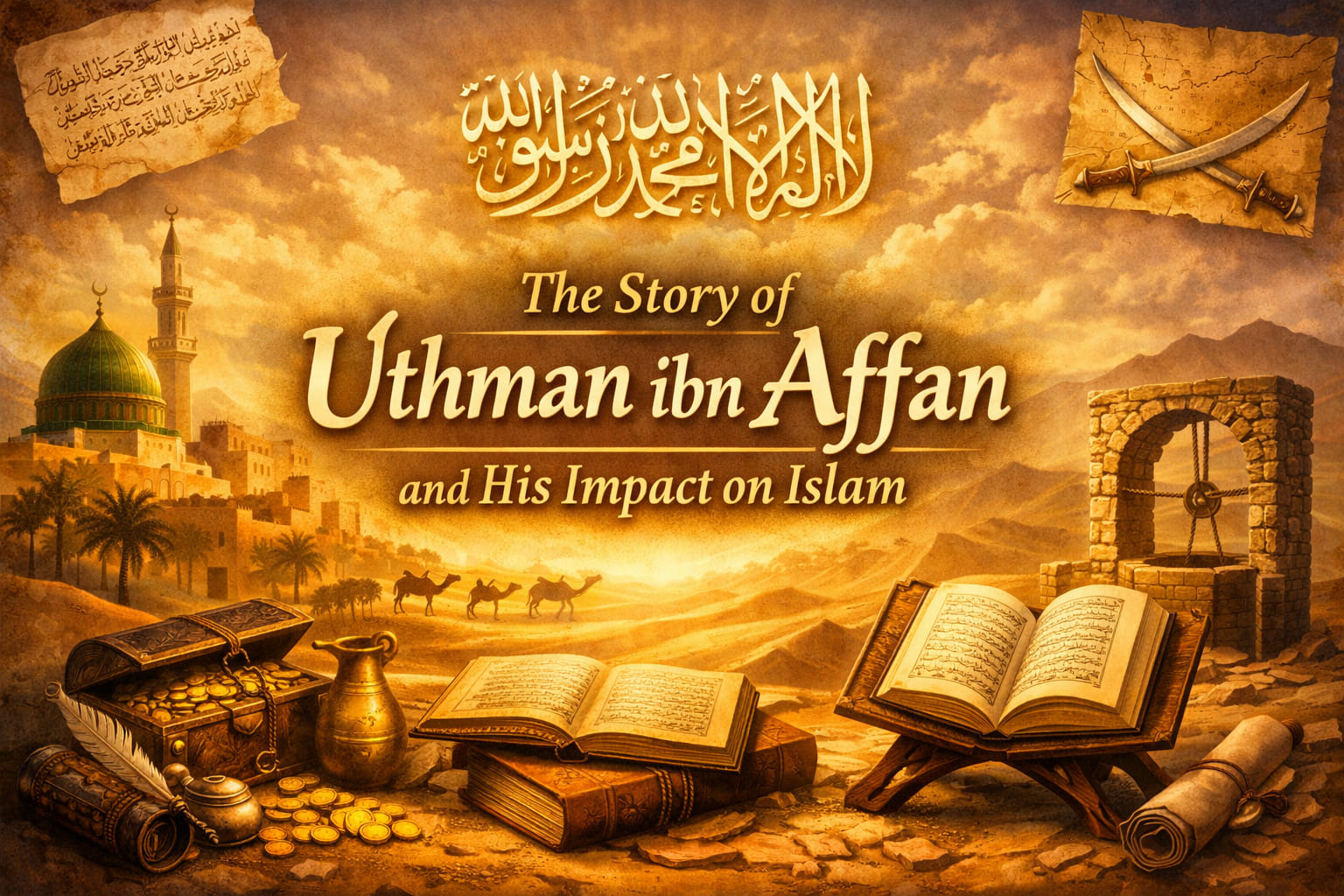
 The Story of Uthman ibn Affan: The Third Rightly Guided Caliph
The Story of Uthman ibn Affan and His Impact on Islam
The story of Uthman ibn Affan is one of the greatest stories in Islamic history. He played a major role in supporting Islam and strengthening the mission of Muhammad from its earliest days. Uthman combined deep faith, noble character, and great generosity, sacrificing his wealth and comfort for the sake of Islam. Because of this, he became one of the most respected companions of the Prophet and later one of the Rightly Guided Caliphs.
In this article, we explore the life of Uthman ibn Affan and his profound impact on Islam during the lifetime of the Prophet Muhammad and after his death.
His Background and Life Before Islam
Uthman ibn Affan was born in Mecca about six years after the Year of the Elephant. He belonged to the powerful Umayyad clan of the Quraysh tribe, one of the most influential families in Mecca.
Before accepting Islam, Uthman was already known for his excellent character. He was a successful merchant and among the wealthy people of Mecca. Despite living in a society filled with idolatry and immoral practices, Uthman was known for his honesty, modesty, and generosity.
He reportedly never worshiped idols and avoided many of the immoral customs of the pre-Islamic period. These qualities prepared his heart to accept the message of Islam when it appeared.
His Early Acceptance of Islam
Uthman ibn Affan was among the earliest people to accept Islam. He embraced the new faith through the invitation of the noble companion Abu Bakr al-Siddiq.
At that time, Islam was still in its early secret stage, and Muslims were few in number. Accepting Islam meant facing hostility, persecution, and social rejection. Yet Uthman did not hesitate when he heard the message of the Prophet Muhammad ﷺ.
His early conversion placed him among the first believers in Islam, showing the sincerity of his faith and his willingness to support the Prophet’s mission from the beginning.
His Patience in the Face of Persecution
Like many early Muslims, Uthman faced persecution from his own people after accepting Islam. His uncle reportedly tied him up and tried to force him to abandon the new religion.
But Uthman remained firm in his faith and declared that he would never leave Islam.
This patience and steadfastness during the difficult early years of Islam demonstrate the strength of his belief and his commitment to the truth.
. ﷺ Marriage to the Daughter of the Prophet Muhammad
One of the greatest honors granted to Uthman ibn Affan was his marriage to the daughter of the Prophet.
He first married Ruqayyah bint Muhammad. Together they migrated to Abyssinia when persecution against Muslims intensified in Mecca.
After Ruqayyah passed away, the Prophet ﷺ married him to his second daughter Umm Kulthum bint Muhammad.
Because of this unique honor, Uthman became known as “Dhul-Nurayn” (The Possessor of Two Lights), since he married two daughters of the Prophet. No other person in Islamic history received this distinction.
His Migration for the Sake of Faith
Uthman participated in two major migrations for the sake of Islam:
-
The migration to Abyssinia (Ethiopia)
-
The migration to Medina
Migration at that time meant leaving behind family, wealth, and homeland in order to preserve one’s faith. Uthman willingly made these sacrifices, demonstrating his devotion to Islam and his loyalty to the Prophet.
His Generosity in Supporting Islam
Uthman ibn Affan was one of the wealthiest companions, but he used his wealth generously in the service of Islam.
The Purchase of the Well of Rumah
In Medina there was a well owned by a Jewish man who sold water to Muslims at a high price. The Prophet said:
“Whoever buys the Well of Rumah and makes it available for the Muslims will have Paradise.”
Uthman purchased the well and made it free for all Muslims, turning it into a charitable endowment.
Supporting the Army of Hardship
During the preparation for the expedition known as Battle of Tabuk, the Muslim community faced severe financial difficulty.
Uthman donated a large number of camels and a great amount of gold to equip the army. His contribution was so significant that the Prophet ﷺ said:
“Nothing will harm Uthman after what he has done today.”
This statement highlights the immense reward and honor given to Uthman for his generosity.
His Extraordinary Modesty
Uthman ibn Affan was famous for his modesty and humility. His shyness was so remarkable that the Prophet ﷺ once said:
“Should I not be shy before a man whom even the angels are shy before?”
This quality made him beloved among the companions and respected by everyone around him.
His Role in Preserving the Quran
One of Uthman’s greatest achievements came later during his leadership as caliph.
As Islam spread to many regions, differences in Quranic recitation began to appear. To protect the unity of the Muslim community, Uthman ibn Affan ordered the compilation of the Quran into a standardized text.
Copies of this official manuscript were sent to various regions of the Muslim world. This text became known as the Uthmanic Mushaf, and it remains the basis of the Quran used by Muslims around the world today.
This act played a crucial role in preserving the Quran exactly as it was revealed.
His Martyrdom
In the later years of his caliphate, political unrest spread within the Muslim community. Some rebels surrounded Uthman’s home in Medina.
Although he had supporters who wanted to defend him, Uthman refused to allow fighting in the city of the Prophet in order to prevent bloodshed.
Eventually he was killed while reading the Quran in his home. He was over eighty years old at the time.
His death was one of the most tragic moments in early Islamic history.
Conclusion
The life of Uthman ibn Affan represents one of the most inspiring examples of faith, generosity, and character in Islamic history.
He was:
-
Among the earliest believers in Islam
-
A close companion and relative of the Prophet
-
One of the greatest supporters of Islam with his wealth
-
A leader who preserved the Quran and protected the unity of the Muslim community
For these reasons, Uthman ibn Affan remains one of the most respected and influential figures in Islamic history, and his legacy continues to inspire Muslims around the world.
You may also enjoy reading the story of Umar ibn Al-Khattab (may Allah be pleased with him).
Join IslamLearn Academy for free and gain authentic Islamic knowledge in a simple and clear way, guided by qualified scholars.
Related Posts
2 September 2026
Is Islam a Continuation of Christianity?
Is Islam a Continuation of Christianity or a Correction of It? Introduction When Islam emerged...
 Read More
30 August 2026
Jesus in Islam and Christianity: Key Differences
Who Is Jesus in Islam and Christianity? A Comparative Reading of the Qur’an and the...
Read More
Search
Categories
Tags
Recent Posts

Is Islam a Continuation of Christianity?
Is Islam a Continuation of...
Jesus in Islam and Christianity: Key Differences
Who Is Jesus in Islam...
How Was the Quran Preserved Before Printing? Complete Guide
How Was the Quran Preserved...
The Story of Uthman ibn Affan: The Third Rightly Guided Caliph
The Story of Uthman ibn...
How to Become a Muslim: A Complete Step-by-Step Guide
How to Convert to Islam:...