30 August 2026
 Jesus in Islam and Christianity: Key Differences
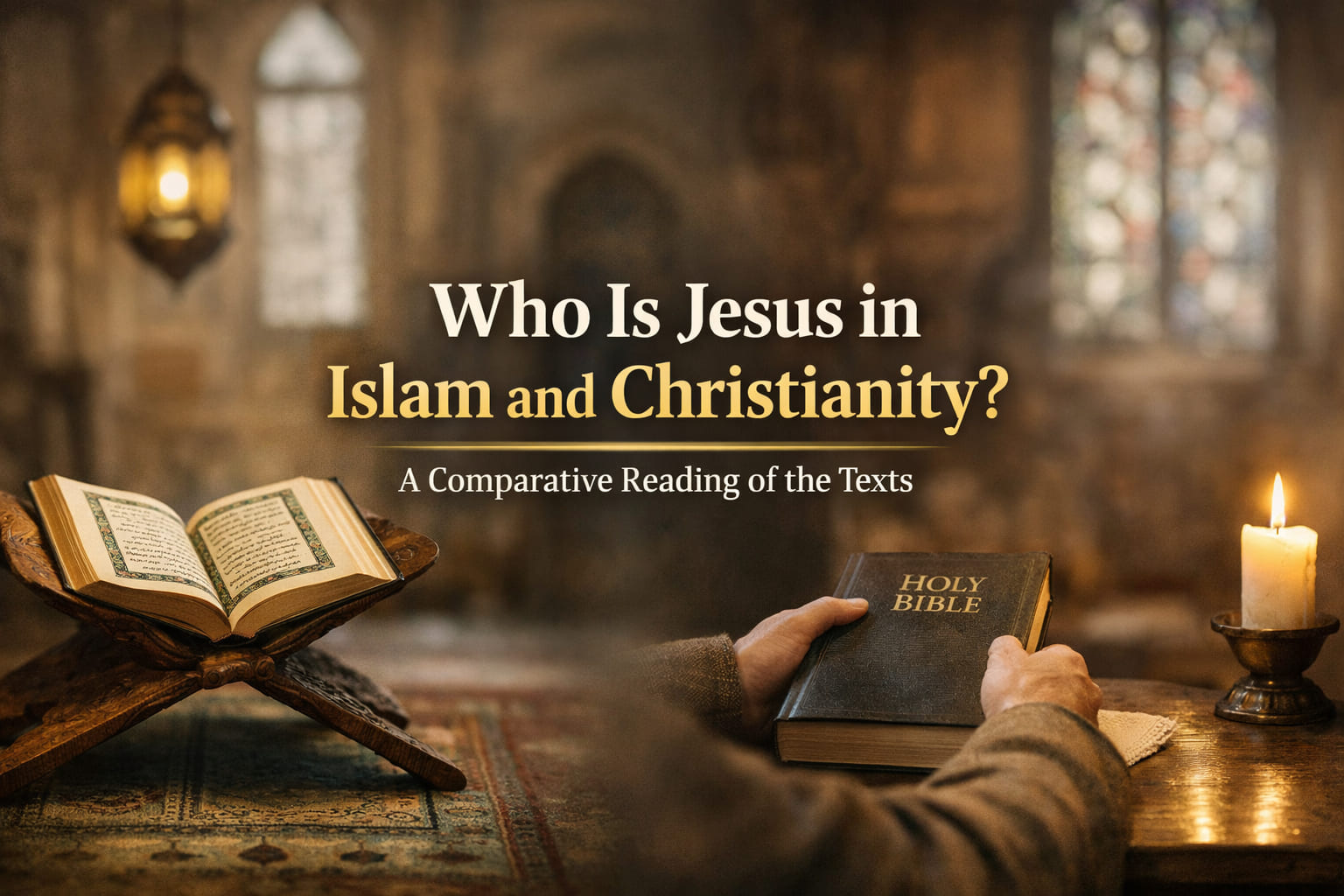
Who Is Jesus in Islam and Christianity? A Comparative Reading of the Qur’an and the Bible
Introduction
Jesus (peace be upon him), known as Jesus Christ in Christianity, is one of the greatest religious figures in history. Both Muslims and Christians believe in him and accord him a great status, yet they differ fundamentally concerning his true identity, nature, and message.
Islam teaches that Jesus the Messiah is a servant and messenger of God, one of His greatest prophets, the Messiah sent to the Children of Israel, miraculously born to the Virgin Mary without a father, and supported by God with great miracles.
Mainstream Christian doctrine teaches that Jesus Christ is the Son of God, and connects him with the doctrines of the Incarnation and the Trinity; his crucifixion and resurrection are central to the Christian doctrine of salvation.
This raises several important questions:
Who truly was Jesus? Was he a prophet and messenger, or God incarnate? What did Jesus say about himself and about God? Do his miraculous birth and miracles prove his divinity? And how does Islam view the crucifixion and atonement?
In this article, we present the Islamic and Christian views of Jesus Christ, compare selected Qur’anic and Biblical texts, and examine the main areas of agreement and disagreement between the two perspectives.
First: Who Is Jesus (Peace Be Upon Him) in Islam?
Jesus, son of Mary (peace be upon him), holds a great position in Islam. Belief in him is not optional for a Muslim; it is part of belief in God’s messengers.
God Almighty says:
“Say, ‘We believe in Allah and what has been revealed to us; and what was revealed to Abraham, Ishmael, Isaac, Jacob, and his descendants; and what was given to Moses, Jesus, and other prophets from their Lord.’”
[Qur’an 2:136]
The Qur’an describes Jesus as:
- the Messiah, Jesus son of
- a servant of God and messenger
- among His messengers.
- a Word conveyed by God
- to Mary.
- a spirit from Him—that is, a spirit
- created by God and specially honored.
- one of the messengers
- of firm resolve.
- born without a father.
- supported with
- great miracles by God’s permission.
- he called people to
- worship God alone.
- he was not killed or crucified
- according to the Qur’an; rather, God raised him to Himself.
- he will have an important role
- at the end of time, as stated in the Prophetic Sunnah.
قال تعالى:
“The Messiah, Jesus son of Mary, was only a messenger of Allah, and His Word which He conveyed to Mary, and a spirit from Him.”
[Qur’an 4:171]
Thus, the Qur’an combines honoring Jesus with rejecting his deification.
Second: The Virgin Mary and the Miraculous Birth of Jesus
Islam greatly honors Mary (peace be upon her), and an entire chapter of the Qur’an is named Surah Maryam (Mary).
قال تعالى:
“And [mention] when the angels said, ‘O Mary, indeed Allah has chosen you, purified you, and chosen you above the women of the worlds.’”
[Qur’an 3:42]
Muslims believe that Mary was a virgin and that Jesus was born to her without a father, through a miracle from God.
قال تعالى:
“She said, ‘My Lord, how can I have a child when no man has touched me?’ He said, ‘So it will be. Allah creates what He wills. When He decrees a matter, He only says to it, “Be,” and it is.’”
[Qur’an 3:47]
Islam, however, does not consider birth without a father to make Jesus God or the Son of God.
The Qur’an gives a clear comparison:
“Indeed, the example of Jesus before Allah is like that of Adam. He created him from dust, then said to him, ‘Be,’ and he was.”
[Qur’an 3:59]
If birth without a father were proof of divinity, Adam would have an even stronger claim, since he was created without either a father or a mother.
But both Adam and Jesus are creations of God, even though the manner of their creation differed.
Third: What Does It Mean That Jesus Is “a Word from God”?
Some may assume that the Qur’an’s description of Jesus as “His Word” means that he is part of God or God Himself.
But the Qur’anic context does not indicate this.
Jesus is a word from God in the sense that he came into existence by God’s command, “Be,” without a father.
Thus, the Qur’an says regarding the creation of Jesus:
“When He decrees a matter, He only says to it, ‘Be,’ and it is.”
[Qur’an 3:47]
The One who says “Be” is God, while the one who comes into existence as a result of that command is the created being.
Fourth: What Does “a Spirit from Him” Mean?
The Qur’an says of Jesus:
“and a spirit from Him.”
[Qur’an 4:171]
In Islamic belief, this does not mean that Jesus is part of God’s essence.
The spirit is created by God, and its attribution to Him here is one of honor and distinction, just as other created things may be attributed to God as a mark of honor.
Therefore, the phrase “a spirit from Him” does not conflict with the same verse describing Jesus as:
“a messenger of Allah.”
Fifth: What Was Jesus’ Message According to Islam?
According to the Qur’an, God sent Jesus to the Children of Israel.
قال تعالى:
“and [make him] a messenger to the Children of Israel.”
[Qur’an 3:49]
The essence of his message was the same as that of all the prophets:
worship God alone.
Jesus says, as quoted in the Qur’an:
“Indeed, Allah is my Lord and your Lord, so worship Him. This is a straight path.”
[Qur’an 3:51]
The Qur’an also says:
“The Messiah said, ‘O Children of Israel, worship Allah, my Lord and your Lord.’”
[Qur’an 5:72]
Thus, according to Islam, Jesus’ message was not a call for people to worship him, but a call to worship the God who sent him.
Sixth: The Miracles of Jesus (Peace Be Upon Him)
Islam affirms great miracles of Jesus, some of the most remarkable miracles associated with the prophets.
قال تعالى:
“I fashion for you from clay the form of a bird, then breathe into it and it becomes a bird by Allah’s permission. I heal the blind and the leper, and I bring the dead to life by Allah’s permission.”
[Qur’an 3:49]
Among his miracles were:
- healing the blind.
- healing the leper.
- bringing the dead to life.
- forming the shape of a bird
- from clay, which then became a bird.
- informing people of some of
- what they ate and stored in their homes.
But one extremely important phrase is repeated when these miracles are mentioned:
“By Allah’s permission.”
The Qur’an makes clear that these miracles were not an independent divine power possessed by Jesus, but signs granted by God to His prophet.
Other prophets were also given great miracles. God parted the sea for Moses (peace be upon him), yet that miracle did not make Moses divine.
Seventh: Jesus in Christian Doctrine
There are many Christian denominations, and they differ on some theological details. However, the major traditional branches of Christianity—such as Catholicism, Orthodoxy, and most Protestant traditions—affirm the divinity of Christ and the doctrine of the Trinity.
According to this doctrine, God is one in essence and three in persons: the Father, the Son, and the Holy Spirit.
Traditional Christianity also teaches the Incarnation: that the Son took on a human nature in the person of Jesus Christ.
Here the fundamental difference with Islam becomes clear.
Islam rejects the idea that God has a son or that any created being shares in His divinity.
قال تعالى:
“Say: He is Allah, One; Allah, the Eternal Refuge. He neither begets nor is born, and there is none comparable to Him.”
[Qur’an 112:1–4]
Eighth: Which Texts Do Christians Cite for the Divinity of Christ?
Christians cite a number of New Testament passages, among the most famous of which are:
“I and the Father are one.”
[John 10:30]
And also:
“Whoever has seen me has seen the Father.”
[John 14:9]
The opening of the Gospel of John is also cited:
“In the beginning was the Word, and the Word was with God, and the Word was God.”
[John 1:1]
Traditional Christianity understands these and other passages as supporting the doctrine of Christ’s divinity.
But Muslim-Christian dialogue does not stop at the existence of these texts; it also asks:
How should they be understood in light of other texts that clearly distinguish between Jesus and God?
Ninth: Biblical Texts That Distinguish Jesus from God
The New Testament contains passages in which Jesus speaks of God as his God, prays to Him, or distinguishes between himself and God.
Among the best-known examples is his statement:
“I am ascending to my Father and your Father, to my God and your God.”
[John 20:17]
In John:
“And this is eternal life: that they know You, the only true God, and Jesus Christ whom You have sent.”
[John 17:3]
In Mark, when asked about the greatest commandment, Jesus said:
“The first of all the commandments is: Hear, O Israel, the Lord our God, the Lord is one.”
[Mark 12:29]
The Gospels also portray Jesus praying to God.
Matthew says:
“He fell on his face and prayed.”
[Matthew 26:39]
Here, the Islamic perspective raises a fundamental question:
If Jesus prayed, to whom was he praying?
Muslims see these passages as naturally consistent with Jesus being a messenger and servant of God.
Christians generally interpret them within the framework of the Incarnation, the distinction between the Father and the Son, and Christ’s divine and human natures.
Tenth: Did Jesus Explicitly Say, “I Am God, Worship Me”?
This is one of the most common questions in Muslim-Christian dialogue.
The four canonical Gospels do not contain a direct, verbatim statement in this exact form:
“I am God; worship me.”
This does not mean that Christians base the divinity of Christ on such a sentence; rather, they appeal to a collection of other passages, actions, and titles that they understand as indicating his divinity.
Muslims, by contrast, argue that a matter of such importance should have been stated with great clarity, especially given the many passages in which Jesus calls people to God, prays to Him, and distinguishes himself from Him.
Eleventh: The Humanity of Jesus in New Testament Texts
The Gospels describe Jesus with many human characteristics.
He:
- was born.
- ate and drank.
- felt hunger.
- felt thirst.
- experienced sorrow.
- called upon God.
Matthew states after his fast:
“He was hungry.”
[Matthew 4:2]
In the Gospel of John, he says:
“I thirst.”
[John 19:28]
Traditional Christianity explains this through the doctrine that Christ is fully divine and fully human.
Islam sees these qualities as directly consistent with Jesus being an honored human being chosen by God for prophethood and messengership.
Twelfth: Was Jesus’ Knowledge Limited?
One notable passage is Jesus’ statement concerning the Hour:
“But of that day and hour no one knows, not even the angels in heaven, nor the Son, but only the Father.”
[Mark 13:32]
Muslims see this passage as evidence of the distinction between God’s perfect knowledge and the knowledge of Christ, to whom God gave whatever knowledge He willed.
Christian theology offers interpretations of this passage within the framework of the Incarnation and Christ’s two natures.
Thirteenth: The Crucifixion in Islam and Christianity
The crucifixion is one of the greatest points of disagreement between the two faiths.
In Christianity
The death of Christ on the cross and his resurrection are central to traditional Christian doctrine and are closely connected to salvation from sin.
In Islam
The Qur’an states that Jesus was neither killed nor crucified:
“And for their saying, ‘We killed the Messiah, Jesus son of Mary, the messenger of Allah.’ But they neither killed nor crucified him—it was only made to appear so to them.”
[Qur’an 4:157]
Then it says:
“Rather, Allah raised him up to Himself.”
[Qur’an 4:158]
Muslims therefore believe that God saved Jesus from being killed and raised him to Himself.
Fourteenth: Sin and Atonement in Islam and Christianity
The issue of the crucifixion is connected to another question:
Does a person need Christ’s sacrifice in order for God to forgive him?
Across broad strands of Christian theology, Christ’s death is connected with salvation, reconciliation, and forgiveness of sins, although Christian traditions differ in how they explain atonement.
Islam, however, establishes the principle of individual responsibility:
“No bearer of burdens will bear the burden of another.”
[Qur’an 6:164]
No person bears the sin of another.
The door of repentance is also open directly between a person and his Lord.
قال تعالى:
“Say, ‘O My servants who have transgressed against themselves, do not despair of Allah’s mercy. Indeed, Allah forgives all sins.’”
[Qur’an 39:53]
In Islam, a person does not need someone else to bear his sin in order to be forgiven. Rather, he repents to God and asks Him for forgiveness.
Fifteenth: Does Calling Jesus the “Son of God” Mean Literal Sonship?
Islamic belief rejects attributing a son to God.
قال تعالى:
“It is not befitting for Allah to take a son. Glory be to Him!”
[Qur’an 19:35]
In comparison, it is important to note that the expression “son of God” appears in the Bible in different contexts and is not, in every instance, used exclusively for Christ.
For this reason, Muslims argue that the mere use of the language of sonship is not by itself sufficient to prove divine sonship in the sense that the person himself is God.
Traditional Christianity, however, distinguishes between figurative uses of sonship and the special theological meaning of Christ as the Son.
Sixteenth: Do Miracles Prove the Divinity of Jesus?
Jesus’ miracles were great, but the question is:
Does everyone who performs a miracle become God?
The logical answer is no.
The Bible itself attributes miracles to other prophets, and the Qur’an likewise recounts miracles of Moses, Abraham, and others.
In the concept of prophethood, a miracle is a sign by which God supports His messenger; it is not necessarily proof that the messenger himself is divine.
For this reason, when speaking about Jesus’ miracles, the Qur’an emphasizes the phrase:
“By Allah’s permission.”
Seventeenth: Does Islam Diminish Jesus?
No.
A Muslim’s faith is not valid if he rejects Jesus or denies his prophethood.
Islam believes in Jesus as:
- a prophet.
- a messenger.
- the Messiah.
- born to the Virgin
- Mary through a miracle.
- supported with miracles.
- one of God’s greatest messengers.
- that God revealed
- the Gospel to him.
- that he called to monotheism.
- that God raised him
- to Himself.
The disagreement between Islam and Christianity is not about whether Jesus should be respected, but about whether Jesus should be worshiped or the God who sent him should be worshiped.
Eighteenth: What Does the Qur’an Say Jesus Will Say on the Day of Judgment?
The Qur’an presents a profound dialogue concerning this issue.
God asks Jesus:
“O Jesus, son of Mary! Did you ever ask the people to worship you and your mother as gods besides Allah?”
He replies:
“Glory be to You! It was not for me to say what I had no right to say.”
Then it says:
“I never told them anything except what You commanded me to say: Worship Allah, my Lord and your Lord.”
[Qur’an 5:116–117]
These verses summarize the Islamic view of Christ’s message:
worship God alone.
Nineteenth: Jesus and Muhammad (Peace Be Upon Them)
Islam does not present Muhammad (peace and blessings be upon him) as a rival to Jesus.
Rather, Muslims believe in all of God’s prophets.
قال تعالى:
“We make no distinction between any of His messengers.”
[Qur’an 2:285]
A Muslim believes in Abraham, Moses, Jesus, Muhammad, and all the other prophets, peace be upon them.
Islam teaches that the foundation of their message was one:
Worship God alone and associate no one with Him.
قال تعالى:
“We never sent a messenger before you without revealing to him: There is no god worthy of worship except Me, so worship Me.”
[Qur’an 21:25]
Twenty-First: Which View Is Closer to Simple Monotheism?
Islamic monotheism is based on a clear principle:
God is One, the Creator of everything. He is not a human being or part of His creation, and He has no need for food, sleep, or any other created need.
قال تعالى:
“Allah—there is no god worthy of worship except Him, the Ever-Living, the Sustainer of all. Neither drowsiness nor sleep overtakes Him.”
[Qur’an 2:255]
And He says:
“There is nothing like Him.”
[Qur’an 42:11]
From this perspective, Islam holds that truly honoring Jesus does not mean elevating him to divinity, but believing in him as God sent him:
an honored prophet, messenger, and Messiah who called humanity to worship their Creator.
Frequently Asked Questions About Jesus in Islam and Christianity
Do Muslims Believe in Jesus Christ?
Yes. Belief in Jesus (peace be upon him) is part of Islamic faith, and a Muslim cannot validly deny Jesus or reject his prophethood.
Do Muslims Believe in the Virgin Birth of Jesus?
Yes. Muslims believe that Mary conceived Jesus without being touched by a man and that his birth was a miracle from God.
Is Jesus the Messiah in Islam?
Yes. The Qur’an explicitly calls him the Messiah, Jesus son of Mary.
Does Islam Consider Jesus the Son of God?
No. Islam declares God far above having offspring and regards Jesus as God’s servant and honored messenger.
Why Is Jesus Called “a Word from God” in the Qur’an?
Because he was created by God’s command and word: God commanded him to exist, and he came into being. This does not mean that Jesus is part of God’s essence.
What Does It Mean That Jesus Is “a Spirit from God”?
It means a spirit created by God and attributed to Him as an honor; it does not mean that Jesus is part of God.
Did Jesus Perform Miracles According to Islam?
Yes. His miracles included healing the blind and the leper and bringing the dead to life, but the Qur’an emphasizes that they occurred by God’s permission.
Does Islam Believe in the Trinity?
No. Islam affirms the absolute oneness of God and rejects dividing divinity into persons.
قال تعالى:
“Do not say, ‘Three.’ Stop—it is better for you. Allah is only One God.”
[Qur’an 4:171]
Do Muslims Believe Jesus Was Crucified?
No. The Qur’an states that Jesus was neither killed nor crucified and that God raised him to Himself.
Do Muslims Believe Jesus Will Return?
Yes. Prophetic hadiths state that Jesus, son of Mary, will descend near the end of time.
Do Muslims Hate Jesus?
No. Muslims are required to believe in Jesus, respect him, and love him as a prophet and messenger from God.
Does Mary Have a Special Status in Islam?
Yes. Mary (peace be upon her) is among the greatest women. The Qur’an mentions her by name, and an entire chapter is named after her.
What Is the Main Difference Between Jesus in Islam and Christianity?
The main difference concerns his nature and status: Islam regards him as the Messiah, a prophet, messenger, and servant of God, while traditional Christianity affirms his divinity and incarnation.
Why Don’t Muslims Consider Jesus’ Fatherless Birth Proof of His Divinity?
Because God is able to create in different ways. Adam was created without a father or mother, Jesus was created from a mother without a father, and other human beings are created from a father and mother. Different modes of creation demonstrate the Creator’s power, not the divinity of the created being.
If Jesus Is Not God, Why Were His Miracles So Great?
Because in Islam, miracles are signs God grants to His prophets to confirm the truth of their message. God also granted great miracles to other prophets.
Can a Person Repent Directly to God in Islam?
Yes. A person does not need an intermediary between himself and God in order to repent. Whoever sincerely repents, believes, and does righteous deeds may receive God’s forgiveness.
Conclusion
Jesus Christ (peace be upon him) is a figure who brings Muslims and Christians together in many respects, yet he also represents one of the most important doctrinal differences between them.
Both recognize his exceptional status, his miraculous birth, and the Virgin Mary, but they differ fundamentally in how they understand his true identity.
Traditional Christianity sees Christ as more than a prophet and messenger and connects him with the doctrines of the Trinity, Incarnation, crucifixion, and salvation.
Islam presents a different understanding:
Jesus is the Messiah, the servant and messenger of God. He was miraculously born, supported by God with signs, and called people to worship God alone.
From here, the Qur’an calls the People of the Book to a common foundation:
﴿قُلْ يَا أَهْلَ الْكِتَابِ تَعَالَوْا إِلَى كَلِمَةٍ سَوَاءٍ بَيْنَنَا وَبَيْنَكُمْ أَلَّا نَعْبُدَ إِلَّا اللَّهَ وَلَا نُشْرِكَ بِهِ شَيْئًا﴾
[Qur’an 3:64]
The question this comparison leaves for the reader seeking the truth is:
How did Jesus himself describe his relationship with God, and whom did he call people to worship?
Islam does not call people to reject Christ, but to believe in him and honor him as all of God’s prophets are honored, without attributing to him any of the unique qualities of the Creator.
In Islam, Jesus is neither a rival to God nor a part of Him. Rather, he is a great messenger sent by God to call people to worship the One God.
Join IslamLearn Academy for free and gain authentic Islamic knowledge in a simple and clear way, guided by qualified scholars.
Related Posts
2 September 2026
Is Islam a Continuation of Christianity?
Is Islam a Continuation of Christianity or a Correction of It? Introduction When Islam emerged...
 Read More
29 July 2026
How Was the Quran Preserved Before Printing? Complete Guide
How Was the Quran Preserved Before Printing? The Complete Story of How the Quran Was...
Read More
Search
Categories
Tags
Recent Posts
Is Islam a Continuation of Christianity?
Is Islam a Continuation of...
Jesus in Islam and Christianity: Key Differences
Who Is Jesus in Islam...
How Was the Quran Preserved Before Printing? Complete Guide
How Was the Quran Preserved...
The Story of Uthman ibn Affan: The Third Rightly Guided Caliph
The Story of Uthman ibn...
How to Become a Muslim: A Complete Step-by-Step Guide
How to Convert to Islam:...