7 June 2026
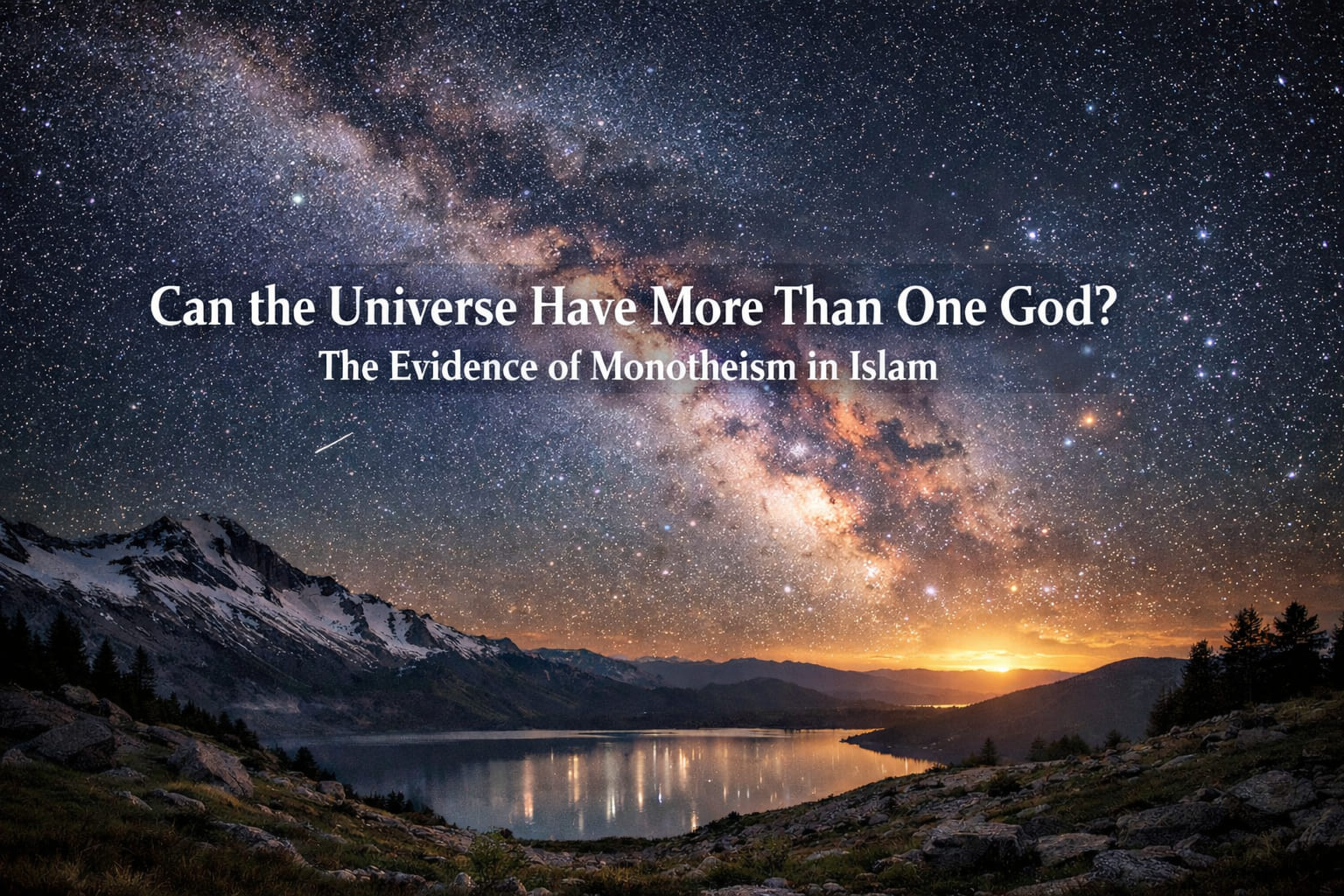
 Can the Universe Have More Than One God?
Can the Universe Have More Than One God?
Evidence for Monotheism in Islam
Since the beginning of human history, people have wondered about the origin of the universe and who controls it. As human thought developed, different ideas about God and creation appeared. Some believed in many gods, while others believed in one God who created and governs everything.
Islam presents a clear and coherent view based on monotheism (Tawhid)—the belief that God is One, with no partner in creation, control, or worship.
A common question asked by many seekers of truth is:
Can the universe have more than one God?
This is not only a religious question; it is also a philosophical and rational question that can be examined through logic and observation of the universe. When we reflect on this issue objectively, we find that the concept of one God is the most logical and consistent explanation.
In this article, we will explore this question through three main perspectives:
-
Logical reasoning
-
The order of the universe
-
Evidence from the Qur’an
First: The Logical Argument Against Multiple Gods
Human reason can analyze the idea of multiple gods logically. Let us suppose—only for the sake of argument—that there are several gods managing the universe.
In this case, a few possibilities arise.
Possibility 1: Their Wills Are Always Identical
One might say that several gods exist but they always agree with each other.
However, this raises an important question:
If their wills are always identical and they never disagree, then why would multiple gods be necessary?
In such a case, one God would be sufficient to govern the universe. The presence of multiple gods would add no additional function or benefit, making the idea unnecessary and logically weak.
Possibility 2: Their Wills Differ
If each god has an independent will, disagreement becomes possible.
In that case, three outcomes may occur:
1. One God’s Will Prevails While the Other Fails
This means the one whose will fails is weak or incapable.
A weak being cannot be a true god.
2. Both Gods Fail to Carry Out Their Will
In this case, neither would truly be a god.
3. Both Wills Are Carried Out Simultaneously Despite Contradiction
This would lead to conflict and disorder in the universe.
For example, if one god wanted a planet to move in one direction while another wanted it to move in the opposite direction, what would happen?
Either one will defeats the other, or chaos occurs.
Logical Conclusion
The existence of more than one independent god is logically impossible.
Second: The Evidence of Order in the Universe
One of the strongest signs of the oneness of the Creator is the remarkable order we observe in the universe.
The universe is not chaotic; it operates according to precise and stable laws.
Consider the Following Examples:
-
The Earth revolves around the Sun at a precise speed.
-
Planets move in carefully calculated orbits.
-
The laws of physics remain consistent throughout the universe.
-
The delicate balance of nature allows life to exist on Earth.
This extraordinary harmony indicates unity in management and control.
Complex and well-organized systems usually result from a single coordinated authority.
If the universe were governed by several independent gods, we would expect to see signs of their differences, such as:
-
Different physical laws in different parts of the universe.
-
Instability in cosmic systems.
-
Disorder in the movement of celestial bodies.
But what we observe is the exact opposite.
The universe functions as a unified and coherent system, suggesting that its controller is One.
Many scientists and philosophers have pointed out that the unity of natural laws throughout the cosmos strongly suggests a single source behind them.
Third: Qur’anic Evidence for the Oneness of God
Islam confirms this truth through clear statements in the Qur’an.
The Qur’an not only calls people to believe in one God but also presents powerful rational arguments.
Allah Says:
“Had there been within them (the heavens and the earth) gods besides Allah, they both would have been ruined.”
(Qur’an 21:22)
This verse presents a profound yet simple argument:
If multiple gods controlled the heavens and the earth, their conflicting wills would have led to corruption and disorder.
Another Verse States:
“Allah has not taken a son, nor has there ever been with Him any deity. If there had been, each god would have taken what he created, and some would have tried to dominate others.”
(Qur’an 23:91)
This verse explains that multiple gods would lead to division and competition, with each trying to control what he created.
However, the universe we observe is not divided into competing realms.
Instead, it is a unified system governed by consistent laws, which indicates that its Creator is One.
Fourth: The Message of the Prophets
Another important point is that all prophets throughout history called people to the same core belief:
Worship one God alone.
Among them were:
-
Prophet Noah (Nuh)
-
Prophet Abraham (Ibrahim)
-
Prophet Moses (Musa)
-
Prophet Jesus (Isa)
-
Prophet Muhammad (peace be upon them all)
Each of them called their people to abandon false gods and worship the One True God.
This shows that monotheism is not a new idea introduced by Islam but rather the central message of all divine revelations.
Islam summarizes this belief in a simple yet profound statement:
“There is no god but Allah.”
This means that no being deserves worship except the one true Creator who governs the entire universe.
Fifth: The Simplicity of the Islamic Concept of God
One of the unique features of Islam is that its concept of God is clear, simple, and free from philosophical complications.
In Islam, God is:
-
The Creator of the entire universe.
-
The sole ruler and sustainer of all existence.
-
Unlike anything in creation.
-
Directly accessible to every human being without intermediaries.
The Qur’an beautifully summarizes the nature of God in Surah Al-Ikhlas:
“Say: He is Allah, the One.
Allah, the Eternal Refuge.
He neither begets nor is born.
And there is none comparable to Him.”
(Qur’an 112:1–4)
This short chapter provides one of the clearest descriptions of pure monotheism.
Conclusion
When we examine the question of multiple gods through reason, observation of the universe, and divine revelation, we arrive at the same conclusion:
-
Reason shows that multiple gods would lead to contradiction and weakness.
-
The precise order of the universe points to a single controlling authority.
-
The Qur’an clearly affirms that God is One with no partner.
Therefore, monotheism in Islam is not merely a religious belief but also a concept that aligns with logic, human nature, and the observable order of the universe.
Islam invites humanity to worship the One Creator—the One who designed the universe with wisdom and governs it with perfect knowledge.
For this reason, belief in one God is not only the foundation of Islamic faith but also the most logical explanation for the existence of this vast and beautifully ordered universe.
Join IslamLearn Academy for free and gain authentic Islamic knowledge in a simple and clear way, guided by qualified scholars.
Related Posts
2 September 2026
Is Islam a Continuation of Christianity?
Is Islam a Continuation of Christianity or a Correction of It? Introduction When Islam emerged...
 Read More
30 August 2026
Jesus in Islam and Christianity: Key Differences
Who Is Jesus in Islam and Christianity? A Comparative Reading of the Qur’an and the...
Read More
Search
Categories
Tags
Recent Posts
Is Islam a Continuation of Christianity?
Is Islam a Continuation of...
Jesus in Islam and Christianity: Key Differences
Who Is Jesus in Islam...
How Was the Quran Preserved Before Printing? Complete Guide
How Was the Quran Preserved...

The Story of Uthman ibn Affan: The Third Rightly Guided Caliph
The Story of Uthman ibn...
How to Become a Muslim: A Complete Step-by-Step Guide
How to Convert to Islam:...