20 July 2026
 What Does the Quran Talk About? Discover Its Main Themes
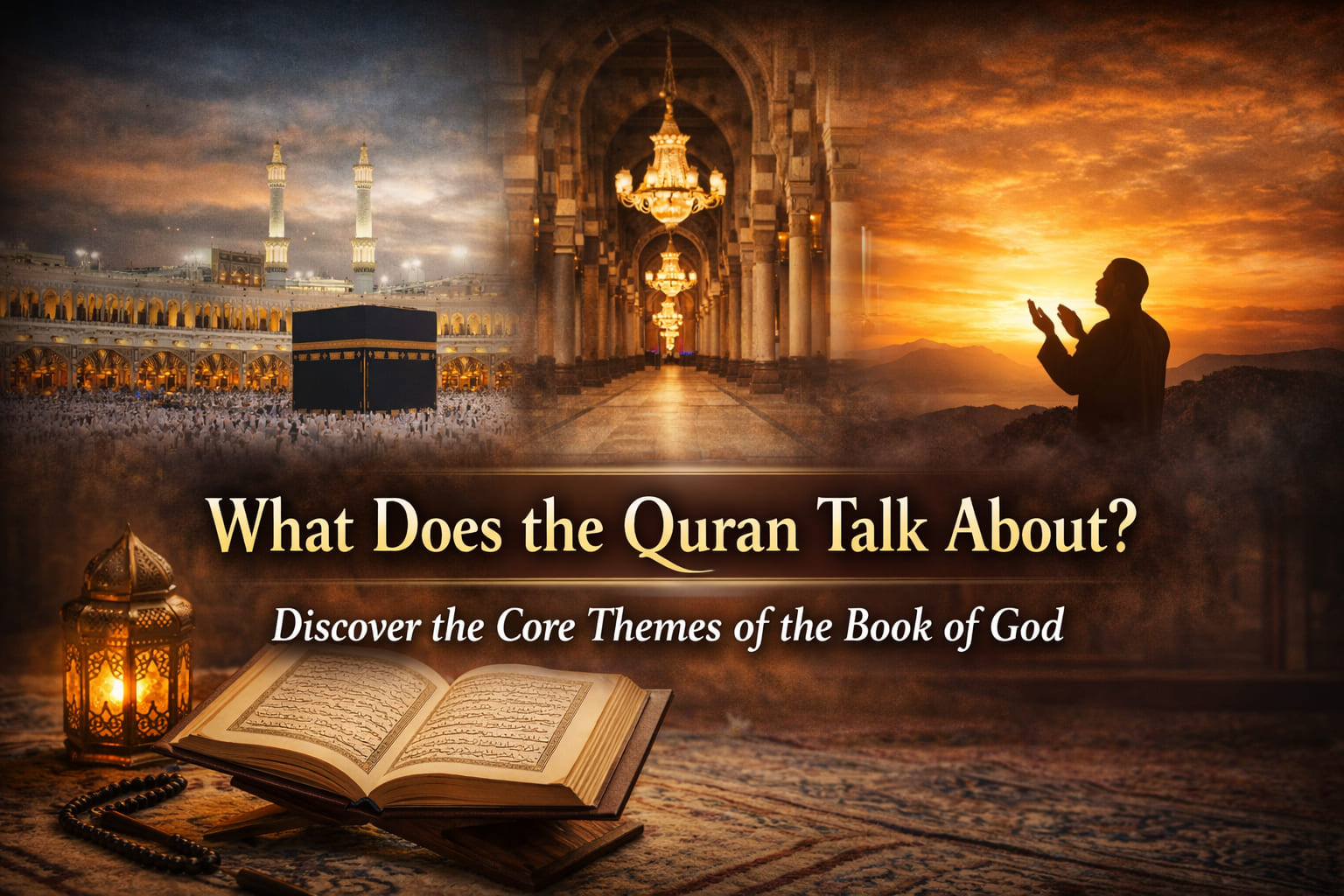
What Does the Quran Talk About? Discover the Core Themes of the Book of God
Many people ask a fundamental question: What does the Quran actually talk about? Is it only a book of worship? A book of morality? Or a collection of historical stories?
In reality, the Quran goes far beyond all these categories. It is not a book limited to a single subject; rather, it is a comprehensive message that addresses every aspect of human life.
The Quran does not merely provide information—it offers a complete vision of existence, reshaping how understands himself, his place in the universe, and his ultimate destiny. In this article, we explore the central themes of the Quran to understand why it has remained a source of guidance throughout history.
First: Knowing God…The Foundation of Everything
The greatest subject of the Quran is God Himself, because everything in human life begins with knowing the Creator.
The Quran introduces God through:
-
His beautiful names
-
His perfect attributes
-
His actions in the universe
Allah says:
“Allah—there is no deity except Him, the Ever-Living, the Sustainer of existence.” (Quran 2:255)
And:
“He is Allah, other than whom there is no deity, Knower of the unseen and the witnessed.” (Quran 59:22)
The Quran presents a clear and profound understanding of God based on absolute perfection.
Second: The Purpose of Human Existence… Why Do We Live?
One of the central themes of the Quran is answering the question that has puzzled humanity: Why are we here?
Allah says:
“And I did not create the jinn and mankind except to worship Me.” (Quran 51:56)
Worship here is not limited to rituals. It includes:
-
Living in obedience to God
-
Acting according to moral values
-
Contributing positively to the world
The Quran also emphasizes accountability:
“And stop them; indeed, they are to be questioned.” (Quran 37:24)
Third: This World… A Test, Not a Permanent Home
The Quran redefines how we view this life. It teaches that this world is temporary, not the final destination.
Allah says:
“And the worldly life is nothing but amusement and diversion.” (Quran 6:32)
This does not mean life has no value, but that:
-
It is a means, not an end
-
True success lies beyond this life
Fourth: The Hereafter… The Ultimate Reality
One of the most emphasized themes in the Quran is the life after death.
It describes:
-
Death
-
Resurrection
-
Judgment
-
Paradise and Hell
Allah says:
“Every soul will taste death.” (Quran 3:185)
And:
“Indeed, the righteous will be in bliss, and indeed, the wicked will be in Hellfire.” (Quran 82:13–14)
This constant reminder shapes human responsibility and awareness.
Fifth: The Human Being… Honored Yet Tested
The Quran presents a balanced view of the human being.
He is honored:
“And We have certainly honored the children of Adam.” (Quran 17:70)
Yet also weak:
“And man was created weak.” (Quran 4:28)
Human beings live between:
-
Reason and desire
-
Guidance and misguidance
Sixth: Guidance and Misguidance… Two Paths
The Quran makes it clear that humans have a choice.
Allah says:
“Indeed, We guided him to the way, whether he be grateful or ungrateful.” (Quran 76:3)
The Quran itself is guidance:
“This is a clear statement for mankind and guidance and instruction for those conscious of Allah.” (Quran 3:138)
Seventh: Divine Laws in Life
The Quran highlights consistent laws governing life and societies.
For example:
-
Injustice leads to destruction
-
Patience leads to success
-
Corruption leads to downfall
Allah says:
“Indeed, Allah will not change the condition of a people until they change what is in themselves.” (Quran 13:11)
Eighth: Stories… Lessons from Human Experience
The Quran contains stories not for entertainment, but for guidance.
Allah says:
“There was certainly in their stories a lesson for those of understanding.” (Quran 12:111)
These stories teach:
-
How truth prevails
-
How patience leads to success
-
How injustice leads to failure
Ninth: Morality… The Foundation of Character
The Quran connects faith with moral conduct.
Allah says:
“Indeed, Allah loves those who do good.” (Quran 2:195)
It emphasizes:
-
Honesty
-
Trustworthiness
-
Justice
-
Compassion
And warns against:
-
Injustice
-
Lying
-
Corruption
Tenth: Knowledge and Reflection… The Path to True Faith
The Quran does not call for blind belief—it calls for thinking.
Allah says:
“Do they not reflect upon the Quran?” (Quran 4:82)
And:
“Indeed, in that are signs for people who reflect.” (Quran 13:3)
It addresses both the mind and the heart.
Conclusion: The Quran… A Book That Transforms Your View of Life
From all of this, it becomes clear that the Quran is not limited to one topic. It provides a complete framework:
-
About God
-
About humanity
-
About life
-
About destiny
It answers the deepest questions and reshapes human priorities.
Reading the Quran deeply is not just an act of worship—it is a journey to discover truth.
👉 The Quran is not just a book to be read…
It is a book to be understood… lived… and applied.
Frequently Asked Questions (FAQ)
1. Is the Quran only a religious book?
No. While the Quran is the holy book of Islam, it is much more than a guide for worship. It discusses faith, morality, history, law, family, economics, justice, human psychology, and the purpose of life. It provides principles that help people build a balanced and meaningful life while preparing for the Hereafter.
2. Does the Quran contain scientific information?
The Quran is not a science textbook, but it encourages people to observe the natural world and reflect on its signs. Throughout the Quran, readers are invited to think about the heavens, the earth, the oceans, plants, animals, and the human body as evidence of God’s wisdom and power. Its primary purpose is guidance, not scientific explanation.
3. Why are there so many stories in the Quran?
The stories in the Quran are meant to teach lessons rather than simply recount history. They show how previous nations responded to God’s guidance, the consequences of justice and injustice, and the importance of faith, patience, and perseverance. Every story is intended to provide practical guidance for people’s lives.
4. Does the Quran only address Muslims?
No. The Quran repeatedly addresses all humanity, inviting every person to reflect on the purpose of life and the existence of God. While it provides specific guidance for Muslims, many of its teachings—such as honesty, justice, mercy, and respect for others—are universal values relevant to everyone.
5. What is the main message of the Quran?
The central message of the Quran is the worship of the One God (Allah) without partners. It teaches people to know their Creator, live righteous lives, prepare for the Day of Judgment, and build societies based on justice, compassion, and moral responsibility.
6. Why does the Quran frequently mention the Hereafter?
The Quran emphasizes the Hereafter because belief in accountability influences human behavior. Knowing that every action will be judged encourages honesty, responsibility, patience, and kindness. It reminds people that this temporary life is only one stage before eternal life.
7. How should someone begin reading the Quran?
A beginner should read the Quran with an open mind and a sincere desire to understand its message. Reading a reliable translation alongside explanations of difficult verses can help. It is also beneficial to reflect on the meanings rather than rushing through the text, because the Quran repeatedly encourages thoughtful reflection.
8. What makes the Quran different from other books?
Unlike ordinary books that focus on a single topic, the Quran combines theology, morality, law, history, wisdom, spiritual guidance, and practical advice within one unified message. Muslims believe it is the direct word of God, preserved without alteration since its revelation over 1,400 years ago, making it unique among religious scriptures.
Join IslamLearn Academy for free and gain authentic Islamic knowledge in a simple and clear way, guided by qualified scholars.
Subscribe now to IslamLearn Academy for free
Related Posts
2 September 2026
Is Islam a Continuation of Christianity?
Is Islam a Continuation of Christianity or a Correction of It? Introduction When Islam emerged...
 Read More
30 August 2026
Jesus in Islam and Christianity: Key Differences
Who Is Jesus in Islam and Christianity? A Comparative Reading of the Qur’an and the...
Read More
Search
Categories
Tags
Recent Posts
Is Islam a Continuation of Christianity?
Is Islam a Continuation of...
Jesus in Islam and Christianity: Key Differences
Who Is Jesus in Islam...
How Was the Quran Preserved Before Printing? Complete Guide
How Was the Quran Preserved...
The Story of Uthman ibn Affan: The Third Rightly Guided Caliph
The Story of Uthman ibn...
How to Become a Muslim: A Complete Step-by-Step Guide
How to Convert to Islam:...