21 July 2026
 The Story of Moses in Islam: Lessons of Faith and Justice
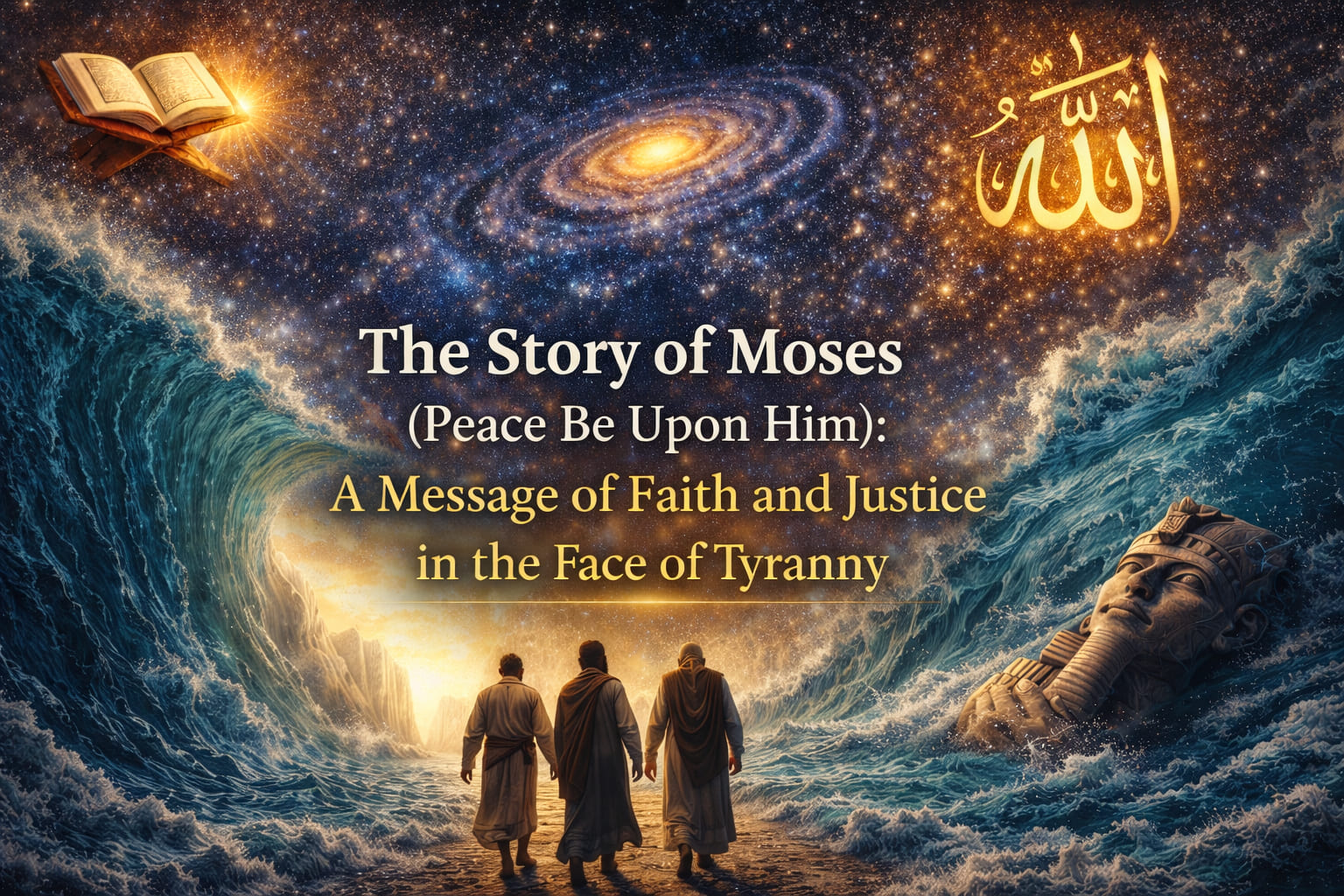
The Story of Moses (Peace Be Upon Him): A Message of Faith and Justice in the Face of Tyranny
The story of Prophet Moses (Musa), peace be upon him, is one of the greatest narratives mentioned in the Qur’an. It is also the story most frequently repeated in the Qur’an compared to other prophetic stories. This repetition is not merely for historical narration; rather, it is because the story of Moses carries profound lessons about faith, justice, the struggle between truth and falsehood, and the ultimate victory of God’s guidance over tyranny.
Reflecting on this story reveals how God directs the course of history with wisdom and how truth ultimately prevails even when falsehood appears powerful.
The Beginning: A Birth in a Time of Fear
The story of Moses began during a time when Pharaoh ruled Egypt with extreme oppression and tyranny. Pharaoh claimed divinity and enslaved the Children of Israel. His tyranny became so severe that he ordered the killing of newborn boys among them, fearing that one of them would eventually threaten his rule.
The Qur’an describes this situation:
“Indeed, Pharaoh exalted himself in the land and divided its people into factions, oppressing a group among them, slaughtering their sons and keeping their women alive.”
(Qur’an 28:4)
In this atmosphere of fear and oppression, Moses was born. Yet from the very beginning, God was planning his protection and destiny. God inspired the mother of Moses to nurse her child, and when she feared for his life, to place him in a chest and cast it into the river.
God says in the Qur’an:
“And We inspired the mother of Moses: ‘Nurse him, but when you fear for him, cast him into the river and do not fear or grieve.’”
(Qur’an 28:7)
From a human perspective, this command seems extraordinary. How could a mother place her child into a river? Yet faith in God’s promise gave her the courage to trust Him. This moment teaches one of the greatest lessons of the story: God’s plan is greater than human plans.
Moses Raised in Pharaoh’s Palace
In a remarkable turn of events, the chest carrying baby Moses floated to Pharaoh’s own palace. The family of Pharaoh found the child, and Pharaoh’s wife felt compassion for him and asked her husband not to kill the infant.
The Qur’an narrates:
“And the wife of Pharaoh said: ‘He will be a comfort of the eye for me and for you. Do not kill him.’”
(Qur’an 28:9)
Thus, Moses was raised in the house of the very ruler who was killing the children of his people. This moment illustrates a profound truth: God can bring safety from the very place a person fears most.
Moreover, God reunited Moses with his mother in a beautiful way. When the baby refused to accept any other nursing woman, his sister guided the palace servants to their own mother without revealing her identity. In this way, Moses returned to his mother’s care.
God says:
“So We restored him to his mother so that her eyes might be comforted and she would not grieve.”
(Qur’an 28:13)
The Beginning of the Mission
After Moses grew up, an incident led him to leave Egypt. He later spent several years in the land of Midian. After those years, while returning to Egypt with his family, he saw a fire near Mount Sinai. When he approached it, God spoke to him and chose him as a prophet.
God said:
“Indeed, I am Allah. There is no deity except Me, so worship Me.”
(Qur’an 20:14)
At that moment, Moses received his great mission: to call Pharaoh to worship the One true God and to abandon tyranny.
Confronting Tyranny
God commanded Moses to go to Pharaoh despite Pharaoh’s immense power and authority.
God said:
“Go to Pharaoh. Indeed, he has transgressed.”
(Qur’an 20:24)
This task was not easy. Pharaoh was a powerful ruler with armies and authority. Yet Moses stood before him courageously and called him to the truth. Moses asked God to support him with his brother Aaron (Harun), and God granted this request.
During their dialogue, Pharaoh arrogantly asked Moses, “Who is your Lord?”
Moses replied:
“Our Lord is the One who gave everything its form and then guided it.”
(Qur’an 20:50)
With this answer, Moses presented a powerful definition of God: the Creator who designed every being and guided it in its purpose.
The Miracles of Moses
God granted Moses great miracles to prove the truth of his message. Among the most famous were the staff that turned into a serpent and the shining white hand.
However, Pharaoh accused Moses of being a magician. He gathered the greatest magicians of the land to challenge Moses in a public gathering.
When the magicians threw their ropes and staffs, they appeared to move like snakes through illusion. Then Moses threw his staff, and it became a real serpent that swallowed what they had produced.
When the magicians saw this, they realized that it was not magic but a true sign from God. Immediately they fell in prostration and declared:
“We believe in the Lord of Moses and Aaron.”
(Qur’an 20:70)
The Great Exodus
After years of calling Pharaoh to the truth and facing rejection, God commanded Moses to lead the Children of Israel out of Egypt.
They left at night, but Pharaoh pursued them with his army. When Moses and his people reached the sea, Pharaoh’s army was close behind them. In fear, the people of Moses said:
“Indeed, we are surely overtaken!”
But Moses answered with complete faith:
“No! Indeed, my Lord is with me; He will guide me.”
(Qur’an 26:62)
God then commanded Moses to strike the sea with his staff. The sea split into two great walls of water, and a dry path appeared between them. Moses and his people crossed safely.
When Pharaoh and his army attempted to follow, the waters returned and drowned them.
The End of Tyranny
At the moment of drowning, Pharaoh declared his belief in God, but it was too late.
God says:
“Now? While you had disobeyed before and were among the corrupters?”
(Qur’an 10:91)
Thus ended the story of one of the greatest tyrants in history, leaving a lesson for all humanity.
Lessons from the Story of Moses
The story of Moses offers many powerful lessons:
-
God supports the oppressed, even when injustice seems overwhelming.
-
Tyranny never lasts forever, no matter how powerful it appears.
-
Faith gives people courage to confront oppression.
- God’s plan surpasses all human plans.
Conclusion
The story of Moses is not merely a historical narrative. It is a timeless message teaching humanity that truth ultimately triumphs and that God never abandons those who believe in Him.
No matter how strong injustice may appear, its end is inevitable. The Qur’an reminds us of this universal truth:
“And the final outcome belongs to the righteous.”
Read Also: The Story of Umar ibn Al-Khattab (may Allah be pleased with him).
Join IslamLearn Academy for free and gain authentic Islamic knowledge in a simple and clear way, guided by qualified scholars.
Related Posts
2 September 2026
Is Islam a Continuation of Christianity?
Is Islam a Continuation of Christianity or a Correction of It? Introduction When Islam emerged...
 Read More
30 August 2026
Jesus in Islam and Christianity: Key Differences
Who Is Jesus in Islam and Christianity? A Comparative Reading of the Qur’an and the...
Read More
Search
Categories
Tags
Recent Posts

Is Islam a Continuation of Christianity?
Is Islam a Continuation of...
Jesus in Islam and Christianity: Key Differences
Who Is Jesus in Islam...
How Was the Quran Preserved Before Printing? Complete Guide
How Was the Quran Preserved...

The Story of Uthman ibn Affan: The Third Rightly Guided Caliph
The Story of Uthman ibn...

How to Become a Muslim: A Complete Step-by-Step Guide
How to Convert to Islam:...