6 May 2026
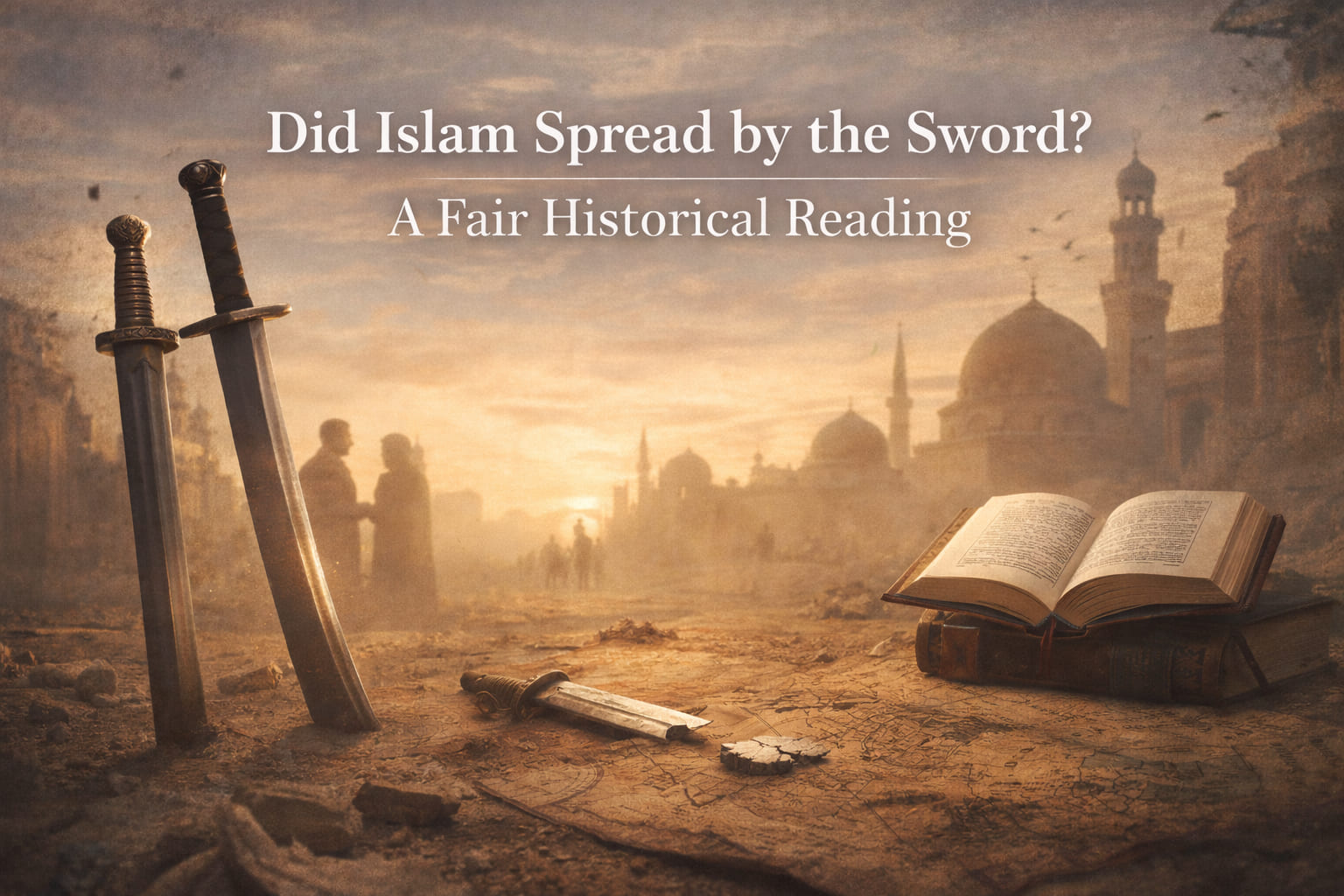
 Did Islam Spread by the Sword? A Fair Historical Reading
Did Islam Spread by the Sword? A Fair Historical Reading
Introduction
One of the most common accusations directed at Islam is the claim that “Islam spread by the sword.”
This statement is frequently repeated in certain books, media outlets, and political discourse, to the point that many non-Muslims accept it as an unquestioned fact—without careful historical examination or objective analysis of events.
But is this claim accurate?
Can a religion truly spread by force and remain alive for centuries in the hearts of hundreds of millions of people?
In this article, we present a fair historical reading based on Islamic texts, historical facts, and testimonies of fair-minded non-Muslim scholars.
First: A Clear Principle in Islam – No Compulsion in Religion
Islam establishes a fundamental and explicit principle that allows no misinterpretation:
“There is no compulsion in religion.”
(Qur’an, Al-Baqarah 2:256)
This verse is not a juristic opinion, but a definitive Qur’anic text affirming that faith cannot be valid if imposed by force, because belief is:
-
An inner conviction
-
A free choice
-
Not something imposed by weapons
So how can a religion that explicitly rejects compulsion be accused of spreading by force?
Second: Distinguishing Between Military Conquests and the Spread of Faith
One of the greatest historical mistakes is confusing between:
-
Islamic military expansions
-
And the spread of Islam as a belief system
The military conquests were:
-
Political and military conflicts with ruling regimes
-
Not wars against populations themselves
As for embracing Islam:
-
It was not compulsory
-
It was not imposed on people
-
As evidenced by the continued presence of followers of other religions for centuries under Islamic rule
Third: A Clear Historical Proof – The Survival of Non-Muslims
If Islam had been imposed by the sword:
-
Christians would not have remained in Syria and Egypt
-
Jews would not have remained in Andalusia and North Africa
-
Hindus would not have remained in India after centuries of Muslim rule
Yet historical reality proves:
-
Churches remained
-
Temples continued to exist
-
Religious practices were preserved with relative freedom compared to other eras
This alone is practical proof that conversion to Islam was not forced.
Fourth: How Did Islam Spread in Regions Without Armies?
One of the strongest proofs against the “sword” accusation is the spread of Islam in regions never reached by Muslim armies, such as:
-
Indonesia
-
Malaysia
-
Large parts of Africa
-
Southeast Asia
Islam reached these regions through:
-
Trade
-
Good character
-
Honesty in dealings
-
Moral example
Today, Indonesia is the largest Muslim country in the world—without ever being conquered militarily.
Fifth: Testimonies of Western Historians
Many fair-minded Western historians rejected the idea that Islam spread by the sword. Among them, Thomas Carlyle, who said:
“The sword indeed, but where will you get your sword? Every new opinion begins without weapons.”
Other historians acknowledged that:
-
The simplicity of Islamic belief
-
The justice of its laws
-
Its harmony with human nature
Were real factors that attracted people to Islam.
Sixth: The Role of Muslim Ethics in the Spread of Islam
Among the most important reasons for the spread of Islam were:
-
Honesty
-
Justice
-
Truthfulness
-
Respect for human dignity
Many peoples testified that Muslim rule was:
-
More merciful than their previous rulers
-
Fairer in taxation
-
Closer to the people
Thus, people entered Islam out of conviction, not fear.
Seventh: What About Wars in Islamic History?
Yes, wars existed in Islamic history—as they did in every civilization.
But the fair question is:
-
Were they fought to force belief?
-
Or for defense and the removal of oppressive regimes?
The reality is:
-
Most wars were defensive
-
Or responses to aggression
-
Or to protect freedom of preaching
Islam strictly forbids the killing of civilians, monks, women, and children—contrary to the image of a “religion of the sword.”
Eighth: Why Did This Accusation Appear in the First Place?
This misconception stems from:
-
Historical conflicts between East and West
-
Biased orientalist writings
-
Contemporary political agendas
-
Actions of extremist groups that do not represent Islam
It is methodologically wrong to hold an entire religion responsible for the actions of deviant groups.
Ninth: A Fair Historical Comparison
When comparing the spread of Islam with that of other religions or ideologies, we find that:
-
Many were imposed by force
-
Or accompanied by religious wars
-
Or involved the destruction of entire cultures
Whereas Islam allowed:
-
Religious pluralism
-
The preservation of identities
-
Peaceful coexistence within the same society
Why Do Many Non-Muslims Embrace Islam Today?
Despite the absence of any power or sword, people continue to embrace Islam today because of:
-
The clarity of its beliefs
-
The simplicity of monotheism
-
Moral justice
-
Answers to existential questions
-
Harmony with reason and human nature
This modern reality proves once again that Islam spreads through ideas—not force.
Conclusion
The claim that Islam spread by the sword is an oversimplification of history, a disregard for facts, and an unfair generalization.
An objective reading of history shows that:
-
Islam explicitly rejected compulsion
-
Distinguished between political authority and faith
-
Spread in regions without wars
-
Allowed other religions to survive under its rule
Islam spread through conviction, justice, and ethics—not by the sword.
Anyone who reads history fairly will realize that this accusation collapses in the face of facts.
Join IslamLearn Academy for free and gain authentic Islamic knowledge in a simple and clear way, guided by qualified scholars.
Related Posts
29 July 2026
How Was the Quran Preserved Before Printing? Complete Guide
How Was the Quran Preserved Before Printing? The Complete Story of How the Quran Was...
 Read More
28 July 2026
The Story of Uthman ibn Affan: The Third Rightly Guided Caliph
The Story of Uthman ibn Affan and His Impact on Islam The story of Uthman...
Read More
Search
Categories
Tags
Recent Posts
How Was the Quran Preserved Before Printing? Complete Guide
How Was the Quran Preserved...

The Story of Uthman ibn Affan: The Third Rightly Guided Caliph
The Story of Uthman ibn...
How to Become a Muslim: A Complete Step-by-Step Guide
How to Convert to Islam:...
The Story of Moses in Islam: Lessons of Faith and Justice
The Story of Moses (Peace...
What Does the Quran Talk About? Discover Its Main Themes
What Does the Quran Talk...