14 July 2026
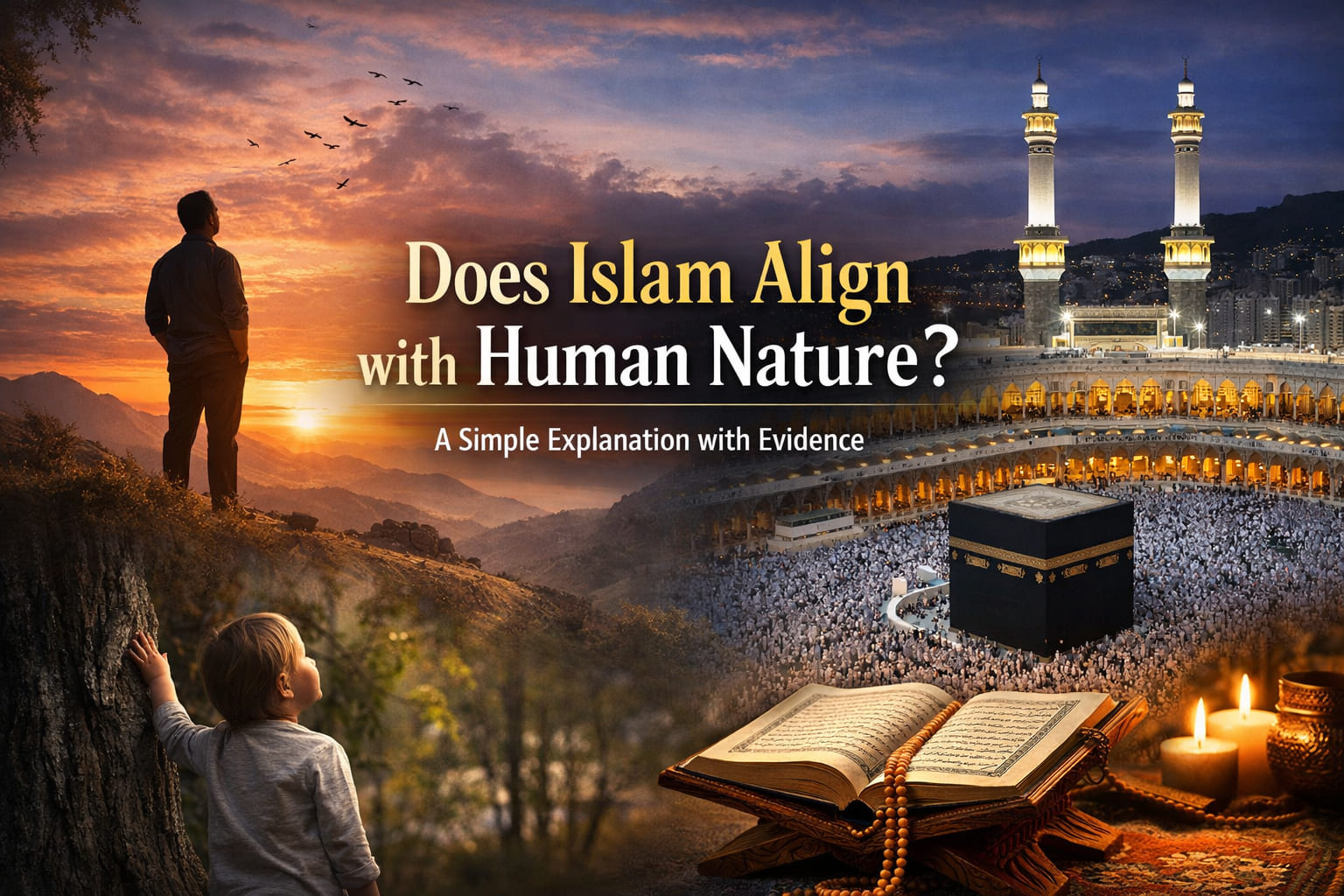
 Does Islam Align with Human Nature? Evidence & Explanation
Does Islam Align with Human Nature? A Simple Explanation with Evidence
:Introduction
Can the true religion be the one that feels “natural” to the human being?
Is it possible for belief to exist in harmony with what we feel deep inside, without conflict or confusion?
This question leads us to an important concept in Islam: human nature (fitrah).
It is not just a religious idea—it speaks to something deeper within every person… an inner sense of truth.
In this article, we will explore—calmly and rationally:
Does Islam truly align with human nature?
First: What Is Human Nature (Fitrah)?
Fitrah can be understood simply as:
the original state in which a human being is created—before being shaped by society and experience.
If you observe a young child, you will notice that they:
-
Naturally incline toward honesty
-
Reject (injustice) instinctively
-
Seek safety and comfort
-
Ask spontaneous questions like: “Who created me?”
These are not learned behaviors—they are built into us.
Islam expresses this idea clearly: the human being is born in a pure state, naturally inclined toward truth.
Second: Does the Human Being Naturally Seek Belief?
Even outside religion, we see that humans:
-
Search for meaning in life
-
Feel that the universe has order and purpose
-
Tend to believe in a higher power
Even in non-religious societies, some form of spirituality often appears.
So the question becomes:
Why does the human being feel this need to believe at all?
If humans were purely material beings, why wouldn’t survival alone be enough?
A rational answer would be:
Because there is something deeper within us—something that seeks truth, not just survival.
The Search for Meaning Is Universal
Throughout history, people from different civilizations, cultures, and backgrounds have searched for answers to the same essential questions:
-
Why do we exist?
-
What happens after death?
-
Is there a purpose behind the universe?
-
Is there a Creator who designed everything?
These questions appear repeatedly across human history, regardless of language or geography. Even individuals who reject religion often continue searching for meaning through philosophy, science, relationships, or personal achievement.
This persistent search suggests that the desire for purpose is not simply a cultural habit. Instead, it appears to be part of the human condition itself.
Islam explains this universal longing by teaching that human beings were created with an innate awareness that life has a higher purpose. Material success alone rarely satisfies the deepest questions of the heart. Wealth, status, and comfort may bring temporary happiness, but many people still feel an emptiness when they lack a clear understanding of why they exist.
According to Islam, this inner search is not a weakness—it is a sign pointing people toward their Creator.
Third: How Does Islam Align with Human Nature?
-
Monotheism: The Simplest and Most Logical Idea
Islam is built upon a clear concept:
There is only one God—the Creator of everything.
This idea:
-
Requires no complex philosophy
-
Avoids contradictions
-
Aligns with the human tendency toward unity and order
When a person reflects:
“Can this universe have multiple creators?”
they often lean toward the idea of one.
And that is exactly what Islam teaches.
-
A Direct Relationship with God
In Islam:
-
There is no intermediary between you and God
-
You do not need a priest to be forgiven
-
You can call upon God directly at any time
This matches the natural human feeling that one can reach out to their Creator without barriers.
How many times have people turned to God in moments of weakness—even if they were not religious?
This alone points to a deep, natural connection.
-
Balance Between Body and Soul
Islam does not ask you to:
-
Abandon worldly life
-
Nor to become consumed by it
Instead, it creates balance between:
-
Work and rest
-
Worship and daily life
-
The spiritual and the physical
This balance reflects human nature—we are neither purely spiritual nor purely material beings.
-
Clear Moral Framework
Islam offers clear moral principles:
-
Honesty is good
-
Injustice is wrong
-
Mercy is a virtue
-
Lying and betrayal are rejected
What is interesting is that these values are not foreign to us—we already feel them within.
Even when someone does wrong, they often feel it is wrong.
This suggests that morality is not just taught—it is rooted in our nature.
Human Nature and Personal Responsibility
Another important aspect of human nature in Islam is the ability to choose.
Although people are born with a natural inclination toward truth, they are also given free will. This means that every person has the freedom to accept or reject what they recognize as right.
Without free choice, concepts such as justice, accountability, reward, and moral responsibility would lose their meaning.
Human beings naturally admire qualities such as honesty, generosity, courage, and compassion because these qualities resonate with their inner nature. At the same time, people recognize that envy, oppression, betrayal, and injustice damage both individuals and societies.
Islam does not claim that people are perfect. Instead, it acknowledges that humans make mistakes, forget, and sometimes follow their desires. What distinguishes a person is the willingness to recognize mistakes, seek forgiveness, and return to what is right.
This balanced understanding of human nature avoids both extremes: it neither views people as inherently evil nor assumes they are incapable of wrongdoing. Instead, Islam teaches that every individual possesses the ability to choose the path that best reflects their original nature.
Fourth: Why Do Some People Drift Away from This Nature?
If human nature points toward truth, why do people differ?
The answer is simple:
Human nature can be influenced and covered.
By:
-
Environment
-
Culture
-
Traditions
-
Inherited ideas
A child raised in a certain environment absorbs its beliefs, whether true or not.
But what is remarkable is this:
Many people, when they reflect deeply, return to the same fundamental questions:
-
Why am I here?
-
Who created me?
-
What is the purpose of life?
This shows that human nature is not erased—it is only covered.
Fifth: Is Human Nature Evidence for Islam?
Here we reach a key point.
If:
-
Humans naturally incline toward belief
-
Islam presents a simple, logical understanding of God
-
It aligns with our moral instincts
-
It gives meaning to life
Is this merely a coincidence?
Or is there a real harmony between this religion and human nature?
Many thinkers argue that:
A belief system that perfectly aligns with human nature is more likely to be true.
Sixth: A Universal Human Experience
Ask yourself honestly:
-
Have you ever felt there is something greater than you?
-
Have you called upon God in moments of fear?
-
Have you felt peace when doing good?
-
Have you felt guilt when doing wrong?
These are not learned behaviors—they are shared human experiences.
Islam does not deny them—it explains them.
Does Modern Life Change Human Nature?
Technology has transformed the way people communicate, work, and access information. However, it has not changed the fundamental questions that every generation continues to ask.
Despite scientific progress and material development, people still experience loneliness, anxiety, uncertainty, and the desire to find lasting meaning. These realities suggest that technological advancement cannot replace humanity’s deeper spiritual needs.
Islam recognizes human progress and encourages learning, reflection, and beneficial knowledge. At the same time, it reminds people that material success alone cannot satisfy the heart.
Many psychologists and researchers acknowledge that having purpose, hope, gratitude, and meaningful relationships contributes significantly to emotional well-being. Islam integrates these values into everyday life through worship, ethical behavior, family relationships, charity, and remembrance of God.
Rather than opposing human nature, Islam seeks to nurture it by providing guidance that addresses both the physical and spiritual dimensions of life. This holistic approach explains why many people from different cultures continue to find the teachings of Islam meaningful even in the modern world.
Conclusion: The Truth May Be Closer Than You Think
Islam does not ask you to abandon your (reason)—
it invites you to use it.
It does not ask you to ignore your feelings—
it helps you understand them.
The idea of fitrah suggests that truth is not far away…
it may already be within you.
So the real question is not: Is Islam foreign to human beings?
But: Could it be what we were created to recognize?
Join IslamLearn Academy for free and gain authentic Islamic knowledge in a simple and clear way, guided by qualified scholars.
Subscribe now to IslamLearn Academy for free
Related Posts
2 September 2026
Is Islam a Continuation of Christianity?
Is Islam a Continuation of Christianity or a Correction of It? Introduction When Islam emerged...
 Read More
30 August 2026
Jesus in Islam and Christianity: Key Differences
Who Is Jesus in Islam and Christianity? A Comparative Reading of the Qur’an and the...
Read More
Search
Categories
Tags
Recent Posts
Is Islam a Continuation of Christianity?
Is Islam a Continuation of...
Jesus in Islam and Christianity: Key Differences
Who Is Jesus in Islam...
How Was the Quran Preserved Before Printing? Complete Guide
How Was the Quran Preserved...
The Story of Uthman ibn Affan: The Third Rightly Guided Caliph
The Story of Uthman ibn...
How to Become a Muslim: A Complete Step-by-Step Guide
How to Convert to Islam:...