12 July 2026
 God in Islam and Christianity: Key Differences Explained
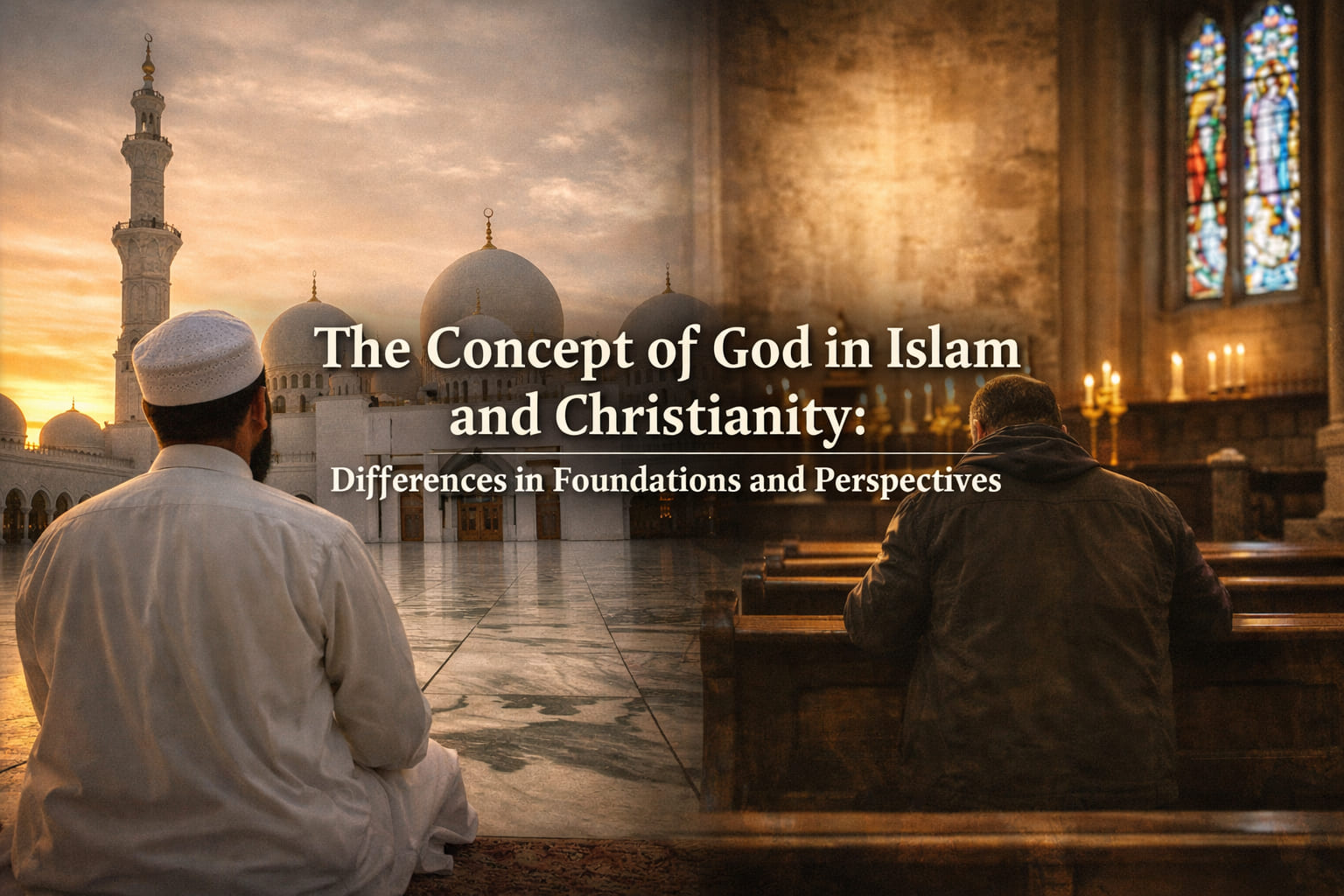
The Concept of God in Islam and Christianity: A Comparison of Theological Foundations and Perspectives
Introduction
The question “Who is God?” is one of the most profound questions any human being can ask. It is not merely a theological issue; it shapes a person’s understanding of life, purpose, morality, worship, and ultimately their destiny after death. Every major religion places belief in God at the center of its teachings, yet they differ significantly in how they define God’s nature, attributes, and relationship with humanity.
Islam and Christianity are the world’s two largest religions. They share a rich historical and prophetic heritage, recognizing many of the same figures, including Adam, Noah, Abraham, Moses, and Jesus (peace be upon them all). Despite these shared roots, however, their understanding of God differs fundamentally—not only in theological details but also in the very foundation of faith.
Islam is built upon the principle of absolute monotheism, affirming that God is One without partner, equal, or division. Traditional Christianity, on the other hand, is founded upon the doctrines of the Trinity and the Incarnation, which present a different understanding of God’s nature.
This article offers a thoughtful and respectful comparison between the Islamic and Christian concepts of God by examining their theological foundations, historical background, and philosophical implications. Its purpose is to help readers understand both perspectives through authentic religious texts and rational reflection.
Why Is the Concept of God the Foundation of Every Religion?
Religious laws, moral values, and acts of worship all originate from one’s understanding of God.
A person who believes in one absolute Creator naturally approaches worship differently from someone who believes that God became incarnate or exists as three distinct persons.
For this reason, the first message of every prophet throughout history was to call people to worship God alone before introducing any other religious obligations.
Allah says in the Qur’an:
“And We certainly sent into every nation a messenger, saying: ‘Worship Allah and avoid false deities.'”
(Qur’an 16:36)
This verse demonstrates that the central mission of every prophet was to establish pure monotheism, making the worship of one God the foundation of divine revelation throughout history.
First: The Concept of God in Islam — Pure Monotheism (Tawheed)
Islam is founded upon its greatest and most fundamental principle: Tawheed, the absolute oneness of God. Tawheed means believing that Allah is One in His essence, His names and attributes, and His exclusive right to be worshipped. He has no partners, equals, rivals, or likeness.
Monotheism in Islam is not merely a philosophical belief; it is the foundation upon which every aspect of Islamic faith, worship, ethics, and law is built.
For this reason, the Qur’an begins by calling people to know their Creator before commanding them to perform acts of worship.
Allah says:
“Say, He is Allah, the One. Allah, the Eternal Refuge. He neither begets nor is born. And there is none comparable to Him.”
(Surah Al-Ikhlas 112:1–4)
Although remarkably brief, this chapter is considered one of the greatest summaries of the Islamic concept of God. The Prophet Muhammad ﷺ even stated that it is equal to one-third of the Qur’an because it encapsulates the essence of Islamic belief.
From these four verses emerge four fundamental principles.
1. God Is Absolutely One
Allah is One, without partner or division. He is not part of another being, nor does He consist of multiple persons or manifestations. He is one perfect Creator, complete in His essence and attributes.
This oneness extends beyond simply acknowledging one Creator; it also means that every act of worship—including prayer, supplication, hope, fear, and reliance—belongs to Him alone.
Therefore, the message proclaimed by every prophet was:
“Worship Allah; you have no deity other than Him.”
2. Allah Is As-Samad (The Eternal Refuge)
One of Allah’s greatest names is As-Samad.
This name signifies that Allah is absolutely perfect and completely independent. He needs nothing from His creation, while every creature depends entirely upon Him.
Human beings require food, water, sleep, and countless other necessities. Allah, however, is free from every need.
Every created being ultimately turns to Him for provision, mercy, forgiveness, guidance, and protection.
3. He Neither Begets Nor Is Born
The Qur’an categorically rejects the idea that God has offspring or parents.
Allah is not part of a family lineage, nor is He subject to birth, inheritance, or succession. His sovereignty has always been perfect and eternal, requiring neither descendants nor predecessors.
For this reason, Islam rejects every belief that attributes divine sonship or literal parenthood to God.
4. Nothing Is Comparable to Him
Allah says:
“There is nothing whatsoever like Him, and He is the All-Hearing, the All-Seeing.”
(Qur’an 42:11)
This verse establishes one of the most important principles of Islamic theology.
Allah hears—but not as humans hear.
He sees—but not as humans see.
He is merciful—but His mercy is unlike human mercy.
He possesses every attribute of perfection without resembling any part of His creation.
Accordingly, Islam rejects the idea that God could resemble a human being, be represented by images, become incarnate in creation, or unite with any created being.
The Names and Attributes of God in Islam
Muslims believe that Allah possesses the most beautiful names and the most perfect attributes, all of which reflect His absolute perfection.
Among His well-known names are:
-
The Most Merciful (Ar-Rahman)
-
The Especially Merciful (Ar-Raheem)
-
The Sovereign (Al-Malik)
-
The Most Holy (Al-Quddus)
-
The All-Wise (Al-Hakeem)
-
The All-Knowing (Al-‘Aleem)
-
The All-Hearing (As-Samee’)
-
The All-Seeing (Al-Baseer)
-
The Almighty (Al-‘Azeez)
-
The Most Forgiving (Al-Ghafoor)
These are not symbolic descriptions but real attributes that befit His majesty and perfection, without distortion, denial, or comparison with His creation.
Allah knows everything, sees everything, hears everything, and nothing in the heavens or the earth escapes His knowledge.
The Qur’an states:
“Indeed, Allah is All-Knowing of everything.”
It also declares:
“Indeed, Allah is over all things Competent.”
Islam presents a perfectly balanced understanding of God, combining His mercy, justice, wisdom, power, and knowledge without allowing one attribute to diminish another.
The Relationship Between Humanity and God in Islam
One of the most beautiful aspects of Islamic belief is that every person has a direct relationship with God.
There is no need for an intermediary, priesthood, or human authority to grant forgiveness or accept repentance on God’s behalf.
Every individual can call upon Allah at any time, in any place, and in any language, knowing that He hears every sincere prayer.
Allah says:
“And when My servants ask you concerning Me, indeed I am near. I answer the call of the supplicant whenever he calls upon Me.”
(Qur’an 2:186)Quran.com
This divine closeness gives believers a profound sense of peace and hope. They know that their Creator hears them, understands them, and responds according to His perfect wisdom.
Likewise, the door of repentance always remains open for anyone who sincerely turns back to God, regardless of the magnitude of their sins.
The Prophet Muhammad ﷺ said:
“Allah stretches out His Hand during the night to accept the repentance of those who sinned during the day, and He stretches out His Hand during the day to accept the repentance of those who sinned during the night, until the sun rises from the west.”
These teachings illustrate an understanding of God that combines absolute greatness with boundless mercy, supreme authority with intimate closeness to His servants.
Why Is Monotheism the Foundation of Every Divine Message?
The Qur’an repeatedly affirms that every prophet—from Adam to Muhammad (peace be upon them all)—called people to the very same foundational belief: worshipping God alone without associating partners with Him.
Allah says:
“And We did not send any messenger before you except that We revealed to him: ‘There is no deity except Me, so worship Me.'”
(Qur’an 21:25)Quran.com
According to Islam, therefore, Tawheed is not a new doctrine introduced by Prophet Muhammad ﷺ. Rather, it is the original and universal message preached by every prophet throughout history. Any departure from pure monotheism is viewed as a departure from the original divine guidance entrusted to humanity.
Second: The Concept of God in Christianity — The Trinity and the Incarnation
The majority of Christian denominations believe that God is one in essence but exists as three distinct Persons: the Father, the Son (Jesus Christ), and the Holy Spirit. This belief is known as the doctrine of the Trinity, one of the central teachings of traditional Christian theology.
According to this doctrine, the three Persons are not three separate gods but one God who exists eternally in three distinct Persons sharing the same divine essence. Although Christian theology emphasizes that this does not constitute belief in three gods, the doctrine of the Trinity has remained one of the most discussed and debated subjects throughout Christian history, both within Christianity itself and in dialogue with followers of other religions.
Another fundamental Christian belief is the Incarnation, which teaches that God became human in the person of Jesus Christ, lived among humanity, and—according to Christian belief—was crucified as an atonement for humanity’s sins before being raised from the dead.
This belief is based on passages from the New Testament, including the Gospel of John:
“For God so loved the world that He gave His one and only Son, that whoever believes in Him shall not perish but have eternal life.”
(John 3:16)
The doctrines of the Trinity and the Incarnation form the foundation of traditional Christian theology, whereas Islam firmly rejects both concepts and maintains that they differ from the message of pure monotheism preached by all prophets.
Did All Christians Throughout History Believe in the Trinity?
From a historical perspective, early Christianity witnessed extensive theological discussions regarding the nature of Jesus Christ and the understanding of God.
During the first centuries after Jesus, different groups held different beliefs. Some regarded Jesus primarily as a prophet and messenger, while others affirmed His divine nature, and still others attempted to reconcile both human and divine characteristics.
To address these theological disputes, several church councils were convened. Among the most influential was the Council of Nicaea (325 CE), which discussed the divinity of Christ and played a pivotal role in shaping orthodox Christian doctrine.
Later, the Council of Constantinople (381 CE) further defined the doctrine of the Trinity by affirming the divinity of the Holy Spirit.
These historical developments illustrate that theological discussions concerning the nature of Christ and the Trinity evolved over time through significant doctrinal debates within the Christian tradition.
The Islamic View of Jesus (Peace Be Upon Him)
Jesus, the son of Mary (peace be upon him), occupies a place of great honor in Islam. He is regarded as one of the greatest prophets and messengers sent by Allah to guide humanity.
Muslims believe that Jesus:
-
Was born miraculously to the Virgin Mary without a human father.
-
Performed miracles by Allah’s permission.
-
Called the Children of Israel to worship Allah alone.
-
Foretold the coming of a messenger after him.
-
Never claimed divinity nor instructed people to worship him.
-
Will return before the end of time.
Allah says:
“Indeed, the example of Jesus before Allah is like that of Adam. He created him from dust; then He said to him, ‘Be,’ and he was.”
(Qur’an 3:59)
The Qur’an explains that Jesus’ miraculous birth does not imply divinity, since Adam was created without either a father or a mother.
Allah also says:
“The Messiah, son of Mary, was no more than a messenger; many messengers passed away before him.”
(Qur’an 5:75)
According to Islam, Jesus was a noble servant and messenger of God who called people to worship Allah alone.
The Qur’anic Position on the Trinity
The Qur’an addresses the doctrine of the Trinity explicitly and presents it as incompatible with the pure monotheism taught by all prophets.
Allah says:
“They have certainly disbelieved who say, ‘Allah is the third of three.’ There is no god except One God.”
(Qur’an 5:73)
The Qur’an also states:
“O People of the Scripture, do not go to extremes in your religion… The Messiah, Jesus, son of Mary, was only a messenger of Allah… So do not say, ‘Three.’ Desist—it is better for you. Indeed, Allah is but One God.”
(Qur’an 4:171)
From the Islamic perspective, all prophets—including Jesus—called humanity to worship God alone without associating partners with Him.
A Rational Comparison Between the Two Concepts
When comparing the Islamic and Christian understandings of God, several fundamental theological differences become apparent.
1. Absolute Oneness or the Trinity?
In Islam, God is absolutely One, without partner, division, or equal.
Traditional Christianity teaches that God is one in essence while existing eternally as three distinct Persons. Although Christian theology maintains that this does not imply belief in three gods, the doctrine is widely acknowledged within Christian scholarship as a profound mystery of faith that transcends complete human understanding.
2. Does God Change?
Islam teaches that God is absolutely perfect and, by virtue of His perfection, does not change, become human, or enter into creation.
Allah says:
“There is nothing whatsoever like Him.”
(Qur’an 42:11)
The doctrine of the Incarnation, however, teaches that God assumed a human nature in the person of Jesus Christ. This raises philosophical discussions regarding the relationship between divine perfection and human limitations.
3. Divine Justice and Individual Responsibility
One of the fundamental principles of Islam is that every individual is accountable for his or her own actions.
Allah says:
“No bearer of burdens shall bear the burden of another.”
(Qur’an 6:164)
Accordingly, sincere repentance and righteous deeds, by Allah’s mercy, are the path to forgiveness, without another person bearing responsibility for one’s sins.
In most Christian traditions, however, salvation is understood through Christ’s sacrificial atonement for humanity’s sins, representing a fundamentally different understanding of divine justice and redemption.
4. The Relationship Between Humanity and God
In Islam, every believer has a direct relationship with Allah.
No intermediary is required to obtain forgiveness, and no priest possesses the authority to forgive sins on God’s behalf.
Allah says:
“Call upon Me; I will answer you.”
(Qur’an 40:60)
Christian practice varies among denominations. For example, the Catholic and Orthodox Churches place significant emphasis on the sacraments and the priesthood in spiritual life, whereas many Protestant traditions emphasize a direct personal relationship between the believer and God.
Can These Two Concepts Be Reconciled?
Although Islam and Christianity share many important beliefs—such as belief in God, respect for the prophets, divine revelation, and the Hereafter—their understanding of God’s nature remains one of their most significant theological differences.
Islam teaches that God:
-
Is absolutely One.
-
Neither begets nor is born.
-
Never becomes incarnate.
-
Is unlike His creation.
-
Alone deserves all worship.
Traditional Christianity, by contrast, is founded upon the doctrines of the Trinity and the Incarnation, which Islam rejects as incompatible with the pure monotheism preached by every prophet.
From the Islamic perspective, therefore, the difference between the two religions is not merely a matter of theological detail but concerns the very nature of God Himself. This difference shapes each religion’s understanding of worship, salvation, and the mission of the prophets.
Conclusion
Exploring the concept of God is far more than an abstract theological exercise; it is a search for the most fundamental truth about human existence. A person’s understanding of the Creator shapes their purpose in life, their form of worship, and their perception of truth.
Islam presents a concept of God that emphasizes absolute oneness, perfection, uniqueness, and direct accessibility. Allah is One without partner, incomparable to His creation, and His mercy is always available to those who sincerely turn to Him.
Traditional Christianity presents a different theological framework centered on the doctrines of the Trinity and the Incarnation, doctrines that developed throughout the history of Christian theology and became central to mainstream Christian belief.
Ultimately, the search for truth requires sincere reflection, careful study, and a willingness to examine the evidence with fairness and humility.
Perhaps the most important question every person can ask is:
Who is God as He has revealed Himself to humanity?
The answer to this question may become the beginning of a deeper understanding of the message shared by all the prophets and the path that leads to knowing and worshipping the Creator.
Read also: Five difference Between Islam and Christianity You Should Know : Islamic Academy
Join IslamLearn Academy for free and gain authentic Islamic knowledge in a simple and clear way, guided by qualified scholars.
Related Posts
18 July 2026
Do Muslims Worship the Kaaba and Prophet Muhammad?
Do Muslims Worship the Kaaba and Prophet Muhammad? Clarifying the Truth Beyond Misconceptions Understanding What...
 Read More
16 July 2026
God in Islam: Holy Scriptures, Messengers & One God
God in Islam: Holy Scriptures, Messengers in Islam, and Why Muslims Believe in One God...
Read More
Search
Categories
Tags
Recent Posts
Do Muslims Worship the Kaaba and Prophet Muhammad?
Do Muslims Worship the Kaaba...
God in Islam: Holy Scriptures, Messengers & One God
God in Islam: Holy Scriptures,...
Does Islam Align with Human Nature? Evidence & Explanation
Does Islam Align with Human...
God in Islam and Christianity: Key Differences Explained
The Concept of God in...
How Does Islam Explain Evil? Lessons from Gaza
How Does Islam Explain Evil...