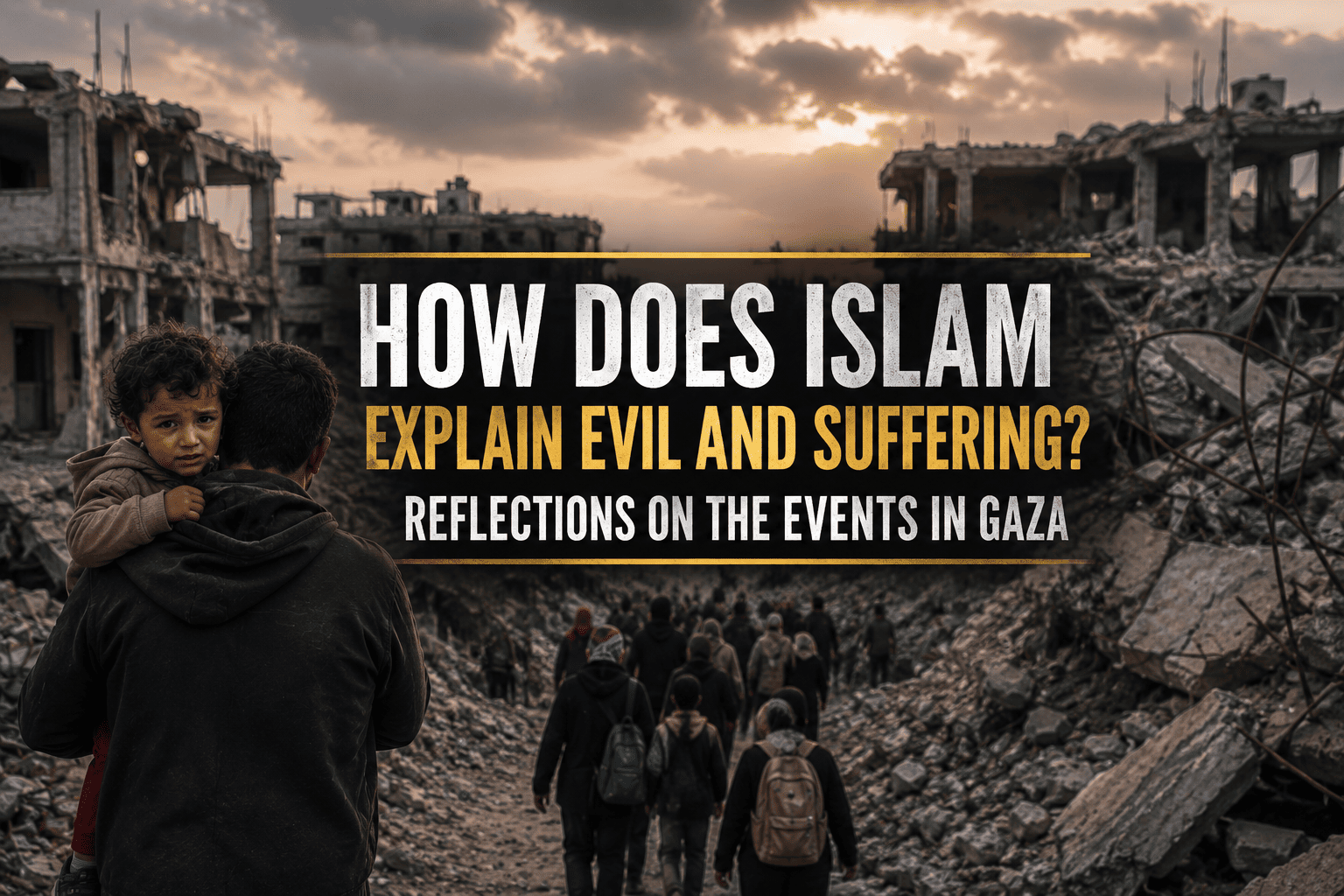
11 July 2026
 How Does Islam Explain Evil? Lessons from Gaza
How Does Islam Explain Evil and Suffering? Reflections on the Events in Gaza
Introduction
How does Islam explain evil and suffering?
One of the most common questions people ask during wars, disasters, and humanitarian tragedies is a question that
appears simple but carries profound philosophical and theological implications:
If God is All-Merciful and All-Powerful, why do evil and suffering exist?
This question becomes even more pressing when people witness the suffering of children, women, and innocent civilians in conflict zones, including what is happening in Gaza. Due to a lack of knowledge and understanding, the faith of some people may be shaken by these events. As a result, some conclude that such suffering proves either that God does not exist or that He is neither merciful nor just.
But is this conclusion logically sound? And does Islam offer a coherent and rational explanation for the existence of evil and suffering?
In this article, we explore the Islamic perspective on this issue while emphasizing from the outset that every human tragedy deserves compassion. Islam strictly forbids ظلم (oppression), aggression against innocent people, and commands believers to support the oppressed and strive for justice.
What Is the Problem of Evil?
The “Problem of Evil” is a philosophical question that asks:
If God is All-Powerful, All-Knowing, and All-Merciful, why does He allow evil and suffering to exist?
Many atheists consider this one of their strongest arguments against the existence of God.
However, before accepting this conclusion, we should ask another question:
Does our inability to understand God’s wisdom mean that no wisdom exists?
Does the Existence of Evil Disprove God?
The answer is no.
The existence of evil does not logically disprove the existence of the Creator.
This argument rests on a hidden assumption: that human beings fully understand every purpose and every aspect of divine wisdom. Therefore, if they cannot perceive a reason for something, they assume there is no reason.
This reasoning is flawed.
Imagine a young child watching a surgeon perform a painful operation. The child may believe the surgeon is cruel, while adults understand that the temporary pain is necessary for healing.
Does the child’s ignorance of the medical purpose make the surgeon unjust?
Of course not.
How much more limited, then, is human knowledge compared with the infinite knowledge of God?
Allah says in the Qur’an:
“But perhaps you hate a thing while it is good for you, and perhaps you love a thing while it is bad for you. Allah knows, while you do not know.”
Quran.com(Qur’an 2:216)
This World Is Not Paradise
One of the fundamental principles of Islam is that this worldly life is a place of testing, not the final place of reward.
Allah says:
“He who created death and life to test you as to which of you is best in deeds.”
Quran.com(Qur’an 67:2)
If this world contained no illness, poverty, wars, death, or hardship, it would no longer be a test. Patience, courage, generosity, justice, and faith would have little opportunity to manifest.
According to Islam, complete justice is not realized entirely in this life but in the Hereafter.
Human Free Will Is the Cause of Much Evil
Allah created human beings with free will. He sent messengers and revealed guidance, showing humanity the path of righteousness and the path of wrongdoing.
Allah says:
“Indeed, We guided him to the way, whether he be grateful or ungrateful.”
(Qur’an 76:3)
If God prevented every act of injustice before it occurred, human freedom would lose its meaning.
Wars, murder, oppression, and injustice are not commands from God. Rather, they are often the result of human choices, for which people will be held accountable.
Why Doesn’t God Punish Wrongdoers Immediately?
Some people ask:
Why doesn’t God destroy every oppressor instantly?
Islam answers that God may delay punishment, but He never neglects justice.
Allah says:
“Do not think that Allah is unaware of what the wrongdoers do.”
(Qur’an 14:42)
The Prophet Muhammad ﷺ said:
“Indeed, Allah gives respite to the oppressor, but when He seizes him, He does not let him escape.”
(Authentically reported in Sahih al-Bukhari and Sahih Muslim.)
The delay of justice is not evidence that justice is absent. Rather, it may serve a wisdom known only to God, while perfect justice awaits in the Hereafter.
What About Children and Innocent People?
This is among the most emotionally difficult questions.
Islam teaches that Allah never wrongs anyone.
Allah says:
“Indeed, Allah does not wrong people at all, but it is people who wrong themselves.”
(Qur’an 10:44)
Muslims believe that children who die before reaching the age of accountability will be admitted to Paradise, and none of their rights are lost before God. His mercy and justice encompass them completely.
This worldly life is not the end. It is only a brief stage before an eternal life in which perfect justice will be established.
How Does Islam View What Is Happening in Gaza?
The suffering experienced by civilians in Gaza—including death, destruction, displacement, and immense hardship—is a profound humanitarian tragedy that calls for compassion, sincere prayers, and lawful efforts to assist those in need and support the oppressed.
From the Islamic perspective:
-
Killing innocent people is forbidden.
-
Oppression is forbidden.
-
Attacking civilians is forbidden.
-
Helping those in need is among the greatest acts of worship.
At the same time, Islam does not view these tragedies as evidence that God is absent. Rather, it distinguishes between:
-
Human actions that result from injustice and abuse of free will.
-
God’s wisdom, which human beings may not fully comprehend.
The existence of injustice does not mean that God approves of it, just as the existence of crime does not mean that the law permits it.
Is Every Calamity a Punishment?
Not necessarily.
The prophets—the best of humanity—experienced the greatest trials.
The Prophet Muhammad ﷺ said:
“The people who are tested most severely are the prophets, then those most like them, then those most like them.”
sunnah.com(Reported by al-Tirmidhi and authenticated by scholars.)
Therefore, hardship may be:
-
A test.
-
A means of elevating one’s rank.
-
An expiation for sins.
-
A trial of faith.
-
Or part of a wisdom known only to God.
For this reason, Muslims should never assume that every calamity is a divine punishment.
Can Human Beings Understand All of God’s Wisdom?
Human reason is a tremendous blessing, but it is limited.
People possess only a small portion of knowledge.
Allah says:
“You have been given only a little knowledge.”
(Qur’an 17:85)
Therefore, failing to understand God’s wisdom does not mean that no wisdom exists.
What Does Islam Ask Believers to Do During Times of Tragedy?
Islam does not teach passivity. Rather, it combines faith with action.
A Muslim is encouraged to:
-
Pray for the oppressed.
-
Help those in need whenever possible.
-
Stand for justice through lawful means.
-
Reject oppression regardless of who commits it.
-
Remain patient while trusting in God’s perfect justice.
Allah says:
“Cooperate with one another in righteousness and piety.”
(Qur’an 5:2)
Responding to Common Objections
If God is All-Powerful, why doesn’t He stop all evil?
Because this life is a test, and meaningful free will requires the possibility of choosing both good and evil, while ultimate justice belongs to the Hereafter.
Why do children suffer?
Islam teaches that children are not held accountable for the sins of others. God is more merciful to them than their own parents, and those who die before accountability will enjoy Paradise without reckoning.
Does suffering mean that God does not love His servants?
No. The prophets and the righteous endured the greatest hardships, and those trials elevated their status rather than indicating God’s anger toward them.
Can human reason fully comprehend God’s actions?
No. Human reason can grasp many aspects of divine wisdom, but it can never encompass God’s complete knowledge.
Conclusion
The question of evil and suffering is one of humanity’s oldest and deepest philosophical questions. Islam offers a comprehensive worldview that affirms God’s justice and mercy while recognizing that this life is not the end but a temporary stage before a final judgment where absolute justice will prevail.
What is happening in Gaza, like other human tragedies around the world, reminds us of our responsibility to show compassion for the oppressed, reject injustice, and strive for justice through lawful means. At the same time, it strengthens the believer’s conviction that God’s justice never fails, no right is ever lost before Him, and that the wisdom hidden from us today will become clear on the Day when all humanity stands before the Lord of the worlds.
Frequently Asked Questions (FAQ)
Does the existence of evil prove that God does not exist?
No. The existence of evil does not logically disprove God’s existence. It raises questions about wisdom, and Islam teaches that God’s wisdom is perfect even when human beings cannot fully understand it.
Why doesn’t God stop wars?
Because this world is a place of testing. God has granted human beings free will, and every individual will ultimately be held accountable for their actions.
Is every tragedy a punishment from God?
No. A hardship may be a test, a means of spiritual elevation, an expiation of sins, or part of a divine wisdom known only to God.
How does Islam view the suffering of innocent people?
Islam views it with compassion and justice. It strictly forbids harming innocent people and teaches that God never wrongs anyone and that every right will be restored on the Day of Judgment.
What should Muslims do when tragedies occur?
Muslims should pray for the victims, help them whenever possible, stand for justice, reject oppression, and place their trust in God’s perfect justice and wisdom.
Join IslamLearn Academy for free and gain authentic Islamic knowledge in a simple and clear way, guided by qualified scholars.
Related Posts
2 September 2026
Is Islam a Continuation of Christianity?
Is Islam a Continuation of Christianity or a Correction of It? Introduction When Islam emerged...
 Read More
30 August 2026
Jesus in Islam and Christianity: Key Differences
Who Is Jesus in Islam and Christianity? A Comparative Reading of the Qur’an and the...
Read More
Search
Categories
Tags
Recent Posts
Is Islam a Continuation of Christianity?
Is Islam a Continuation of...
Jesus in Islam and Christianity: Key Differences
Who Is Jesus in Islam...
How Was the Quran Preserved Before Printing? Complete Guide
How Was the Quran Preserved...
The Story of Uthman ibn Affan: The Third Rightly Guided Caliph
The Story of Uthman ibn...
How to Become a Muslim: A Complete Step-by-Step Guide
How to Convert to Islam:...