221
18 July 2026
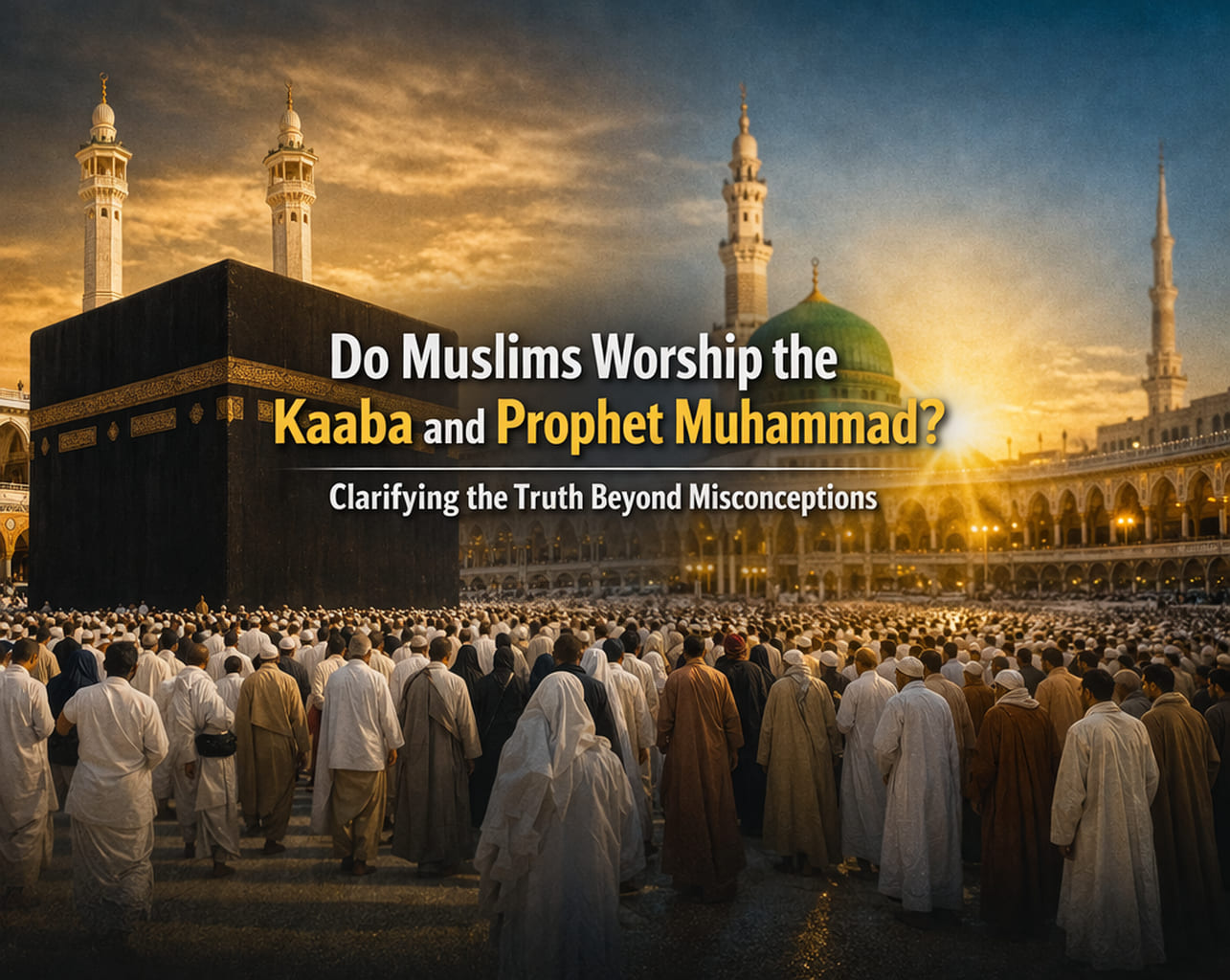
 Do Muslims Worship the Kaaba and Prophet Muhammad?
Do Muslims Worship the Kaaba and Prophet Muhammad? Clarifying the Truth Beyond Misconceptions
Understanding What Muslims Truly Worship
One of the most common questions asked by people who are unfamiliar with Islam is: Do Muslims worship the Kaaba? Another frequent question is: Do Muslims worship Prophet Muhammad?
These questions often arise after watching videos on social media, seeing images of millions of Muslims praying toward the Kaaba in Mecca, or hearing inaccurate claims that Muslims have replaced God with a building or a human being.
At first glance, these misconceptions may seem understandable. After all, Muslims pray facing the Kaaba, they deeply love Prophet Muhammad, and they frequently mention his name alongside discussions about Islam. However, appearances alone do not always reveal reality.
To understand the truth, it is essential to examine what Islam actually teaches—not what critics claim or what isolated images may suggest.
The answer is clear and unequivocal:
Muslims worship Allah alone. They do not worship the Kaaba, nor do they worship Prophet Muhammad.
This belief is not a secondary teaching; it is the very foundation upon which Islam stands.
What Does Worship Mean in Islam?
Before asking whether Muslims worship the Kaaba or Prophet Muhammad, we must first understand what worship means in Islam.
In Islamic belief, worship is far more than prayer. It includes every act of devotion performed sincerely for Allah alone, such as:
-
Prayer
-
Supplication
-
Trust
-
Hope
-
Fear
-
Sacrifice
-
Seeking forgiveness
-
Reliance upon God
-
Ultimate love and submission
Every act of worship must be directed exclusively to Allah, the Creator of the heavens and the earth.
The Qur’an repeatedly emphasizes this central principle.
Allah says:
“And your God is One God. There is no deity except Him, the Most Compassionate, the Most Merciful.”
(Qur’an 2:163)
He also says:
“Indeed, I am Allah. There is no deity except Me, so worship Me and establish prayer for My remembrance.”
(Qur’an 20:14)
These verses leave no room for worshipping any created being.
Why Do Muslims Face the Kaaba During Prayer?
Perhaps the greatest source of confusion comes from seeing Muslims pray toward the Kaaba.
Many people assume that facing something during prayer automatically means worshipping it.
But is that conclusion logical?
Imagine a classroom where every student faces the teacher.
Are they worshipping the teacher?
Or imagine thousands of people standing in the same direction during a national ceremony.
Does facing one direction make that direction an object of worship?
Of course not.
Facing a direction simply creates unity and order.
The Kaaba serves exactly this purpose.
It is the Qiblah—the direction of prayer—not the object of worship.
No Muslim believes that the Kaaba answers prayers, forgives sins, controls the universe, or possesses divine power.
Instead, Muslims believe that Allah alone hears every prayer, regardless of where a person stands on earth.
Why Did Allah Choose the Kaaba?
The Kaaba is the first house dedicated to the worship of Allah.
The Qur’an states:
“Indeed, the first House established for mankind was that at Bakkah, blessed and a guidance for the worlds.”
(Qur’an 3:96)
According to Islamic tradition, Prophet Abraham (Ibrahim) and his son Ishmael (Isma’il) rebuilt the Kaaba by Allah’s command.
The Qur’an describes this moment:
“And when Abraham and Ishmael were raising the foundations of the House, they prayed: Our Lord, accept this from us.”
(Qur’an 2:127)
Notice something remarkable.
Even while building the Kaaba, Abraham did not worship it.
Instead, he worshipped Allah alone.
The building itself was simply a place dedicated to monotheistic worship.
Could Muslims Pray Without the Kaaba?
Yes.
This fact alone proves that Muslims do not worship the Kaaba.
If someone is unable to determine the direction of Mecca, Islam instructs them to pray in the direction they sincerely believe is correct.
If they later discover they were mistaken, their prayer remains valid.
Likewise, Muslims who are ill, traveling, or in dangerous situations may pray according to their circumstances.
This flexibility would make no sense if the Kaaba itself were considered divine.
The purpose is obedience to Allah—not devotion to a building.
What Happens If the Kaaba Were Destroyed?
This question surprises many people.
If Muslims truly worshipped the Kaaba, destroying it would destroy their religion.
But Islam teaches no such thing.
Even if the Kaaba were damaged or rebuilt—as has happened several times throughout history—Muslims would continue worshipping Allah exactly as before.
History records that the Kaaba has been damaged by floods, fires, warfare, and reconstruction projects.
Yet Muslims never believed that Allah had been harmed.
Nor did they stop praying.
Why?
Because the Kaaba is not God.
It is merely the direction chosen by Allah for the unity of Muslim prayer.
Their worship belongs to Allah alone.
Do Muslims Believe the Kaaba Has Divine Power?
No.
Islam explicitly rejects assigning divine qualities to any object.
The Kaaba cannot forgive sins.
It cannot answer prayers.
It cannot bring wealth.
It cannot protect someone independently.
It possesses no supernatural authority of its own.
Everything belongs to Allah.
The Qur’an repeatedly teaches that benefit and harm belong only to Him.
This distinction is one of the clearest differences between Islamic monotheism and any form of object worship.
Why Do Muslims Kiss the Black Stone?
Another common misunderstanding concerns the Black Stone embedded in one corner of the Kaaba.
Some observers conclude that kissing the stone means worshipping it.
However, Islamic history provides an important explanation.
The second Caliph, Umar ibn al-Khattab, approached the Black Stone and famously said:
“I know that you are only a stone. You can neither benefit nor harm anyone. Had I not seen the Messenger of Allah kiss you, I would not have kissed you.”
(Sahih al-Bukhari)
This statement perfectly summarizes the Islamic understanding.
The stone has no divine power.
Muslims kiss it only because Prophet Muhammad practiced this symbolic act during pilgrimage.
It is an act of obedience—not an act of worship.
If reaching the Black Stone is impossible due to crowds, pilgrims simply point toward it and continue walking.
Their pilgrimage remains completely valid.
This would not be possible if the stone itself were an object of worship.
The Foundation of Islamic Monotheism
The first declaration every Muslim embraces is known as the Shahadah:
“There is no deity worthy of worship except Allah, and Muhammad is the Messenger of Allah.”
Notice the distinction.
Allah is the One who is worshipped.
Muhammad is His Messenger.
Islam never places the Prophet alongside Allah as an object of worship.
On the contrary, the Shahadah clearly separates the Creator from His servant and messenger.
Understanding this distinction is the key to answering one of the most frequently searched questions online:
Do Muslims worship the Kaaba?
The answer is an unequivocal no.
The Kaaba is a sacred direction chosen by Allah, while worship belongs exclusively to Allah Himself.
Do Muslims WorshipProphet Muhammad? Understanding Love, Respect, and True Worship in Islam
After learning that Muslims do not worship the Kaaba, another important question naturally follows:
Do Muslims worship Prophet Muhammad?
This misconception is widespread, particularly among people who notice how often Muslims mention Prophet Muhammad, send blessings upon him, or strive to follow his example in daily life.
To someone unfamiliar with Islam, this deep respect may appear similar to worship.
Yet Islam makes a clear distinction between loving a prophet and worshipping him.
The difference is enormous.
According to Islamic belief, Prophet Muhammad was neither divine nor a partner with God. He was a human being chosen by Allah to deliver His final revelation to humanity.
His greatness lies in his role as Allah’s Messenger—not in possessing any divine qualities.
Understanding this principle is essential to understanding Islam itself.
Who Was Prophet Muhammad According to Islam?
Islam teaches that Muhammad was the final messenger in a long line of prophets that includes Adam, Noah, Abraham, Moses, Jesus, and many others.
Like the prophets before him, his mission was remarkably simple:
To call people to worship Allah alone.
The Qur’an instructs Prophet Muhammad to declare:
“Say, I am only a man like you, to whom it has been revealed that your God is One God.”
(Qur’an 18:110)
This verse removes any possibility of treating him as divine.
He was a servant of Allah before he was a messenger.
He ate, slept, became tired, experienced sorrow, rejoiced, and eventually passed away like every other human being.
Islam therefore rejects the idea that Muhammad possessed independent supernatural powers or deserved acts of worship.
What Did Prophet Muhammad Teach About Worship?
One of the strongest proofs that Muslims do not worship Prophet Muhammad is found in his own teachings.
Throughout his life, he repeatedly warned people against exaggerating his status.
He said:
“Do not exaggerate in praising me as the Christians praised the son of Mary. I am only His servant, so say: the servant of Allah and His Messenger.”
(Sahih al-Bukhari)
This statement is remarkable.
Rather than encouraging people to elevate him, Prophet Muhammad actively prevented them from doing so.
He consistently reminded his followers that every form of worship belongs to Allah alone.
In fact, protecting pure monotheism was one of the central themes of his mission.
Why Do Muslims Love Prophet Muhammad So Deeply?
If Muslims do not worship him, why do they love him so much?
The answer lies in gratitude and guidance.
Muslims believe that Allah chose Prophet Muhammad to deliver the Qur’an, explain its teachings, and provide the perfect example of righteous character.
Through him, millions learned how to pray, give charity, care for families, show mercy, seek justice, and worship Allah correctly.
The Qur’an says:
“Indeed, in the Messenger of Allah you have an excellent example for whoever hopes in Allah and the Last Day and remembers Allah often.”
(Qur’an 33:21)
Following an example is not the same as worshipping that person.
People admire great teachers, scientists, and reformers without worshipping them.
Similarly, Muslims follow Prophet Muhammad because they believe he conveyed God’s guidance faithfully.
Why Do Muslims Say “Peace Be Upon Him”?
Another practice that sometimes causes confusion is the phrase:
“Peace and blessings be upon him.”
Muslims say this whenever Prophet Muhammad’s name is mentioned.
This is not a prayer directed to Muhammad.
Rather, it is a prayer for Muhammad.
Muslims ask Allah to honor and bless His Messenger.
The Qur’an itself commands believers:
“Indeed, Allah and His angels send blessings upon the Prophet. O you who believe, send blessings and peace upon him.”
(Qur’an 33:56)
This act resembles praying for someone you respect.
It does not transform that person into an object of worship.
Can Muslims Pray to Prophet Muhammad?
The answer is simple:
No.
Islam strictly forbids praying to Prophet Muhammad or to any other created being.
Every supplication must be directed to Allah alone.
The Qur’an declares:
“And the places of worship are for Allah, so do not invoke anyone along with Allah.”
(Qur’an 72:18)
Whether someone is asking for forgiveness, guidance, provision, healing, or protection, Muslims believe only Allah possesses absolute power to answer those prayers.
This principle is one of the clearest expressions of Islamic monotheism.
What About Visiting the Prophet’s Mosque?
Millions of Muslims visit the Prophet’s Mosque in Madinah every year.
Critics sometimes misunderstand these visits as acts of worship directed toward Muhammad.
In reality, Muslims visit the mosque out of love and respect, while continuing to worship Allah alone.
They may greet the Prophet with words of peace, just as they greet other deceased believers.
But they do not bow to his grave.
They do not pray to him.
They do not believe he controls the universe or answers prayers independently.
Their acts of worship remain directed solely to Allah.
Does Following Prophet Muhammad Mean Worshipping Him?
Not at all.
Every society follows role models.
Athletes imitate successful players.
Students follow respected professors.
Citizens follow national laws established by leaders.
None of these actions constitute worship.
Likewise, Muslims follow Prophet Muhammad because they believe Allah instructed them to follow His Messenger.
The Qur’an states:
“Whoever obeys the Messenger has obeyed Allah.”
(Qur’an 4:80)
This obedience is ultimately obedience to Allah, who sent the Messenger.
The authority comes from God—not from Muhammad independently.
The Difference Between Respect and Worship
Many misconceptions disappear once this distinction becomes clear.
Respect may include:
-
Loving someone
-
Following their example
-
Speaking positively about them
-
Studying their teachings
-
Honoring their memory
Worship, however, involves acts such as:
-
Praying to someone
-
Seeking forgiveness from them
-
Believing they control destiny
-
Depending upon them as a deity
-
Offering sacrifices in their name
Islam allows the first category regarding Prophet Muhammad.
It strictly forbids the second.
This balance protects both respect for God’s messengers and the absolute uniqueness of Allah.
The Core Message of Islam
From the first day of his mission until his final sermon, Prophet Muhammad consistently called people to worship Allah alone.
He never claimed divinity.
He never asked people to worship him.
He never accepted being treated as a god.
Instead, he spent his life directing humanity toward the One Creator.
This is why the central declaration of Islam says:
“There is no deity worthy of worship except Allah, and Muhammad is the Messenger of Allah.”
The statement deliberately separates the Creator from His Messenger.
Allah alone deserves worship.
Muhammad is honored because he faithfully delivered Allah’s message.
Conclusion
The claim that Muslims worship the Kaaba or Prophet Muhammad is based on misunderstanding rather than on Islamic teachings.
The Kaaba is the direction of prayer—not the object of worship.
Prophet Muhammad is the final Messenger—not a deity.
The heart of Islam has remained unchanged for more than fourteen centuries:
Allah alone is worthy of worship.
Everything else—including prophets, angels, holy places, and sacred objects—exists to guide people toward Him, never to replace Him.
When Islam is understood through its own scriptures rather than through misconceptions, the answer becomes unmistakably clear:
Muslims worship neither the Kaaba nor Prophet Muhammad. They worship Allah alone—the One Creator of all humanity.
Join IslamLearn Academy for free and gain authentic Islamic knowledge in a simple and clear way, guided by qualified scholars.
Related Posts
2 September 2026
64
Is Islam a Continuation of Christianity?
Is Islam a Continuation of Christianity or a Correction of It? Introduction When Islam emerged...
 Read More
30 August 2026
82
Jesus in Islam and Christianity: Key Differences
Who Is Jesus in Islam and Christianity? A Comparative Reading of the Qur’an and the...
Read More
Search
Categories
Tags
Abraham
Abraham in Islam
Adam
Allah
Atheism
belief
Belief in Prophets
Can God Become a Human
Christianity
Christianity and Islam
Coexistence in Islam
comparative religion
Convert to Islam
Creation
creation of humanity
Creation of the Universe
Creator
disciples of Jesus
Divine Origin of the Quran
Doubt and Faith
Evidence for God
Evidence for Islam
Existence of God
faith
Fitrah
free will in Islam
Gaza
God in Islam
God is One
God's Word
history of the Quran
Holy Scriptures
Human Existence
Human Nature
Imran Family
Incarnation in Islam
Is Jesus God
Islam
Islam and Christianity
Islam and Non-Muslims
Islam and Peace
Islam and Science
Islam and Tolerance
Islam Explained
Islam facts
Islam for beginners
Islam vs Christianity
Islamic Belief
Islamic beliefs
Islamic culture
Islamic Faith
Islamic Monotheism
Islamic scripture
Islamic Teachings
Islamic Theology
Islamic values
Jesus
Jesus Birth
Jesus Christ
Jesus disciples
Jesus in Islam
Kaaba
Mary
Maryam
meaning of life
Messengers of God
Miracles
Misconceptions About Islam
monotheism
Moses
Moses in Islam
Mother of Mary
Muhammad
Muhammad Prophet
Multi-Religious Society
Muslim beliefs
Muslim life
Muslims
New Muslims
Non-Muslims
One God Argument
Oneness of God
pillars of Islam
Preservation of the Bible
Preservation of the Quran
preserved Quran
prophet Jesus
Prophet Muhammad
Prophet Musa
prophets
Prophets in Islam
purpose of life
Quran
Quran manuscripts
Quran memorization
Quran preservation
Quran Prophets
Quran teachings
Quran Themes
Quranic stories
Religion
religion and culture
Religion and Society
religion explained
religions
Religious Freedom
Return to Faith
Revelation in Islam
Search for Truth
Son of Mary
Story of Moses
Tawheed
tawhid
Teachings
Trinity
Understanding Islam
Unity of Prophets
Uthman ibn Affan
what is Islam
Who Created the Universe
Why Islam
why were we created
worship in Islam
Worship Jesus
Recent Posts
Is Islam a Continuation of Christianity?
Is Islam a Continuation of...
Jesus in Islam and Christianity: Key Differences
Who Is Jesus in Islam...
How Was the Quran Preserved Before Printing? Complete Guide
How Was the Quran Preserved...
The Story of Uthman ibn Affan: The Third Rightly Guided Caliph
The Story of Uthman ibn...
How to Become a Muslim: A Complete Step-by-Step Guide
How to Convert to Islam:...