16 July 2026
 God in Islam: Holy Scriptures, Messengers & One God
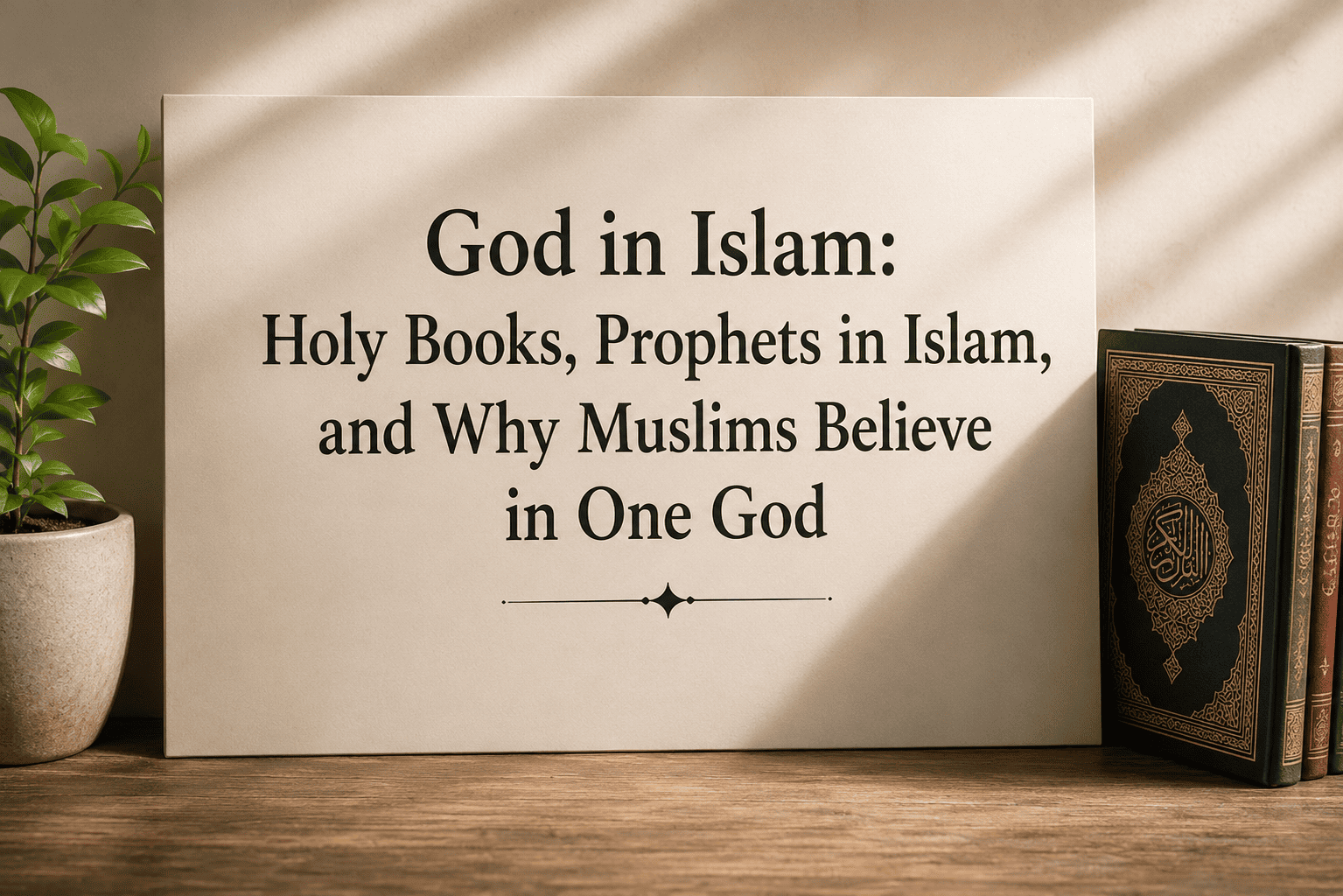
God in Islam: Holy Scriptures, Messengers in Islam, and Why Muslims Believe in One God
Introduction
Across different cultures and civilizations, people have always searched for answers to the same fundamental questions: Who created the universe? Why are we here? Does God communicate with humanity? Which religion truly reflects His guidance? These questions have shaped human history and continue to inspire millions of people to explore faith with sincerity and an open mind.
Among the world’s major religions, Islam offers a clear and comprehensive understanding of God, revelation, and the purpose of life. It teaches that humanity was not created without meaning, nor left without guidance. Throughout history, God sent prophets and messengers to every nation, revealed scriptures to guide mankind, and ultimately completed His message through the Qur’an.
Many people who are unfamiliar with Islam ask questions such as “Do Muslims believe in God?” or wonder whether Muslims worship a different deity. Others are curious about the Islam holy scriptures, the role of the prophets, and the relationship between Islam and earlier revelations such as the Torah and the Gospel.
This article provides a thoughtful introduction to these important topics. We will explore God in Islam, examine the holy book of Islam religion, learn about the messengers in Islam, and understand why Muslims believe that Islam represents the final and complete message from the Creator.
Rather than asking readers to accept conclusions without reflection, Islam consistently encourages people to think, observe, and seek knowledge. The Qur’an repeatedly invites humanity to reflect upon the universe, history, and their own hearts as signs pointing toward the existence and wisdom of God.
What Is Islam?
The word Islam comes from the Arabic root s-l-m, which conveys meanings such as peace, purity, and submission. In its religious sense, Islam means willingly submitting oneself to the will of the One true God. According to Islamic belief, genuine peace is achieved when a person recognizes the Creator, worships Him alone, and lives according to His guidance.
Islam is not presented as a new religion that began with Prophet Muhammad (peace be upon him). Rather, Muslims believe it is the continuation and completion of the same divine message preached by all previous prophets, including Adam, Noah, Abraham, Moses, and Jesus (peace be upon them all). Every prophet called people to worship the same Creator and to live righteous lives based on justice, mercy, and truth.
For Muslims, faith is not limited to rituals or ceremonies. It influences every aspect of life, including family relationships, honesty in business, compassion toward others, care for the environment, and personal responsibility. Islam teaches that worship includes both acts of devotion—such as prayer and charity—and everyday actions performed with sincere intentions.
The Qur’an emphasizes that human beings were created with purpose. Life is viewed as a test in which every individual is given the freedom to choose between guidance and misguidance. This understanding gives meaning to both blessings and hardships, encouraging believers to remain grateful during times of ease and patient during difficulties.
One of the central principles of Islam is that every human being is born with an innate inclination to recognize and worship the Creator. While cultures and traditions may differ, Islam teaches that the natural human disposition is to seek truth and acknowledge God.
God in Islam
Understanding God in Islam is essential to understanding the religion itself. Everything in Islam begins with belief in one God, known in Arabic as Allah. The word “Allah” is not the name of a separate deity; it is simply the Arabic word for the one true God. Arabic-speaking Christians and Jews also use the word “Allah” when referring to God.
The most fundamental belief in Islam is Tawhid, the absolute oneness of God. Muslims believe that God has no partners, no children, no parents, and no equals. He alone created the heavens and the earth, controls the universe, and deserves all acts of worship.
Unlike human beings, God is not limited by time, space, or physical needs. He does not become tired, hungry, or dependent upon His creation. His knowledge encompasses everything—past, present, and future—and nothing happens without His perfect wisdom and permission.
The Qur’an beautifully summarizes the uniqueness of God in Surah Al-Ikhlas:
“Say, He is Allah, the One. Allah, the Eternal Refuge. He neither begets nor is born, nor is there anyone comparable to Him.”
quran.com (Qur’an 112:1–4)
This short chapter is regarded by Muslims as one of the clearest explanations of God’s nature. It rejects the idea that God resembles His creation or shares His divinity with anyone.
God’s oneness does not mean that He is distant from humanity. On the contrary, Islam teaches that God is close to every person, hears every sincere prayer, and knows every hidden thought.
The Qur’an states:
“And We are closer to him than his jugular vein.”
quran.com (Qur’an 50:16)
This verse reminds believers that God is fully aware of their struggles, hopes, fears, and intentions. No sincere prayer goes unheard, and no act of goodness is forgotten.
Muslims also believe that God possesses perfect attributes. He is the Most Merciful, the Most Compassionate, the All-Knowing, the All-Powerful, the Most Just, and the Most Forgiving. These names are not merely descriptions; they reflect the relationship between the Creator and His creation. Every chapter of the Qur’an, except one, begins by reminding readers of God’s mercy:
“In the name of Allah, the Most Compassionate, the Most Merciful.”
This constant emphasis demonstrates that mercy is one of the defining characteristics of God’s relationship with humanity.
Understanding God in Islam also means recognizing the balance between hope and accountability. Muslims believe that God is infinitely merciful, yet perfectly just. Every individual is responsible for his or her own choices, and every deed will ultimately be judged with complete fairness.
For this reason, Islam encourages believers to combine faith with righteous action, trusting in God’s mercy while striving to live according to His guidance.
Do Muslims Believe in God?
One of the most common questions asked by people who are unfamiliar with Islam is: Do Muslims believe in God?
The answer is simple: Yes. Belief in one God is the very foundation of Islam. Without belief in God, there is no Islam.
In fact, the first declaration a Muslim makes is:
“There is no deity worthy of worship except Allah, and Muhammad is the Messenger of Allah.”
This testimony summarizes the essence of Islamic belief. It begins with acknowledging the absolute oneness of God before mentioning the final messenger.
Muslims do not believe in multiple gods or in different gods for different nations. They believe in the same Creator worshipped by Abraham, Moses, Jesus, and all the prophets. According to Islam, the differences between religions are not about the identity of God, but about changes that occurred in some religious teachings over time and the completion of revelation through the Qur’an.
The belief in one God shapes every aspect of a Muslim’s life. It inspires gratitude, humility, honesty, patience, and compassion. Knowing that God sees every action encourages believers to act with integrity even when no one else is watching.
For Muslims, faith is therefore much more than an intellectual belief—it is a complete way of living in conscious awareness of the Creator, trusting His wisdom, seeking His mercy, and striving to follow His guidance in every aspect of life.
The Religion in the Sight of Allah Is Islam
One of the most profound statements found in the Qur’an is:
“Indeed, the religion in the sight of Allah is Islam.”
(Qur’an 3:19)
This verse has often been misunderstood by those unfamiliar with Islamic teachings. It does not simply refer to a community that began in seventh-century Arabia. Rather, it expresses a timeless principle: throughout history, God has always called humanity to worship Him alone and to submit to His guidance. In this universal sense, Islam represents the way of sincere submission to the Creator.
From the Islamic perspective, every prophet preached this same essential message. Although specific laws and practical rulings differed according to the needs of different nations and historical periods, the core belief never changed. Every messenger invited people to abandon false gods, reject idolatry, and worship the One true God.
This understanding explains why Muslims deeply respect prophets such as Noah, Abraham, Moses, and Jesus. Islam does not regard them as founders of separate religions but as noble messengers who conveyed the same divine truth.
The Qur’an emphasizes this shared message:
“And We certainly sent into every nation a messenger, saying, ‘Worship Allah and avoid false deities.'”
(Qur’an 16:36)
According to Islam, humanity was never abandoned without guidance. Throughout history, God continuously sent prophets to remind people of their purpose and to call them back whenever they strayed from the truth.
This concept highlights both God’s justice and His mercy. Rather than leaving mankind to speculation, He provided revelation through trustworthy individuals chosen for their honesty, wisdom, and exemplary character.
The phrase “the religion in the sight of Allah is Islam” therefore reflects continuity rather than exclusivity. Muslims believe that all genuine prophets taught submission to God, while the Qur’an serves as the final revelation confirming and preserving this eternal message.
Why Submission to God Brings Peace
The Arabic word Islam shares the same linguistic root as Salaam, meaning peace. This connection is deeply meaningful. Islam teaches that true inner peace is not found through wealth, fame, or worldly success alone, but through recognizing one’s Creator and living according to His guidance.
Modern life often offers endless choices yet leaves many people searching for lasting purpose. Islam addresses this human need by teaching that life has meaning because it comes from a Wise and Merciful Creator.
When a person understands that every blessing comes from God and every hardship carries wisdom, life’s challenges become easier to face. Gratitude replaces arrogance, patience replaces despair, and hope replaces fear.
The Qur’an says:
“Unquestionably, by the remembrance of Allah hearts find rest.”
(Qur’an 13:28)
For Muslims, faith is therefore not merely a set of beliefs but a source of comfort, resilience, and direction throughout every stage of life.
Messengers in Islam
One of the defining characteristics of Islam is its belief in all of God’s prophets and messengers. Belief in the messengers in Islam is one of the six pillars of Islamic faith.
Muslims believe that God selected righteous individuals from among humanity to convey His guidance. These prophets were ordinary human beings—not divine figures—but they were chosen because of their integrity, wisdom, and unwavering commitment to truth.
The Qur’an mentions twenty-five prophets by name, although Islamic tradition teaches that many more were sent throughout history.
Among the most well-known messengers in Islam are:
-
Adam
-
Noah (Nuh)
-
Abraham (Ibrahim)
-
Lot (Lut)
-
Ishmael (Isma’il)
-
Isaac (Ishaq)
-
Jacob (Ya’qub)
-
Joseph (Yusuf)
-
Moses (Musa)
-
David (Dawud)
-
Solomon (Sulayman)
-
Jonah (Yunus)
-
Zechariah (Zakariyya)
-
John the Baptist (Yahya)
-
Jesus (‘Isa)
-
Muhammad (peace be upon them all)
Each prophet was sent to guide his people according to God’s command. Although their communities differed, their central message remained the same:
Worship God alone and live according to His guidance.
This consistency across centuries is viewed by Muslims as evidence of a single divine source.
Abraham: A Model of Pure Monotheism
Among all the prophets, Abraham occupies a special place in Islam. Muslims regard him as one of the greatest examples of faith and devotion.
Abraham rejected idol worship despite living in a society where it was widespread. He devoted himself entirely to God and willingly sacrificed personal comfort for the sake of truth.
The Qur’an describes him as:
“Indeed, Abraham was a nation in himself, devoutly obedient to Allah, inclining toward truth.”
(Qur’an 16:120)
Muslims see Abraham as a model of sincere submission to God, and many Islamic rituals—including the pilgrimage to Makkah—commemorate events from his life.
Moses in Islam
Moses is the most frequently mentioned prophet in the Qur’an. His story teaches courage, patience, justice, and reliance upon God.
Muslims believe that God revealed the Torah to Moses as guidance for the Children of Israel. His confrontation with Pharaoh remains one of history’s greatest examples of standing for truth against oppression.
The Qur’an repeatedly reminds believers that God’s help arrives even during the darkest moments.
Jesus in Islam
Jesus occupies an honored position among the messengers in Islam.
Muslims believe that:
-
Jesus was born miraculously to the Virgin Mary.
-
He performed miracles by God’s permission.
-
He was the Messiah sent to the Children of Israel.
-
He called people to worship God alone.
-
He was neither God nor the son of God.
-
God raised him, and he will return before the Day of Judgment.
The Qur’an praises both Jesus and his mother Mary with profound respect.
Muslims therefore love and honor Jesus while distinguishing between honoring a prophet and worshipping him.
Prophet Muhammad: The Final Messenger
Muslims believe that Prophet Muhammad (peace be upon him) is the final messenger sent by God.
Unlike previous prophets who were sent primarily to specific nations, Muhammad’s message is regarded as universal.
The Qur’an declares:
“And We have not sent you except as a mercy to the worlds.”
(Qur’an 21:107)
His mission completed the chain of prophethood that began with Adam.
During his lifetime, Muhammad taught justice, compassion, honesty, forgiveness, charity, and respect for human dignity. Even many non-Muslim historians have acknowledged his remarkable influence on world civilization.
Why Are There So Many Messengers?
A common question is why God sent numerous prophets instead of only one.
Islam answers that humanity lived across different lands, languages, and historical periods. Every nation received guidance suitable for its circumstances.
As societies changed over time, some revelations were forgotten, altered, or neglected. Therefore, God continued sending prophets to renew His guidance until the final revelation—the Qur’an—was revealed to Prophet Muhammad.
This explains why Muslims respect all prophets without making distinctions regarding belief in them.
The Qur’an says:
“We make no distinction between any of His messengers.”
(Qur’an 2:285)
Believing in one prophet while rejecting another is inconsistent with the Islamic understanding of divine revelation.
The Shared Mission of All Prophets
Although prophets lived in different centuries and cultures, their essential mission remained unchanged.
They taught people to:
-
Believe in one God.
-
Reject idolatry.
-
Live with honesty and justice.
-
Care for parents, neighbors, and the needy.
-
Respect human dignity.
-
Prepare for the Hereafter.
-
Seek God’s mercy through sincere repentance.
These universal principles demonstrate the remarkable consistency of God’s message throughout history.
According to Islam, this continuity reaches its completion in the Qur’an, which Muslims believe confirms the truths revealed to earlier prophets while preserving God’s guidance for all humanity until the end of time.
Islam Holy Scriptures: Why Does God Reveal Scriptures?
Throughout history, God did not merely send prophets to teach people verbally. According to Islam, He also revealed holy scriptures to preserve His guidance and provide a clear standard for faith, morality, and worship.
The Islam holy scriptures represent an essential part of Islamic belief. Muslims believe that God communicated with humanity through revelation, ensuring that His guidance was accessible to people across different generations.
These revelations were not the result of human philosophy or cultural traditions. Instead, they were divine messages delivered through angels to chosen messengers. Every scripture was intended to guide its people toward faith in one God, righteous conduct, justice, and compassion.
The Qur’an repeatedly reminds readers that God’s guidance has always been consistent. While societies changed over time, the central message remained the same: worship the Creator alone and live according to His commands.
This continuity demonstrates that Islam does not reject previous revelations. Instead, it recognizes them as part of one divine plan that culminated in the revelation of the Qur’an.
The Holy Islam Books
Many people ask whether Muslims believe only in the Qur’an. The answer is no.
Muslims believe in several holy Islam books revealed by God throughout history. Although not all of these scriptures remain preserved in their original form according to Islamic belief, Muslims respect them because they were originally revealed by God.
The Qur’an mentions several major revelations.
The Scrolls of Abraham (Suhuf Ibrahim)
Islam teaches that God granted scriptures to Prophet Abraham containing wisdom and guidance for his people. Although these scrolls are no longer available today, Muslims believe they formed part of God’s early revelation to humanity.
The Torah (Tawrah)
The Torah was revealed to Prophet Moses (peace be upon him).
Muslims believe it originally contained divine guidance for the Children of Israel.
The Qur’an says:
“Indeed, We sent down the Torah, in which was guidance and light.”
(Qur’an 5:44)
Islam therefore acknowledges the Torah as one of God’s revealed books while believing that the original revelation was not completely preserved over the centuries.
The Psalms (Zabur)
The Psalms were revealed to Prophet David.
The Qur’an simply states:
“And We gave David the Psalms.”
(Qur’an 17:55)
Muslims respect David both as a prophet and as a righteous king whose scripture emphasized praise and remembrance of God.
The Gospel (Injil)
The Gospel was revealed to Jesus (peace be upon him).
According to Islam, it confirmed many teachings of the Torah while bringing additional guidance.
The Qur’an says:
“And We sent, following in their footsteps, Jesus, the son of Mary, confirming what came before him of the Torah; and We gave him the Gospel, in which was guidance and light.”
(Qur’an 5:46)
Muslims therefore honor Jesus and believe that the original Gospel was genuine revelation from God.
The Qur’an
The final and greatest revelation is the Qur’an.
Muslims believe it was revealed to Prophet Muhammad over approximately twenty-three years through the Angel Gabriel.
Unlike earlier scriptures that were intended primarily for specific communities, the Qur’an is regarded as a universal message for all people until the end of time.
The Holy Book of Islam Religion
When people refer to the holy book of Islam religion, they are speaking about the Qur’an.
For Muslims, the Qur’an is not simply a religious text or a collection of spiritual reflections. It is believed to be the literal word of God revealed in Arabic exactly as transmitted to Prophet Muhammad.
This belief distinguishes the Qur’an from books written by scholars or inspired by personal experiences.
Muslims believe that every verse originates from God Himself.
The Qur’an addresses a wide range of subjects, including:
-
Belief in God
-
The purpose of life
-
Stories of previous prophets
-
Moral principles
-
Family relationships
-
Justice
-
Charity
-
Social responsibility
-
Human rights
-
Economic ethics
-
Life after death
Because of its comprehensive guidance, Muslims turn to the Qur’an not only during worship but also when making decisions about everyday life.
Millions of Muslims around the world memorize the Qur’an in its entirety, preserving both its wording and pronunciation through continuous oral transmission.
How Was the Qur’an Preserved?
One of the most remarkable characteristics of the Qur’an is its preservation.
Muslims believe that God Himself promised to protect His final revelation.
The Qur’an declares:
“Indeed, it is We who sent down the Reminder, and indeed, We will surely preserve it.”
(Qur’an 15:9)
This promise has been reflected in an extraordinary historical tradition.
From the time of Prophet Muhammad, many companions memorized the entire Qur’an.
Others carefully wrote every revelation as it was received.
After the Prophet’s death, these written records and oral recitations were compiled under the supervision of his closest companions.
Today, Muslims across every continent recite exactly the same Qur’an in Arabic.
Whether one visits a mosque in Cairo, Jakarta, London, Istanbul, Lagos, or New York, the Qur’an being recited is identical.
This remarkable consistency is one reason why Muslims believe the Qur’an remains exactly as it was revealed over fourteen centuries ago.
Why Is the Qur’an Unique?
Muslims believe the Qur’an possesses several qualities that distinguish it from any other book.
A Universal Message
Unlike earlier revelations sent primarily to individual nations, the Qur’an addresses all humanity.
Its teachings transcend race, nationality, language, and social class.
The Qur’an repeatedly addresses readers with the words:
“O mankind…”
rather than speaking only to one particular community.
Consistency
Despite being revealed over twenty-three years during very different historical circumstances, the Qur’an presents a remarkably consistent message about God, morality, and human purpose.
Its teachings remain coherent from beginning to end.
Intellectual Reflection
The Qur’an repeatedly encourages readers to think rather than blindly imitate others.
It asks people to reflect upon:
-
The universe
-
Human creation
-
History
-
Nature
-
Justice
-
Life and death
Faith, according to Islam, should be supported by sincere reflection and understanding.
Spiritual Guidance
For Muslims, reading the Qur’an is more than gaining information.
It strengthens faith, brings comfort during hardship, inspires hope, and encourages moral excellence.
Millions describe its recitation as a source of inner peace unlike any other experience.
The Relationship Between the Qur’an and Earlier Scriptures
One common misconception is that Islam rejects previous revelations.
In reality, Muslims believe the opposite.
The Qur’an confirms that God revealed scriptures before it.
It honors Moses, David, and Jesus while affirming the original revelations they received.
However, the Qur’an also teaches that over time some earlier religious texts experienced alterations, losses, or differences in transmission.
For this reason, Muslims believe God revealed the Qur’an as the final preserved guidance for all humanity.
The Qur’an describes itself as:
“A confirmation of what came before it and a guardian over it.”
(Qur’an 5:48)
In this sense, the Qur’an does not erase previous revelation but confirms its original truth while preserving God’s final message in its complete form.
Why Muslims Study the Qur’an Every Day
For Muslims, the Qur’an is not a book reserved for scholars or religious leaders.
Children begin learning it from an early age.
Adults continue studying it throughout their lives.
Many Muslims read portions of the Qur’an daily, seeking both knowledge and spiritual guidance.
Its verses are recited during every formal prayer, memorized by millions, and reflected upon in personal study circles around the world.
This continuous engagement explains why the holy book of Islam religion remains at the center of Muslim life more than fourteen centuries after its revelation.
The Qur’an is therefore not only the most important of the Islam holy scriptures, but also the living source of faith, guidance, and inspiration for nearly two billion Muslims today.
How Belief in God Shapes a Muslim’s Daily Life
Understanding God in Islam is not simply about learning theological concepts. For Muslims, belief in God influences every aspect of life. Faith is reflected not only in worship but also in character, relationships, work, and responsibility toward society.
A Muslim begins the day by remembering God, performs daily prayers, seeks to earn an honest livelihood, treats others with kindness, and hopes to end the day having fulfilled both personal and social responsibilities. Every good action—whether helping a neighbor, caring for parents, giving charity, or speaking truthfully—is considered an act of worship when done sincerely for God’s sake.
This understanding creates a strong connection between belief and behavior. Islam teaches that true faith should produce honesty, compassion, humility, patience, and justice.
The Prophet Muhammad (peace be upon him) said:
“The best among you are those with the best character.”
For this reason, Islamic teachings consistently emphasize moral excellence alongside acts of worship.
Tolerance and Religion in Islam
One of the subjects frequently discussed today is the relationship between tolerance and religion. Islam teaches that genuine faith cannot be forced upon anyone.
The Qur’an clearly states:
“There shall be no compulsion in religion.”
quran.com (Qur’an 2:256)
This verse establishes an important principle: belief must be based on sincere conviction rather than coercion.
Throughout Islamic history, people of different faiths lived under Muslim rule while maintaining their own places of worship, legal traditions, and religious practices in many societies. Although history contains periods of conflict—as in the history of nearly every civilization—the core teachings of Islam call for justice, respect, and peaceful coexistence.
The Qur’an also teaches Muslims to deal fairly and kindly with those who live peacefully with them:
“Allah does not forbid you from showing kindness and acting justly toward those who have not fought you because of your religion nor driven you from your homes. Indeed, Allah loves those who act justly.”
(Qur’an 60:8)
Therefore, discussions about tolerance and religion in Islam should begin with the religion’s foundational texts rather than isolated historical events or the actions of individuals who may not represent Islamic teachings.
Why Do Muslims Believe Islam Is the Final Message?
After studying God in Islam, the messengers in Islam, and the Islam holy scriptures, a natural question arises:
Why do Muslims believe Islam is God’s final revelation?
According to Islam, every prophet brought the same essential message: worship the One true God and live according to His guidance.
However, previous revelations were intended primarily for particular communities and historical periods.
The Qur’an, by contrast, presents itself as a universal message for all humanity.
Muslims believe that God preserved the Qur’an from alteration so that His final guidance would remain available until the end of time.
They also believe that Prophet Muhammad was the final messenger, completing the long chain of prophethood that began with Adam.
This belief does not diminish earlier prophets. On the contrary, Muslims honor and respect them all while believing that God’s final revelation confirms and completes their shared message.
Frequently Asked Questions
Do Muslims Believe in God?
Absolutely.
In fact, the question “Do Muslims believe in God?” can be answered with complete confidence: belief in one God is the foundation upon which Islam is built.
Muslims worship the same Creator worshipped by Abraham, Moses, and Jesus. They reject the worship of created beings and direct every act of worship solely to God.
Is Allah a Different God?
No.
“Allah” is simply the Arabic word for God.
Arabic-speaking Christians and Jews also use the word “Allah” in their prayers and religious writings.
The difference lies not in the name itself but in the understanding of God’s nature and attributes.
What Is the Holy Book of Islam Religion?
The holy book of Islam religion is the Qur’an.
Muslims believe it is the literal word of God revealed to Prophet Muhammad through the Angel Gabriel.
They regard it as the final and preserved revelation that confirms the original truth contained in earlier divine scriptures.
What Are the Islam Holy Scriptures?
The Islam holy scriptures include the revelations that God sent throughout history.
These include:
-
The Scrolls of Abraham
-
The Torah
-
The Psalms
-
The Gospel
-
The Qur’an
Muslims believe the Qur’an confirms the truth of the original revelations while serving as God’s final preserved message for humanity.
Why Are the Messengers Important in Islam?
The messengers in Islam serve as examples of faith, patience, courage, and moral excellence.
Their lives demonstrate how divine guidance can be applied in everyday life.
Rather than being worshipped, they are respected and followed as God’s chosen servants.
A Universal Message for Humanity
One of Islam’s remarkable features is its universal outlook.
The Qur’an repeatedly addresses all humanity rather than a single race or nation.
It teaches that every person is honored by God and accountable for his or her own choices.
Islam calls people to:
-
Worship one God.
-
Seek knowledge.
-
Live honestly.
-
Help those in need.
-
Respect parents.
-
Care for neighbors.
-
Protect justice.
-
Show mercy toward all creation.
These values are not limited to one culture or historical period. They continue to resonate with people seeking purpose, meaning, and ethical guidance.
Reflecting on God’s Signs
The Qur’an consistently encourages thoughtful reflection.
Rather than asking people to accept faith blindly, it invites them to observe the universe, human life, and history.
It asks readers to consider the precision of creation, the order of nature, the diversity of life, and the remarkable abilities of the human mind.
According to Islam, these are signs pointing toward the wisdom and power of the Creator.
Faith is therefore presented as a harmonious relationship between revelation, reason, and sincere reflection.
Conclusion
The central message of Islam is both simple and profound.
There is one Creator who deserves worship alone.
Throughout history, He guided humanity by sending messengers in Islam and revealing Islam holy scriptures to teach people truth, justice, mercy, and righteousness.
Muslims believe that the Qur’an—the holy book of Islam religion—is God’s final revelation, perfectly preserved for all generations.
Understanding God in Islam helps explain why Muslims worship only one God, honor every prophet from Adam to Muhammad, and believe that the religion in the sight of Allah is Islam—a timeless call to sincere submission to the Creator.
For anyone sincerely searching for truth, Islam offers an invitation rather than a demand: read, reflect, ask questions, and explore its teachings with an open heart and an open mind.
The Qur’an repeatedly reminds humanity that guidance begins with a sincere desire to know the truth.
Whether one is learning about Islam for the first time or seeking a deeper understanding of its beliefs, studying its scriptures and the lives of its prophets provides valuable insight into one of the world’s most influential religions.
Ultimately, Islam teaches that every human being has direct access to God through prayer, reflection, and sincere worship. No intermediary is required between the Creator and His creation. This personal relationship with God, together with belief in His revealed guidance, forms the foundation of Islamic faith and continues to inspire nearly two billion Muslims around the world.
As the Qur’an declares:
“Indeed, the religion in the sight of Allah is Islam.”
(Qur’an 3:19)
For Muslims, this verse summarizes not merely the name of a religion but the timeless message carried by every prophet: to know the Creator, worship Him alone, and live a life guided by faith, justice, mercy, and hope.
Join IslamLearn Academy for free and gain authentic Islamic knowledge in a simple and clear way, guided by qualified scholars.
Subscribe now to IslamLearn Academy for free
Related Posts
18 July 2026
Do Muslims Worship the Kaaba and Prophet Muhammad?
Do Muslims Worship the Kaaba and Prophet Muhammad? Clarifying the Truth Beyond Misconceptions Understanding What...
 Read More
14 July 2026
Does Islam Align with Human Nature? Evidence & Explanation
Does Islam Align with Human Nature? A Simple Explanation with Evidence :Introduction Can the true...
Read More
Search
Categories
Tags
Recent Posts
Do Muslims Worship the Kaaba and Prophet Muhammad?
Do Muslims Worship the Kaaba...
God in Islam: Holy Scriptures, Messengers & One God
God in Islam: Holy Scriptures,...
Does Islam Align with Human Nature? Evidence & Explanation
Does Islam Align with Human...
God in Islam and Christianity: Key Differences Explained
The Concept of God in...
How Does Islam Explain Evil? Lessons from Gaza
How Does Islam Explain Evil...