4 July 2026
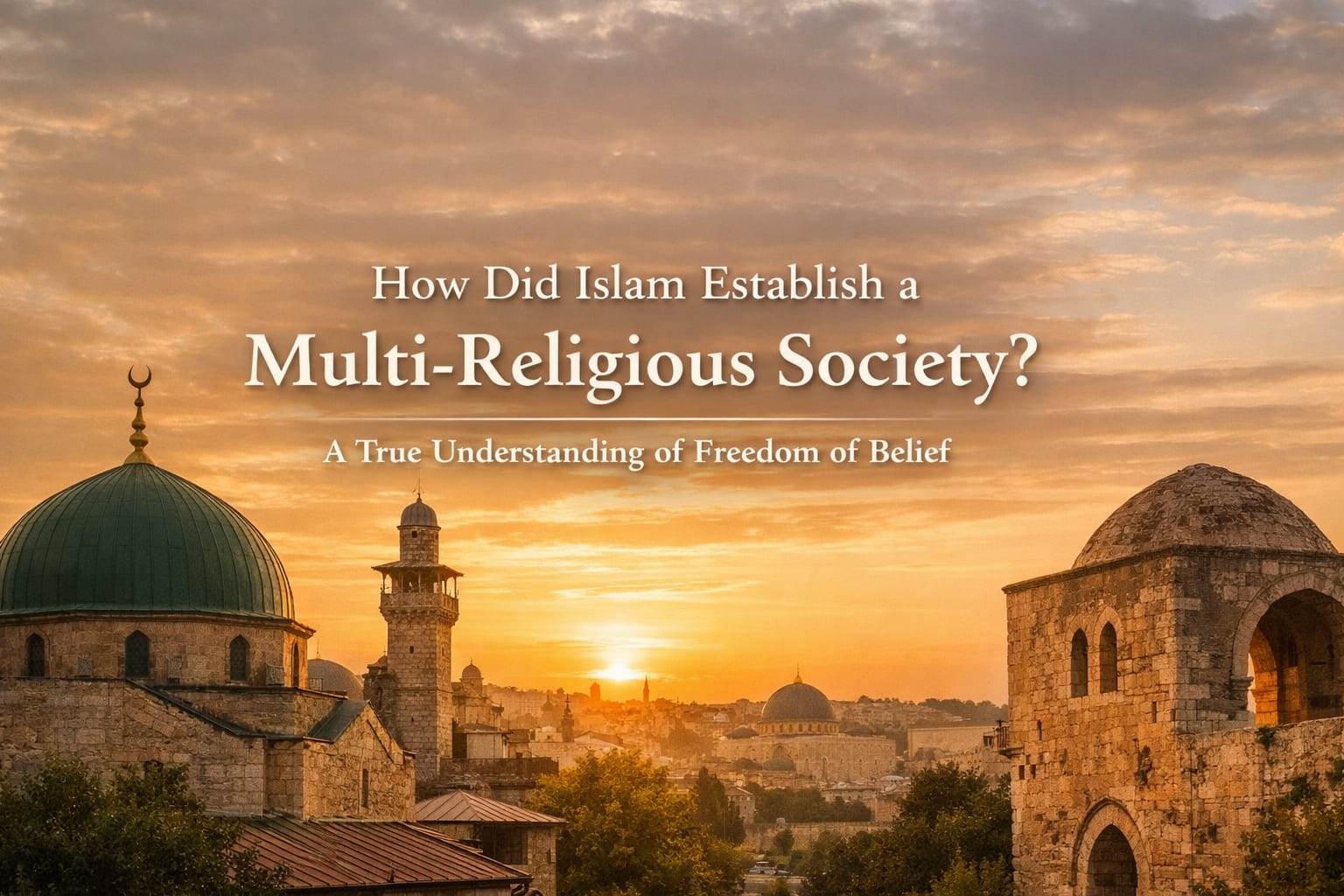
 How Did Islam Establish a Multi-Religious Society?
How Did Islam Establish a Multi-Religious Society?
A True Understanding of Freedom of Belief
Introduction
A crucial question often arises today: can people of different religions truly coexist within one society without conflict?
Islam presents a unique historical model of a multi-religious society built upon justice, mercy, and freedom of belief.
Islam did not come to force people into faith, but to present the truth and leave individuals free to choose, while guaranteeing rights for all—Muslims and non-Muslims alike.
First: Freedom of Belief as a Fundamental Principle in Islam
One of the greatest principles established in the Qur’an is:
“There is no compulsion in religion.” (Qur’an 2:256)
This is not merely a slogan, but a foundational rule that affirms freedom of religious choice.
True faith cannot be forced—it must come from conviction.
Allah also says:
“The truth is from your Lord, so whoever wills—let him believe; and whoever wills—let him disbelieve.” (Qur’an 18:29)
This clearly shows that Islam acknowledges human freedom in choosing belief, while holding individuals accountable for their choices.
Second: Islam Recognizes Religious Diversity as a Human Reality
Islam does not deny differences among people; rather, it acknowledges them as part of divine wisdom.
Allah says:
“If your Lord had willed, He could have made mankind one community, but they will continue to differ.” (Qur’an 11:118)
This means that religious diversity is not an error to be eliminated by force, but a reality to be managed with justice and wisdom.
Third: The Model of Medina – The First Multi-Religious Society
When the Prophet Muhammad ﷺ migrated to Medina, he established a society that included:
-
Muslims
-
Jews
-
Some polytheists
He drafted a historic document known as the Constitution of Medina, one of the earliest written social contracts.
Among its principles:
-
“The Jews have their religion, and the Muslims have theirs”
-
Mutual cooperation in defending the city
-
Justice for all members of society
This demonstrates that Islam accepted religious diversity within one community while preserving rights.
Fourth: Justice Toward Non-Muslims in Islam
Islam commands justice for all, regardless of religion.
Allah says:
“Allah does not forbid you from being kind and just to those who did not fight you because of religion nor expel you from your homes.” (Qur’an 60:8)
This establishes that the default relationship with non-Muslims is:
-
Kindness
-
Justice
Not hostility.
Fifth: Examples from the Prophetic Tradition
The Prophet ﷺ embodied these principles in practice:
-
Kind and Fair Dealings
He engaged in trade and daily interactions with non-Muslims. At the time of his death, his armor was pledged to a Jewish man.
-
Respect for Human Dignity
When a Jewish funeral passed by, the Prophet ﷺ stood up. When told it was a Jewish funeral, he said:
“Is it not a human soul?”
This reflects profound respect for human dignity, regardless of faith.
-
Protection of Non-Muslims
The Prophet ﷺ said:
“Whoever kills a person under covenant will not smell the fragrance of Paradise.”
This highlights the sanctity of non-Muslim lives under protection.
Sixth: Examples from the Companions
🔹 Umar ibn Al-Khattab (RA)
When he entered Jerusalem, he granted safety to its people, including:
-
Their churches
-
Their wealth
-
Their lives
He even refused to pray inside a church so it would not later be taken as a mosque.
🔹 Ali ibn Abi Talib (RA)
He stood in court as an equal against a non-Muslim in a dispute over armor, and judgment was given fairly.
Seventh: Examples from the Successors (Tabi‘in) and Scholars
This approach continued after the Companions:
-
Scholars emphasized the rights of non-Muslims
-
They declared injustice forbidden regardless of a person’s religion
Some scholars stated:
“They have rights similar to ours and responsibilities similar to ours,” within the framework of justice.
Eighth: The Balance Between Da‘wah and Freedom of Choice
Islam invites people to the truth but does not force them.
Allah says:
“Invite to the way of your Lord with wisdom and good instruction.” (Qur’an 16:125)
Da‘wah is based on:
-
Wisdom
-
Dialogue
-
Persuasion
Not coercion.
Ninth: Why the Islamic Model Succeeded (Rational Perspective)
From a rational standpoint, any system based on coercion:
-
Creates hypocrisy
-
Leads to conflict
Whereas a system based on freedom and justice:
-
Promotes stability
-
Encourages coexistence
Islam achieved this balance by combining:
👉 Firm belief
👉 Respect for others’ freedom
Tenth: Between Reality and Misconceptions
Some claim Islam spread by the sword, but history shows otherwise:
-
Many regions embraced Islam without force
-
Non-Muslims lived within Islamic societies for centuries
This proves that the foundation was conviction, not coercion.
Conclusion
Islam established a unique model for a multi-religious society built on:
-
Freedom of belief
-
Justice for all
-
Respect for human dignity
Islam is not a religion of compulsion, but one of wisdom in calling others, fairness in dealings, and mercy for all.
Understanding Islam correctly reveals that coexistence is not optional—it is part of its core teachings.
Islam does not demand that all people become identical, but that they live together in justice and peace, with freedom of choice preserved for every individual.
Join IslamLearn Academy for free and gain authentic Islamic knowledge in a simple and clear way, guided by qualified scholars.
Subscribe now to IslamLearn Academy for free
Related Posts
2 September 2026
Is Islam a Continuation of Christianity?
Is Islam a Continuation of Christianity or a Correction of It? Introduction When Islam emerged...
 Read More
30 August 2026
Jesus in Islam and Christianity: Key Differences
Who Is Jesus in Islam and Christianity? A Comparative Reading of the Qur’an and the...
Read More
Search
Categories
Tags
Recent Posts
Is Islam a Continuation of Christianity?
Is Islam a Continuation of...
Jesus in Islam and Christianity: Key Differences
Who Is Jesus in Islam...
How Was the Quran Preserved Before Printing? Complete Guide
How Was the Quran Preserved...

The Story of Uthman ibn Affan: The Third Rightly Guided Caliph
The Story of Uthman ibn...
How to Become a Muslim: A Complete Step-by-Step Guide
How to Convert to Islam:...