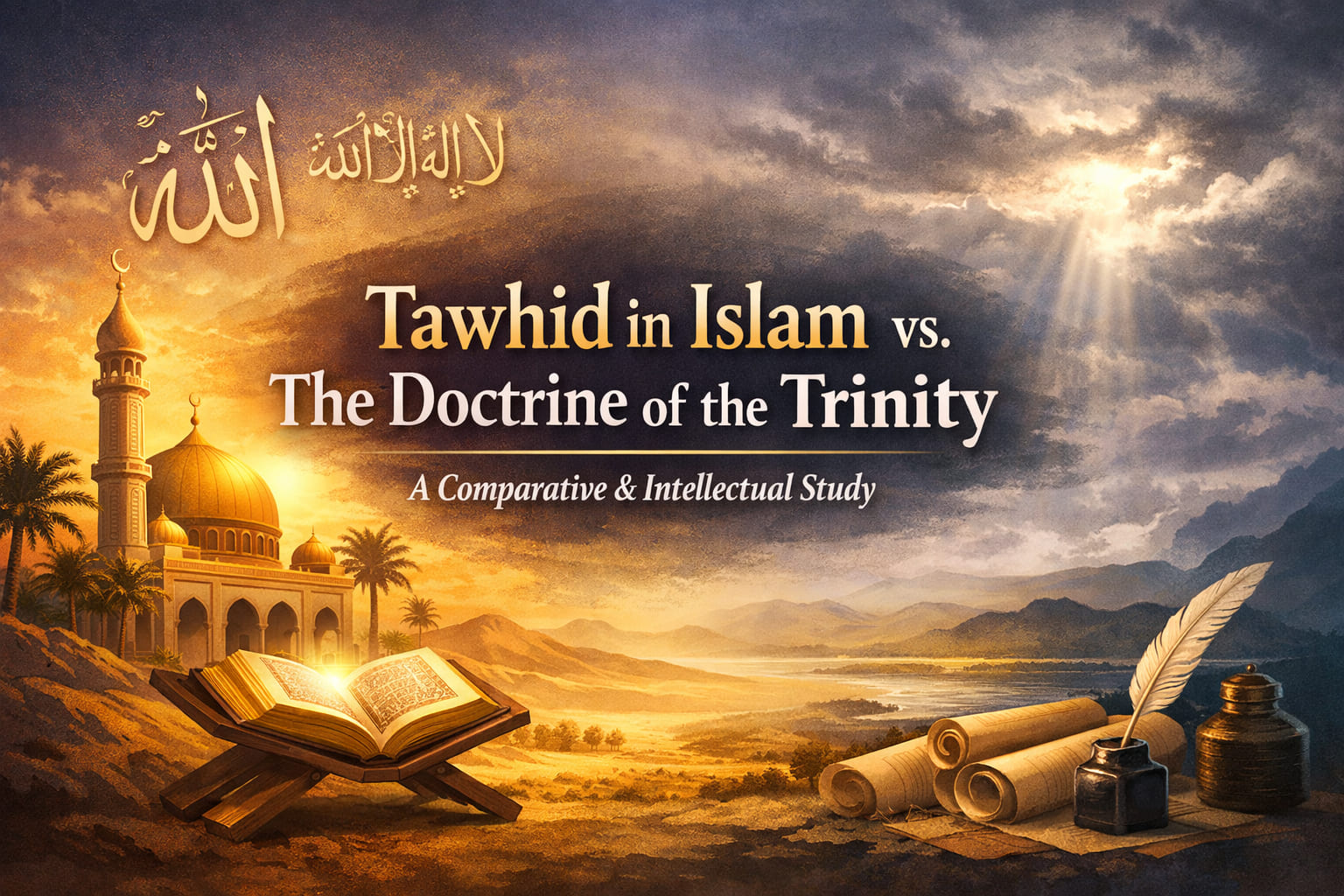
2 June 2026
 Is God One or Three? Islamic Monotheism and the Trinity
Is God One or Three? Islamic Monotheism and the Trinity
Introduction
Belief in God is one of the most important subjects that has occupied religious and philosophical thought throughout history. While all revealed religions call people to worship God, their understanding of God’s nature and oneness differs significantly.
Islam is founded upon the principle of pure monotheism (Tawhid), whereas traditional Christianity embraces the doctrine of the Trinity. This article explores the Islamic concept of monotheism and compares it with the doctrine of the Trinity, highlighting the rational and scriptural arguments that demonstrate the clarity and simplicity of Islamic belief in God.
First: The Concept of Tawhid in Islam
Tawhid is the foundation of Islamic belief. It is the conviction that God is One, without partners in His essence, attributes, actions, or worship.
The Quran summarizes this concept in a short but profound chapter:
“Say: He is Allah, the One. Allah, the Eternal Refuge. He neither begets nor is born, nor is there anything comparable to Him.”
(Quran 112:1–4)
This chapter establishes four fundamental truths:
-
God is One and indivisible.
-
God is the Eternal Refuge upon whom all creation depends.
-
He neither begets nor is born.
-
Nothing is comparable to Him.
The Three Categories of Tawhid
1. Tawhid al-Rububiyyah (Oneness of Lordship)
This is the belief that Allah alone is the Creator and Sustainer of the universe.
“Allah is the Creator of all things.”
(Quran 39:62)
2. Tawhid al-Uluhiyyah (Oneness of Worship)
This means dedicating all acts of worship exclusively to Allah.
“And they were not commanded except to worship Allah, being sincere to Him in religion.”
(Quran 98:5)
3. Tawhid al-Asma wa al-Sifat (Oneness of Allah’s Names and Attributes)
This involves affirming the names and attributes that Allah has described Himself with, without distortion, comparison, or likeness to creation.
Together, these categories present a clear and simple understanding of God: one perfect, absolute, and unique Creator with no partners.
Second: The Concept of the Trinity in Christian Theology
In traditional Christian doctrine, God is understood as one being existing in three persons:
-
The Father
-
The Son (Jesus Christ)
-
The Holy Spirit
These three persons are said to share one divine essence while remaining distinct persons.
This doctrine developed through church councils during the early centuries of Christianity, particularly:
-
The Council of Nicaea (325 CE), which affirmed the divinity of Christ.
-
The Council of Constantinople (381 CE), which affirmed the divinity of the Holy Spirit.
As a result, the Trinity became a central doctrine of mainstream Christian theology.
Third: A Rational Comparison Between Tawhid and the Trinity
1. Simplicity and Clarity
Islamic monotheism presents a straightforward concept:
There is only one God.
The doctrine of the Trinity, however, seeks to combine two ideas:
- God is One.
- God exists as three persons.
This raises questions such as:
- If each person is fully God, how is God one?
- If there are three distinct persons, how does this not constitute plurality?
For this reason, many thinkers find Tawhid more consistent with human reason and logic.
2. The Indivisibility of God
A perfect God must be absolute and indivisible.
If God consists of three persons, two possibilities arise:
- Each person is only part of God, making God composite.
- Each person is fully God, resulting in three gods.
Both possibilities appear inconsistent with the concept of one absolute God.
Islam, by contrast, teaches that God is One and indivisible, which aligns with the concept of divine perfection.
3. The Question of Incarnation
Christian theology teaches that God became incarnate in Jesus Christ.
This raises philosophical questions:
- How can the infinite God become a finite human being?
- How can human limitations coexist with absolute divine power?
Islam rejects the concept of incarnation entirely because God transcends His creation.
The Quran states:
“There is nothing like unto Him.”
(Quran 42:11)
God does not resemble His creation and does not transform into a human being.
Fourth: Scriptural Evidence in the Quran
The Quran explicitly rejects the doctrine of the Trinity and emphasizes God’s absolute oneness.
Allah says:
“They have certainly disbelieved who say, ‘Allah is the third of three.’ There is no god except One God.”
(Quran 5:73)
The Quran also teaches that Jesus himself called people to worship God alone:
“Indeed, Allah is my Lord and your Lord, so worship Him. That is the straight path.”
(Quran 3:51)
And Allah says:
“The Messiah, son of Mary, was no more than a messenger.”
(Quran 5:75)
These verses affirm the Islamic belief that Jesus was a noble prophet and messenger, not God.
Fifth: Monotheism as the Message of All Prophets
Islam teaches that all prophets conveyed the same essential message: worship God alone.
Allah says:
“And We did not send before you any messenger except that We revealed to him: ‘There is no deity except Me, so worship Me.’”
(Quran 21:25)
According to Islam, the message of Noah, Abraham, Moses, Jesus, and Muhammad (peace be upon them all) was fundamentally the same:
Worship God alone without partners.
Muslims therefore believe that the doctrine of the Trinity emerged later as a theological development rather than being part of the original message of the prophets.
Sixth: The Impact of Tawhid on Human Life
In Islam, Tawhid is not merely a theological concept; it shapes every aspect of a believer’s life.
1. Freedom from the Worship of Human Beings
Belief in one God liberates a person from submission to any supposedly sacred human authority.
2. Equality Among People
All human beings are servants of God, and no individual possesses inherent divine status over others.
3. Spiritual Balance and Inner Peace
Faith in one God provides comfort, purpose, and tranquility.
Allah says:
“Verily, in the remembrance of Allah do hearts find rest.”
(Quran 13:28)
Conclusion
Islam presents a clear and coherent understanding of God based on pure monotheism: belief in one absolute God without partners.
This concept is distinguished by its simplicity and harmony with both reason and human nature. By contrast, the doctrine of the Trinity raises philosophical and logical questions concerning the nature and unity of God.
For this reason, Muslims believe that Islamic monotheism represents the natural continuation of the message brought by all prophets and expresses the fundamental truth upon which the relationship between humanity and its Creator is built:
The worship of the One and Only God, without any partner or associate.
Join IslamLearn Academy for free and gain authentic Islamic knowledge in a simple and clear way, guided by qualified scholars.
Related Posts
2 September 2026
Is Islam a Continuation of Christianity?
Is Islam a Continuation of Christianity or a Correction of It? Introduction When Islam emerged...
 Read More
30 August 2026
Jesus in Islam and Christianity: Key Differences
Who Is Jesus in Islam and Christianity? A Comparative Reading of the Qur’an and the...
Read More
Search
Categories
Tags
Recent Posts
Is Islam a Continuation of Christianity?
Is Islam a Continuation of...
Jesus in Islam and Christianity: Key Differences
Who Is Jesus in Islam...
How Was the Quran Preserved Before Printing? Complete Guide
How Was the Quran Preserved...

The Story of Uthman ibn Affan: The Third Rightly Guided Caliph
The Story of Uthman ibn...
How to Become a Muslim: A Complete Step-by-Step Guide
How to Convert to Islam:...