2 May 2026
 Why Do Muslims Believe in All the Prophets?
Why Do Muslims Believe in All the Prophets?
Introduction
Many non-Muslims may wonder: Why do Muslims believe in all the prophets, rather than in just one?
And why do Muslims believe in prophets who are revered by followers of other religions, such as Abraham, Moses, and Jesus (peace be upon them all)?
In fact, belief in all the prophets is not a secondary idea in Islam. It is a fundamental pillar of Islamic faith, without which a Muslim’s belief is incomplete.
This article explains the concept in a simple way and highlights the human and rational dimensions behind this comprehensive belief.
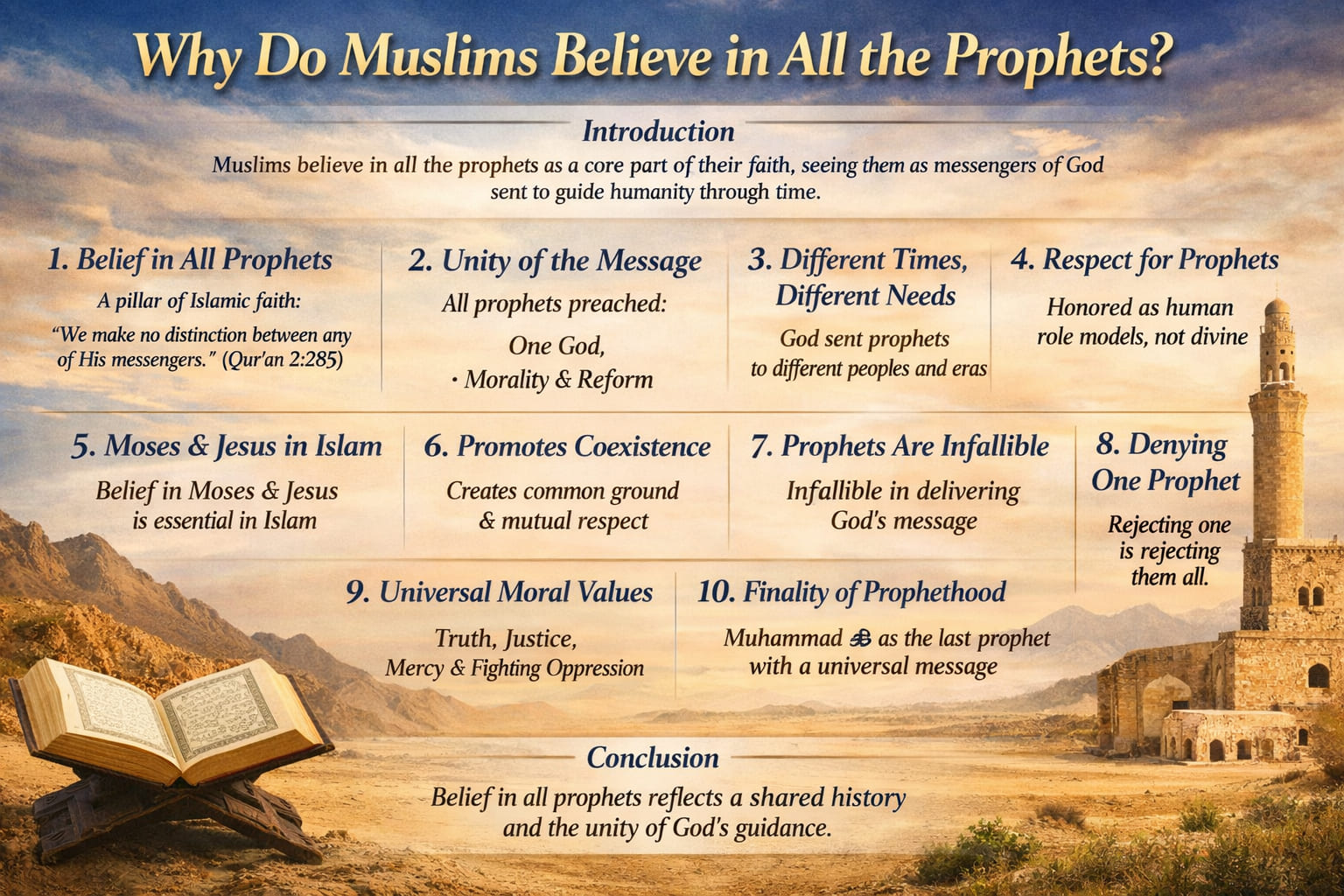
First: Belief in the Prophets Is a Fundamental Pillar in Islam
Muslims believe that God sent messengers and prophets throughout history to guide humanity—not just one nation or people.
The Qur’an states:
“The Messenger has believed in what was revealed to him from his Lord, and so have the believers. All of them have believed in God, His angels, His books, and His messengers, saying: ‘We make no distinction between any of His messengers.’”
(Qur’an, Al-Baqarah 2:285)
This verse establishes the principle of believing in and respecting all prophets without discrimination.
Second: Unity of the Message and Diversity of Times
From the Islamic perspective, all prophets came with one core message, which is:
-
Belief in one God
-
Calling to moral values
-
Reforming individuals and societies
The differences among them were in:
-
Time
-
Place
-
Specific laws and regulations
Just as civil laws change according to societies and eras, divine laws were revealed gradually, suited to each community, while the moral and spiritual foundation remained the same.
Third: Why Didn’t God Send Only One Prophet?
Islam teaches that humanity:
-
Passed through different stages of development
-
Lived in diverse environments and cultures
-
Needed repeated reminders and reform
Therefore, God sent:
-
Noah to his people
-
Abraham as a leader of monotheism
-
Moses to the Children of Israel
-
Jesus (peace be upon him) at a later stage
-
And finally Muhammad ﷺ as the last prophet with a universal message
Belief in all prophets reflects God’s justice and mercy toward all humanity.
Fourth: The Status of the Prophets in Islam
Islam views the prophets as:
-
Moral role models
-
Human beings chosen by God
-
Messengers conveying God’s guidance—not gods or sons of God
Islam rejects:
-
Deifying prophets
-
Disrespecting or diminishing them
-
Favoring some over others based on race or ethnicity
This balanced position preserves both the sanctity of the message and the humanity of the prophets.
Fifth: Why Do Muslims Believe in Moses and Jesus?
Some may be surprised to learn that:
-
Belief in Moses and Jesus is a condition for being Muslim
-
Denying either of them invalidates one’s faith in Islam
Islam teaches that:
-
Moses was a great prophet and lawgiver
-
Jesus (peace be upon him) was a noble prophet, born miraculously
-
Both called people to worship God alone
Sixth: Belief in All Prophets Promotes Coexistence
This inclusive belief creates:
-
Common ground among religions
-
Mutual respect between their followers
-
A deeper understanding of humanity’s shared origin
Thus, Islam does not see itself as an isolated religion, but as a continuation of a single chain of faith that began at the dawn of humanity.
Seventh: Are the Prophets Infallible in Islam?
Muslims believe that prophets are:
-
Infallible in conveying God’s message
-
Human beings who experienced real-life trials
-
Presented as realistic role models supported by divine miracles
This strengthens:
-
Practical emulation of their lives
-
A sense of closeness between prophets and people
-
Understanding religion as a way of life, not a mythical story
Eighth: Why Is Denying One Prophet Considered Denying Them All?
Islamic logic is straightforward:
-
The message comes from one source
-
Belief in that source requires belief in all His messengers
Therefore, denying a single prophet ultimately means questioning the authenticity of the divine message itself.
Ninth: The Prophets and the Universal Moral Message
All prophets called for:
-
Truthfulness
-
Justice
-
Mercy
-
Respect for human dignity
-
Fighting oppression
These values are not exclusive to one religion. They form the moral conscience of humanity, making belief in the prophets a universal concept rather than a limited one.
Tenth: Why Does Islam End with Prophet Muhammad ﷺ?
Muslims believe that the message of Muhammad ﷺ:
-
Is comprehensive
-
Is valid for all times and places
-
Has been preserved from distortion
Thus, prophethood ended not because humanity no longer needs guidance, but because the final message was completed and made universal.
Conclusion
Muslims’ belief in all the prophets is not mere religious tradition. It represents:
-
A comprehensive view of human history
-
An affirmation of the unity of divine guidance
-
A call for understanding rather than conflict
Islam does not begin with Muhammad ﷺ alone. It sees itself as the final link in a long chain of guidance founded on justice, mercy, and belief in one God.
Join IslamLearn Academy for free and gain authentic Islamic knowledge in a simple and clear way, guided by qualified scholars.
Related Posts
2 September 2026
Is Islam a Continuation of Christianity?
Is Islam a Continuation of Christianity or a Correction of It? Introduction When Islam emerged...
 Read More
30 August 2026
Jesus in Islam and Christianity: Key Differences
Who Is Jesus in Islam and Christianity? A Comparative Reading of the Qur’an and the...
Read More
Search
Categories
Tags
Recent Posts
Is Islam a Continuation of Christianity?
Is Islam a Continuation of...
Jesus in Islam and Christianity: Key Differences
Who Is Jesus in Islam...
How Was the Quran Preserved Before Printing? Complete Guide
How Was the Quran Preserved...

The Story of Uthman ibn Affan: The Third Rightly Guided Caliph
The Story of Uthman ibn...
How to Become a Muslim: A Complete Step-by-Step Guide
How to Convert to Islam:...