9 June 2026
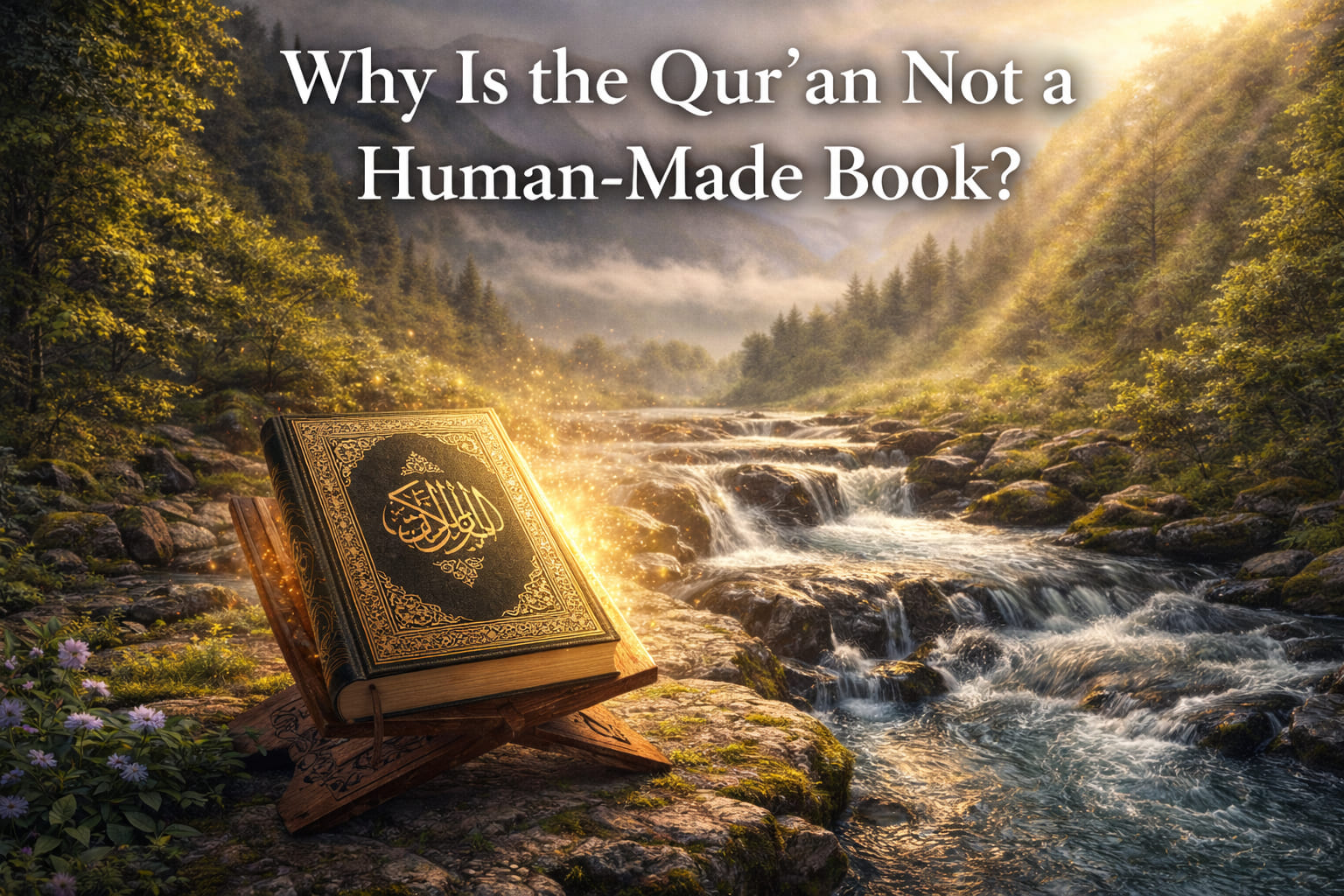
 Why Is the Qur’an Not a Human-Made Book?
Why Is the Qur’an Not a Human-Made Book?
Linguistic, Historical, and Rational Evidence
Introduction
Why Is the Qur’an Not a Human-Made Book? This question has been discussed by believers, skeptics, philosophers, and historians for centuries. The Qur’an does not merely claim to contain divine guidance; it explicitly presents itself as the literal word of God revealed to Prophet Muhammad ﷺ.
For Muslims, the Qur’an is the final revelation from God. However, even from a purely rational and historical perspective, the Qur’an possesses unique characteristics that distinguish it from ordinary human writings. Its linguistic structure, historical accuracy, preservation, internal consistency, and transformative influence have led countless scholars to conclude that the Qur’an cannot reasonably be explained as a human invention.
This article examines the evidence for the divine origin of the Qur’an and explores why many researchers consider the Qur’an fundamentally different from any human-made book.
Why Is the Qur’an Not a Human-Made Book? The Qur’anic Challenge
One of the most remarkable aspects of the Qur’an is its open challenge to humanity:
“Say: If mankind and jinn gathered together to produce the like of this Qur’an, they could not produce the like of it, even if they assisted one another.”
(Qur’an 17:88)
Unlike philosophical arguments that remain theoretical, this challenge is practical. The Qur’an invites its critics to produce something comparable to it.
The challenge was gradually reduced:
-
Produce an entire book like it.
-
Produce ten chapters like it.
-
Produce even a single chapter comparable to it.
For more than fourteen centuries, countless critics have attempted to answer this challenge, yet no text has achieved widespread recognition as an equal to the Qur’an in language, structure, meaning, and impact.
If the Qur’an were merely a human composition, one would expect successful imitation to be possible, especially among generations of highly skilled Arabic linguists and literary experts.
Linguistic Evidence That the Qur’an Is Not a Human-Made Book
The Qur’an emerged in seventh-century Arabia, a society renowned for eloquence and poetry. Arabs celebrated linguistic excellence and considered poetry one of the highest forms of artistic achievement.
Yet the Qur’an introduced a literary form unlike anything previously known.
Unique Literary Style
The Qur’an is neither poetry nor ordinary prose. It follows patterns that differ from both classical Arabic poetry and traditional speech.
Precision of Language
The Qur’an consistently employs words with extraordinary precision. Terms are selected in ways that fit both immediate context and broader themes throughout the text.
Depth of Meaning
Many verses convey multiple layers of meaning while remaining concise and memorable. This combination of brevity and depth is one reason the Qur’an continues to be studied centuries after its revelation.
Structural Harmony
Modern literary studies have identified intricate thematic and structural relationships between chapters and verses. These patterns contribute to a remarkable sense of unity throughout the text.
The linguistic uniqueness of the Qur’an forms one of the strongest arguments against the claim that it is a human-made book.
Could an Illiterate Man Produce the Qur’an?
Another important question is whether Prophet Muhammad ﷺ could have authored the Qur’an himself.
Historical sources consistently describe Muhammad ﷺ as unlettered. He was not known as a poet, philosopher, theologian, or scholar before receiving revelation.
Consider the following facts:
-
He did not attend schools of learning.
-
He did not study previous religious scriptures formally.
-
He lived in a largely tribal society.
-
He had no known literary works before the Qur’an.
Yet the Qur’an addresses:
-
Theology
-
Ethics
-
Law
-
Human psychology
-
Social organization
-
Historical narratives
-
Spiritual development
The sudden appearance of a text with such complexity and influence raises profound questions regarding its origin.
If Muhammad ﷺ were its author, history would present an unparalleled example of literary genius emerging without precedent, education, or comparable works.
Historical Evidence for the Divine Origin of the Qur’an
The Qur’an contains numerous historical references that deserve attention.
Correcting Earlier Narratives
In several cases, the Qur’an differs from existing religious traditions and presents details that many historians consider more historically plausible.
Knowledge Unknown to Arabian Society
The Qur’an discusses ancient civilizations such as:
- Pharaoh’s Egypt
- The people of Aad
- The people of Thamud
- Ancient prophets and nations
Many of these accounts would have been difficult to access accurately within the social environment of seventh-century Arabia.
Accurate Historical References
The Qur’an frequently demonstrates awareness of historical realities that have continued to attract scholarly interest.
These observations contribute to the broader discussion of whether the Qur’an could realistically have been produced by a human author living in that context.
Prophecies and Knowledge Beyond Human Prediction
Another reason many people ask, “Why Is the Qur’an Not a Human-Made Book?”, is its discussion of future events.
One famous example is the prediction concerning the Byzantine Empire.
At a time when the Byzantines suffered devastating military defeats, the Qur’an stated that they would eventually regain victory.
This prediction appeared unlikely when it was made. Yet historical events unfolded in a manner consistent with the Qur’anic announcement.
The Qur’an also contains references to:
-
The peaceful return to Mecca.
-
The preservation of the revelation.
-
The spread of Islam.
Supporters argue that these fulfilled predictions provide evidence that the Qur’an originates from a source beyond ordinary human knowledge.
The Internal Consistency of the Qur’an
The Qur’an was revealed over approximately twenty-three years.
During this period, circumstances changed dramatically:
-
Persecution and hardship
-
Migration
-
Political leadership
-
Military conflict
-
Social transformation
Despite these changes, the Qur’an maintains:
Consistent Theology
The central message of monotheism remains unchanged from beginning to end.
Consistent Ethics
The moral principles of justice, mercy, honesty, and accountability remain stable throughout the revelation.
Absence of Contradictions
The Qur’an itself draws attention to this point:
“Had it been from anyone other than God, they would surely have found within it many contradictions.”
Maintaining such coherence over two decades under constantly changing conditions would be exceptionally difficult for any human author.
The Qur’an’s Legal and Moral System
The Qur’an introduced a legal and ethical framework that transformed Arabian society.
Its teachings address:
- Family relationships
- Economic transactions
- Social justice
- Criminal law
- Charity
- Governance
- Human rights
A notable feature of Qur’anic legislation is balance.
It balances:
- Rights and responsibilities
- Justice and mercy
- Individual freedom and social welfare
- Spiritual and material concerns
Importantly, the Qur’an does not merely empower authority figures. It places restrictions upon them, including the Prophet ﷺ himself.
This characteristic differs significantly from texts that primarily serve the interests of their authors.
Why the Preservation of the Qur’an Matters
A key reason why many scholars consider the Qur’an unique is its preservation.
Memorization Tradition
From the earliest generations, Muslims memorized the Qur’an in its entirety.
Today, millions of people around the world continue this tradition.
Written Preservation
Ancient Qur’anic manuscripts discovered in different regions correspond substantially with the text recited today.
Global Uniformity
Despite being read by diverse cultures and nations, the Qur’an remains remarkably consistent.
This level of preservation is unusual among ancient texts and strengthens the argument that the Qur’an occupies a unique position in religious history.
The Global Impact of the Qur’an
The influence of the Qur’an extends far beyond literature.
It helped transform:
-
Tribal societies into a civilization.
-
Oral cultures into centers of learning.
-
Fragmented communities into a global religious tradition.
Inspired by Qur’anic teachings, Muslims contributed significantly to:
-
Science
-
Medicine
-
Mathematics
-
Philosophy
-
Architecture
-
Education
Few books in human history have produced such enduring and widespread influence.
The impact of the Qur’an continues today, shaping the beliefs and practices of more than a billion people worldwide.
Conclusion: Why Is the Qur’an Not a Human-Made Book?
After examining the linguistic uniqueness of the Qur’an, its historical accuracy, fulfilled predictions, internal consistency, preservation, legal framework, and civilizational impact, the question becomes increasingly significant.
Why Is the Qur’an Not a Human-Made Book?
While individuals may reach different conclusions, the evidence demonstrates that the Qur’an is far more than an ordinary literary work. Its unique characteristics have challenged scholars, critics, and believers for centuries.
For Muslims, these characteristics point clearly to divine revelation. For seekers of truth, they provide compelling reasons to investigate the Qur’an carefully and objectively.
The Qur’an continues to issue the same challenge it presented more than fourteen centuries ago—a challenge that remains at the center of the discussion about its origin and authenticity.
Join IslamLearn Academy for free and gain authentic Islamic knowledge in a simple and clear way, guided by qualified scholars.
Related Posts
2 September 2026
Is Islam a Continuation of Christianity?
Is Islam a Continuation of Christianity or a Correction of It? Introduction When Islam emerged...
 Read More
30 August 2026
Jesus in Islam and Christianity: Key Differences
Who Is Jesus in Islam and Christianity? A Comparative Reading of the Qur’an and the...
Read More
Search
Categories
Tags
Recent Posts
Is Islam a Continuation of Christianity?
Is Islam a Continuation of...
Jesus in Islam and Christianity: Key Differences
Who Is Jesus in Islam...
How Was the Quran Preserved Before Printing? Complete Guide
How Was the Quran Preserved...
The Story of Uthman ibn Affan: The Third Rightly Guided Caliph
The Story of Uthman ibn...
How to Become a Muslim: A Complete Step-by-Step Guide
How to Convert to Islam:...