23 May 2026
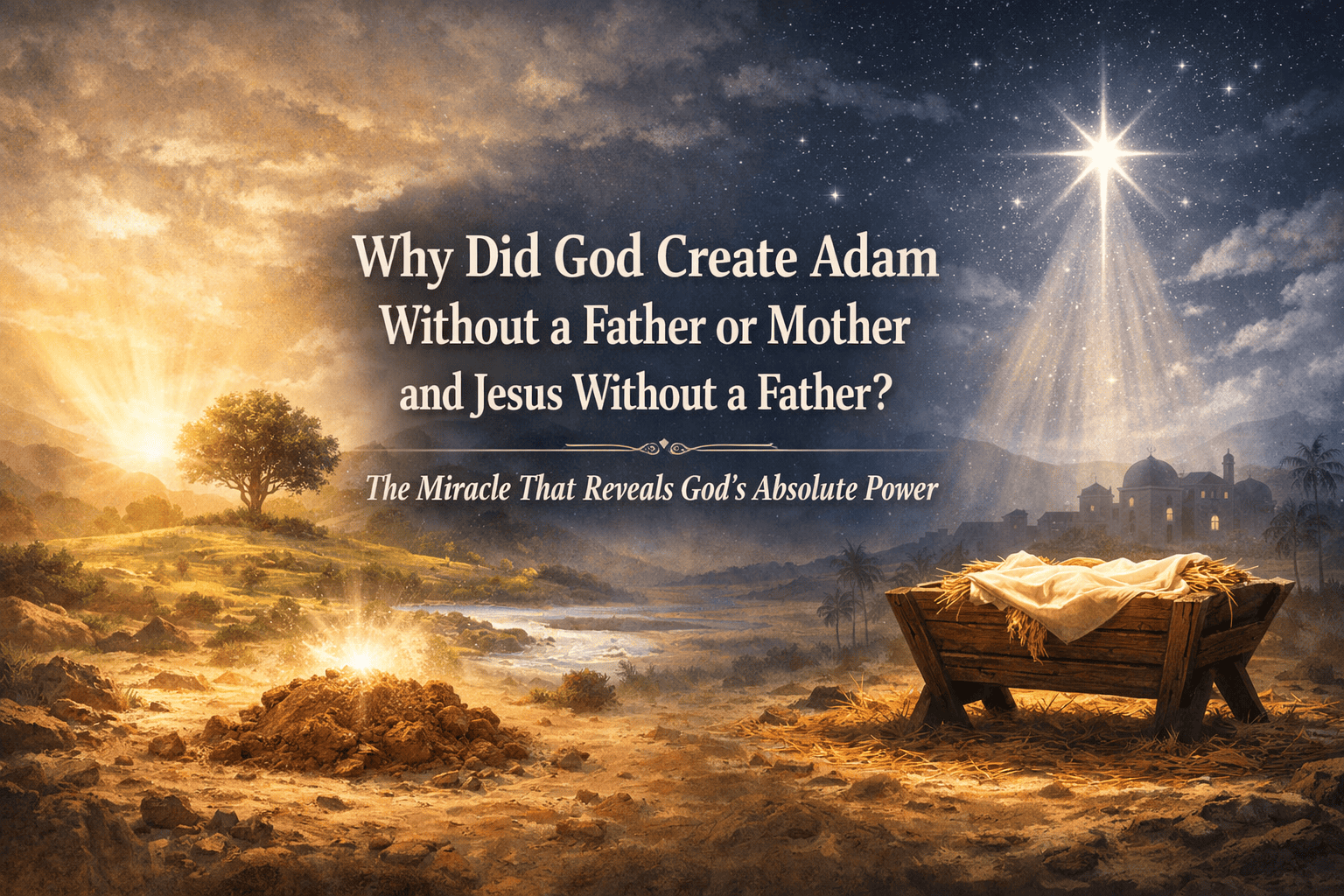
 Why Was Adam Parentless and Jesus Fatherless?
Why Was Adam Parentless and Jesus Fatherless?
Introduction
Many people ask an important question when they read about the creation of human beings in religious texts: Why did God create Adam without a father or a mother? And why was Jesus created from a mother without a father? Is there a wisdom or message behind these extraordinary events?
This question is not merely historical; it is deeply connected to understanding God’s power and the nature of creation in Islam. The Qur’an mentions these two exceptional cases to reveal an important truth: God is able to create in any way He wills, and the natural laws we observe are not limitations upon the Creator.
When we reflect on the Qur’anic texts, the teachings of the Prophet, and rational reasoning, we discover that the creation of Adam and Jesus (peace be upon them) carries a clear message: it demonstrates the absolute power of God and corrects misunderstandings about miracles.
In this article, we will explore this subject through three main perspectives: the Qur’anic evidence, the evidence from the Prophet’s teachings, and rational reflection.
First: Evidence from the Qur’an
The Qur’an clearly explains the creation of Adam (peace be upon him). God says:
“Indeed, the example of Jesus to Allah is like that of Adam. He created him from dust; then He said to him, ‘Be,’ and he was.”
(Qur’an 3:59)
This verse is one of the most important explanations of the relationship between the creation of Adam and the creation of Jesus. The Qur’an shows that the birth of Jesus without a father is not more extraordinary than the creation of Adam, who had neither father nor mother.
If some people find the birth of Jesus without a father astonishing, the creation of Adam is even more remarkable because he had no parents at all. Therefore, the Qur’an presents this comparison to show that such miracles do not imply divinity but rather demonstrate God’s creative power.
The Qur’an also explains how Adam was created in several places. For example, God says:
“And We certainly created man from an extract of clay.”
(Qur’an 23:12)
And He also says:
“Indeed, I will create a human being from clay.”
(Qur’an 38:71)
As for the creation of Jesus (peace be upon him), the Qur’an says:
“The angels said, ‘O Mary, indeed Allah gives you good news of a Word from Him, whose name will be the Messiah, Jesus, the son of Mary.’”
(Qur’an 3:45)
Mary then said:
“My Lord, how will I have a child when no man has touched me?”
God replied:
“Thus Allah creates what He wills.”
(Qur’an 3:47)
This verse highlights the central message: God creates whatever He wills in whatever way He wills.
Second: Evidence from the Teachings of the Prophet (Sunnah)
The teachings of Prophet Muhammad ﷺ also emphasize God’s power in creation.
The Prophet ﷺ said:
“Allah created Adam from a handful that He took from the entire earth.”
(Narrated by Al-Tirmidhi and Abu Dawud)
This narration explains that Adam’s creation was a great miracle and that the origin of humanity comes from the earth itself.
The Qur’an also describes the moment when Adam was given life:
“When I have fashioned him and breathed into him of My spirit, fall down before him in prostration.”
(Qur’an 15:29)
As for Jesus (peace be upon him), he was also given great miracles. The Qur’an mentions some of them:
“And I heal the blind and the leper and give life to the dead—by Allah’s permission.”
(Qur’an 3:49)
However, the Qur’an repeatedly emphasizes that these miracles occurred by Allah’s permission, meaning that Jesus was a noble prophet supported by God, not a divine being.
Third: Rational Reflection
When we reflect on the ways human beings were created, we notice that God demonstrated His power through four different forms of creation:
-
Adam was created without a father or mother.
-
Eve was created from Adam.
-
Jesus was created from a mother without a father.
-
All other humans are created from both a father and a mother.
This diversity in the methods of creation shows that the Creator is not limited by a single natural process.
The laws of nature we observe are simply systems established by God to organize the universe. However, the One who created these laws is not bound by them. He can suspend them or show exceptions whenever He wills.
If human creation were only possible through a father and mother, the first human could never have existed. Therefore, the creation of Adam was necessary as the beginning of humanity.
The birth of Jesus without a father was another divine miracle demonstrating that God can create without the usual means.
From a rational perspective, the clear conclusion is that these miracles are not evidence of divinity for any human being; rather, they are evidence of the power of the Creator.
Fourth: The Message of These Miracles for Humanity
The creation of Adam and Jesus carries an important message for all humanity: God is capable of everything.
He created the universe from nothing, created humans from clay, gives life to the dead, and creates in whatever way He wills.
These stories also correct misunderstandings about miracles. In Islam, a miracle does not mean that the person performing it is divine. Instead, it means that God supported a prophet with extraordinary signs to confirm the truth of his message.
Throughout history, prophets were given miracles:
-
Moses (peace be upon him) witnessed the sea part.
-
Abraham (peace be upon him) was saved from the fire.
-
Prophet Muhammad ﷺ was given the Qur’an as an everlasting miracle.
Yet none of these prophets ever claimed divinity.
Conclusion
The creation of Adam without a father or mother, and the creation of Jesus from a mother without a father, are not merely historical events. They are powerful signs of God’s absolute power.
The Qur’an presents a simple logical argument: if the creation of Adam without parents is possible, then the birth of Jesus without a father cannot be considered impossible.
These examples guide humanity toward a profound truth: God alone is the Creator who has power over everything. Miracles are not proof of the divinity of humans but evidence of the limitless power of the Creator.
Reflecting on these Qur’anic narratives leads people to a deeper understanding of monotheism and reminds us that the laws of nature cannot limit God, because He is the One who created those laws.
For this reason, the creation of Adam and Jesus (peace be upon them) remains one of the greatest signs of God’s power and unity, and a powerful reminder that the universe has a wise and all-powerful Creator.
Join IslamLearn Academy for free and gain authentic Islamic knowledge in a simple and clear way, guided by qualified scholars.
Related Posts
2 September 2026
Is Islam a Continuation of Christianity?
Is Islam a Continuation of Christianity or a Correction of It? Introduction When Islam emerged...
 Read More
30 August 2026
Jesus in Islam and Christianity: Key Differences
Who Is Jesus in Islam and Christianity? A Comparative Reading of the Qur’an and the...
Read More
Search
Categories
Tags
Recent Posts
Is Islam a Continuation of Christianity?
Is Islam a Continuation of...
Jesus in Islam and Christianity: Key Differences
Who Is Jesus in Islam...
How Was the Quran Preserved Before Printing? Complete Guide
How Was the Quran Preserved...
The Story of Uthman ibn Affan: The Third Rightly Guided Caliph
The Story of Uthman ibn...
How to Become a Muslim: A Complete Step-by-Step Guide
How to Convert to Islam:...