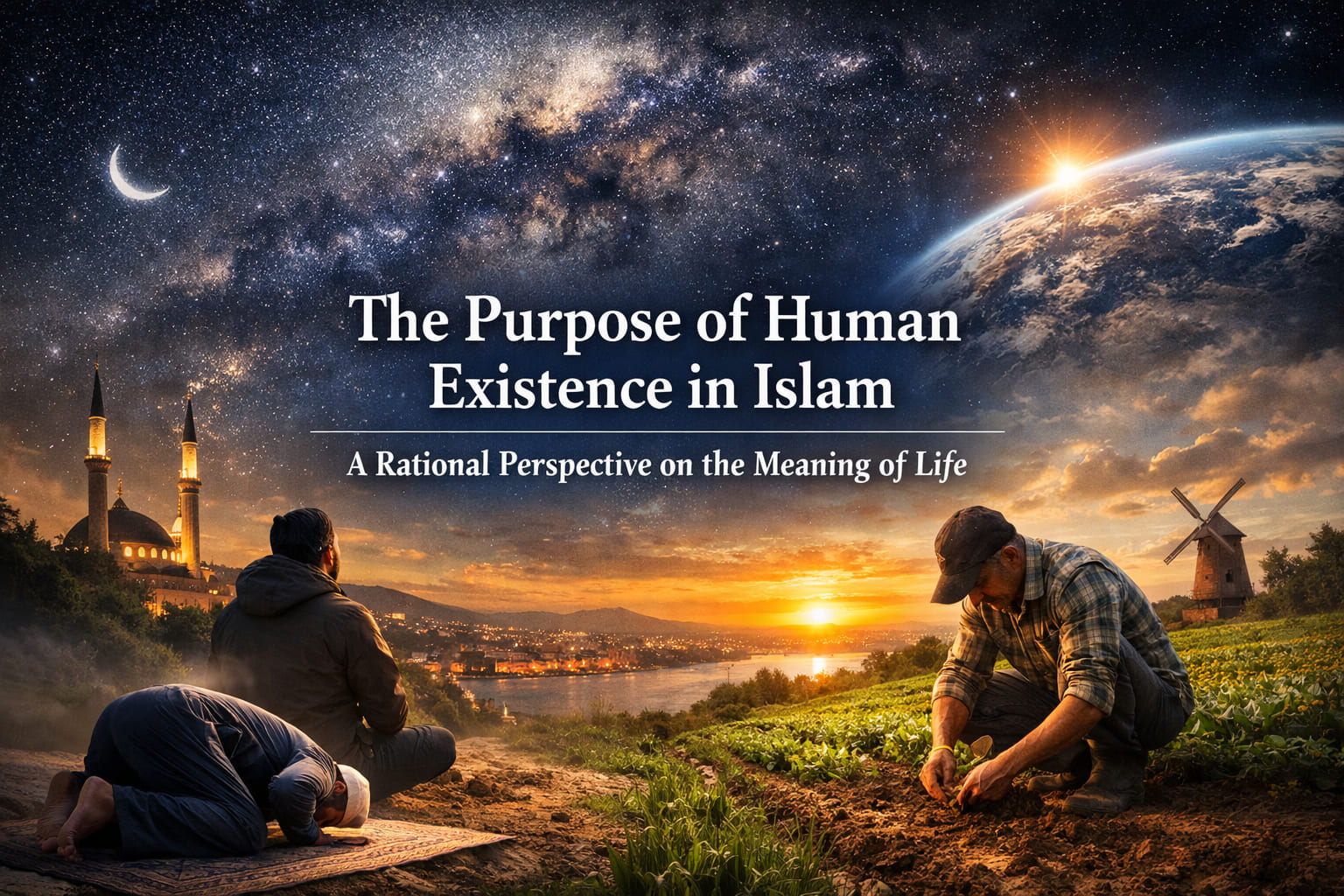
23 May 2026
 Why Were Humans Created? Islam’s Clear Answer
Why Were Humans Created? Islam’s Clear Answer
Introduction
The question of the purpose of human existence is one of the deepest existential questions that has occupied human thought throughout history. Despite remarkable scientific and technological progress, this question has not disappeared; rather, it has become more pressing, especially in an age marked by material abundance alongside a widespread sense of existential emptiness.
In this context, Islam offers a comprehensive understanding of human existence—one that is not based on blind faith alone, but rather integrates reason, innate human nature (fitrah), and moral purpose. This article seeks to present the Islamic conception of the purpose of human existence from a rational perspective, highlighting its internal coherence and its ability to provide a meaningful and consistent explanation of life.
First: The Question of Purpose as a Rational Necessity
The human intellect naturally rejects the idea of existence without purpose. Everything we observe in the universe—its order, precision, and harmony—leads us to ask not only how things function, but why they exist at all. Interpreting human existence as the product of blind chance raises a serious rational dilemma:
How can the most conscious, self-aware, and meaning-seeking being arise from a process devoid of meaning?
From this standpoint, Islam views the question of purpose not as a sign of intellectual weakness, but as evidence of intellectual maturity. Ignoring this question, on the other hand, often leads to nihilism and moral confusion.
Second: The Human Being in the Islamic Worldview as an Honored Creation
The Islamic worldview begins with the idea that the human being is an honored creation, not a random byproduct of nature. This honor does not imply perfection or moral infallibility, but rather signifies that human beings have been endowed with unique capacities, including:
-
Reason and critical thinking
-
Moral awareness
-
Freedom of choice and responsibility
These characteristics strongly indicate that the human being is not a purposeless entity, but a being created for a meaningful end and entrusted with a responsibility that transcends mere biological survival.
Third: Worship as a Comprehensive Concept
When Islam states that the purpose of human existence is worship, it does not restrict this concept to ritual practices in their narrow sense. Instead, worship is understood as a comprehensive way of life.
In the Islamic conception, worship includes:
-
Moral integrity and ethical conduct
-
Productive work and beneficial contribution
-
Justice, compassion, and accountability
-
Directing human behavior toward what is good and constructive
Thus, worship becomes a rational framework that gives life meaning, rather than a burden or a constraint imposed on human freedom.
Fourth: Stewardship and the Cultivation of the Earth
One of the central elements of the Islamic understanding of human existence is the concept of stewardship (khilāfah)—the responsibility to cultivate and care for the earth according to moral principles.
This concept offers a rational answer to the question: Why has the human being been granted such remarkable abilities?
Islam does not view work, knowledge, or civilizational progress as contradictions to faith, but as integral components of humanity’s existential purpose, so long as they are guided by justice and ethical responsibility. In this way, Islam transcends the false dichotomy between spirituality and material advancement.
Fifth: Freedom and Moral Responsibility
Islam affirms that human beings possess freedom of choice, yet this freedom is not absolute or unrestrained. Rather, it is inseparably linked to moral responsibility and accountability.
From a rational perspective, accountability is meaningless without purpose, and freedom loses its significance without a moral framework. By balancing freedom with responsibility, the Islamic worldview grants human actions genuine value, transforming them from random events into morally meaningful choices.
Sixth: The Meaning of Life in the Face of Nihilism
In the absence of a clear sense of purpose, human beings often fall into one of two extremes:
-
Immersion in fleeting pleasures
-
Or surrender to anxiety and nihilism
The Islamic perspective, however, offers a meaning of life that transcends the present moment without negating its value. Life is understood as a meaningful stage in which values are formed, character is tested, and moral integrity is developed.
This understanding enables individuals to endure hardship and suffering, as pain itself becomes part of a meaningful journey rather than evidence of an absurd existence.
Seventh: The Rational Coherence of the Islamic Worldview
What distinguishes the Islamic conception of human existence is its internal rational coherence. It:
-
Explains moral consciousness
-
Justifies the innate sense of responsibility
-
Provides meaning to good and evil
-
Offers a logical foundation for accountability and ultimate justice
In doing so, it surpasses purely materialistic explanations, which often fail to provide convincing answers to questions of value, meaning, and moral purpose.
Conclusion
Islam presents a comprehensive vision of the purpose of human existence—one that neither dismisses reason nor relies on unexamined belief. Instead, it addresses the human being as a conscious, free, and morally responsible agent.
Within this framework, life is not absurd, and humanity is not lost without direction. Rather, human beings are entrusted with a mission that transcends the self and imbues existence with genuine meaning.
The purpose of human existence in Islam is not merely a theological claim, but a rationally coherent worldview that explains existence and restores balance between reason, spirituality, and action.
Join IslamLearn Academy for free and gain authentic Islamic knowledge in a simple and clear way, guided by qualified scholars.
Related Posts
2 September 2026
Is Islam a Continuation of Christianity?
Is Islam a Continuation of Christianity or a Correction of It? Introduction When Islam emerged...
 Read More
30 August 2026
Jesus in Islam and Christianity: Key Differences
Who Is Jesus in Islam and Christianity? A Comparative Reading of the Qur’an and the...
Read More
Search
Categories
Tags
Recent Posts
Is Islam a Continuation of Christianity?
Is Islam a Continuation of...
Jesus in Islam and Christianity: Key Differences
Who Is Jesus in Islam...
How Was the Quran Preserved Before Printing? Complete Guide
How Was the Quran Preserved...
The Story of Uthman ibn Affan: The Third Rightly Guided Caliph
The Story of Uthman ibn...
How to Become a Muslim: A Complete Step-by-Step Guide
How to Convert to Islam:...