1 June 2026
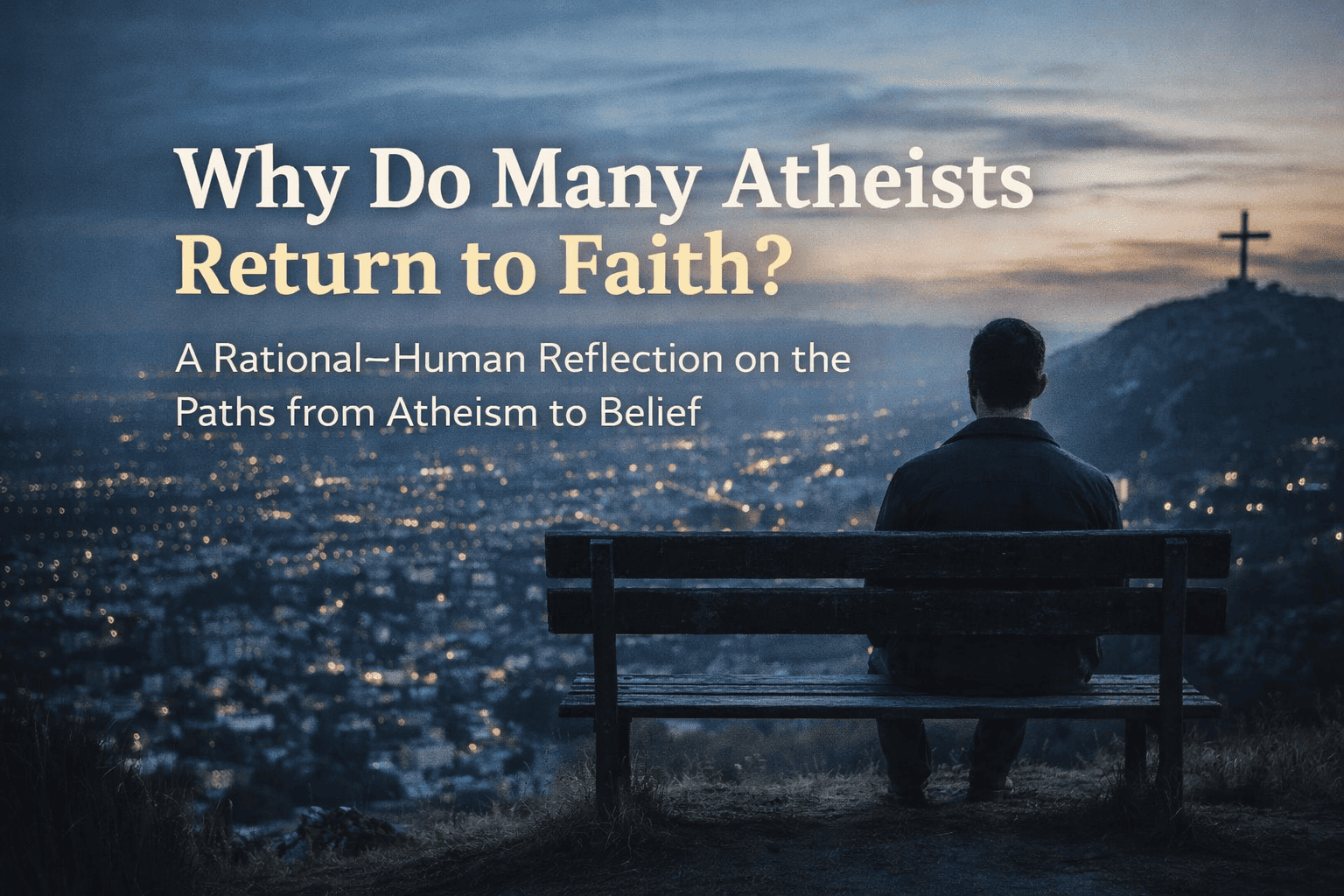
 Why Do Many Atheists Return to Faith?
Why Do Many Atheists Return to Faith?
A Rational–Human Reflection on the Paths from Atheism to Belief
Introduction
The contemporary world has witnessed a noticeable rise in atheistic discourse, particularly within academic and media environments. Yet alongside this trend exists a parallel phenomenon that often receives far less attention: the return of a significant number of atheists to faith after varying periods of doubt or denial.
This return cannot be reduced to emotional impulses or social pressure, as many of these individuals initially embraced atheism through rational and critical reasoning. What, then, leads them later to reconsider? And why do some ultimately find in faith an explanation more consistent with the totality of the human experience?
First: Atheism Is Not the End of Questions
Atheism is sometimes presented as a liberation from “questions without answers.” However, lived experience shows that atheism does not end questioning; it merely changes its nature.
Once the theistic hypothesis is dismissed, several fundamental questions remain without satisfactory answers:
-
Why does the universe exist at all?
-
Why is nature governed by precise, intelligible laws?
-
What is the foundation of meaning and value if existence has no ultimate purpose?
Over time, some atheists discover that ignoring or suspending these questions does not bring intellectual peace, but instead deepens existential anxiety.
Second: The Problem of Meaning in the Materialist Worldview
One of the most common motivations for returning to faith is a crisis of meaning. While a purely materialist worldview succeeds in explaining physical phenomena, it struggles to provide a convincing answer to why life should possess value in the first place.
When the human being is reduced to the product of blind, purposeless evolution, concepts such as meaning, dignity, and ultimate purpose become mere subjective projections. Many later realize that this reductionism conflicts with their deep inner experience, which seeks a meaning that transcends momentary pleasure and utility.
Third: Consciousness and Morality as Philosophical Challenges
Atheism faces a profound philosophical challenge in explaining both self-consciousness and moral obligation.
Consciousness is not merely neural activity that can be fully measured; it is a subjective experience involving awareness, choice, and responsibility.
As for morality, in the absence of a transcendent reference point, it becomes a set of human conventions subject to change.
With time, some atheists recognize that the lack of an objective foundation for morality undermines essential concepts such as justice, duty, and responsibility—concepts without which human society cannot function.
Fourth: Suffering and the Search for a Non-Absurd Explanation
Suffering plays a central role in many intellectual transformations. When a person encounters pain, loss, or injustice, the question is rarely limited to how to cope, but rather extends to why it exists at all.
Within a strict atheistic framework, suffering is reduced to a biological or social event devoid of ultimate meaning. Yet this explanation often fails in the face of harsh existential realities, prompting a search for a framework that grants suffering meaning—not as punishment, but as part of a test, a responsibility, or a process of moral growth.
Fifth: Faith as a More Comprehensive Explanation, Not an Irrational Leap
It is a mistake to assume that returning to faith requires abandoning reason. In many cases, the opposite is true: faith is rediscovered as a more comprehensive interpretation of reality.
Faith brings together:
-
The order of the universe
-
Human consciousness
-
Moral values
-
The longing for meaning and justice
Rather than offering limited technical answers, it provides a holistic vision that integrates these elements within a single coherent framework.
Sixth: A Critical Reassessment of the Atheistic Experience Itself
Many who return to faith acknowledge that their former atheism was not always the result of a fully developed philosophical inquiry, but was sometimes a reaction to:
-
Incorrect religious practices
-
Rigid discourse that rejected questioning
-
Confusing religion itself with its flawed human representations
With intellectual maturity, a distinction is often made between religion as a text and worldview, and religion as a human practice prone to error—leading to a reevaluation of the entire stance.
Seventh: Faith and Intellectual Freedom
Some atheists eventually discover that atheism, despite its claim of liberation, can impose strict epistemological limitations by confining truth exclusively to the material realm.
Rational faith, by contrast, opens a broader horizon of thought: it acknowledges matter without denying meaning, and values reason without reducing it. This intellectual openness becomes a point of attraction for those seeking an explanation that does not exclude a fundamental dimension of the human experience.
Conclusion
The return of many atheists to faith is neither a marginal phenomenon nor an expression of intellectual or emotional weakness. Rather, it is the outcome of a thoughtful journey and a deep human experience.
When reason encounters the limits of material explanation, when the human heart confronts a crisis of meaning, and when conscience demands a solid moral foundation, faith emerges as a plausible rational option—not the opposite of thinking.
The real question is not: Why do some atheists return to faith?
But rather: Which worldview is more capable of embracing the human being in all dimensions—matter alone, or matter and meaning together?
Join IslamLearn Academy for free and gain authentic Islamic knowledge in a simple and clear way, guided by qualified scholars.
Related Posts
2 September 2026
Is Islam a Continuation of Christianity?
Is Islam a Continuation of Christianity or a Correction of It? Introduction When Islam emerged...
 Read More
30 August 2026
Jesus in Islam and Christianity: Key Differences
Who Is Jesus in Islam and Christianity? A Comparative Reading of the Qur’an and the...
Read More
Search
Categories
Tags
Recent Posts
Is Islam a Continuation of Christianity?
Is Islam a Continuation of...
Jesus in Islam and Christianity: Key Differences
Who Is Jesus in Islam...
How Was the Quran Preserved Before Printing? Complete Guide
How Was the Quran Preserved...

The Story of Uthman ibn Affan: The Third Rightly Guided Caliph
The Story of Uthman ibn...
How to Become a Muslim: A Complete Step-by-Step Guide
How to Convert to Islam:...